Estimated read time: 2-3 minutes
This archived news story is available only for your personal, non-commercial use. Information in the story may be outdated or superseded by additional information. Reading or replaying the story in its archived form does not constitute a republication of the story.
John Hollenhorst reporting We're in the worst era for dust in 5,000 years, and it's causing our mountain snowpacks to melt way too soon. That's one of the startling conclusions of an expert who says the impact of dust on snow is something everyone ought to care about.
Thomas Painter has been studying snow in Colorado for years. His subspecialty is dust. "More often than not, it's deposited with the snow," he said.
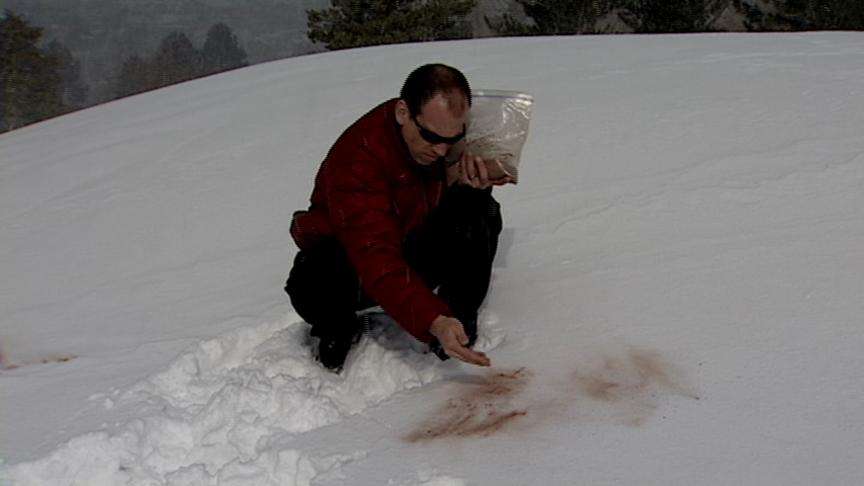
Here's a simple demonstration: red dust on snow. Any science student can guess what happens next. "It's absorbing sunlight directly," Painter explained.
As the dark-colored dust absorbs energy, it warms up the snow. Even with air temperatures well below freezing, where the dust is heaviest, the snow level drops nearly two inches in four hours. "Turns out this is a big effect," Painter said.
You can't have snow without dust--every snowflake forms around a little particle of dust. But what happens when there's just too much of it?" "In southwest Colorado, the snowpack melts away a month earlier than it would without these big dust storms," Painter said.
Painter just moved to Utah and is launching similar studies here to see what role dust plays in the Wasatch Mountains. But he's already noticed a certain discoloration, thanks to dust and air pollution. "On the license plate it does say 'The Greatest Snow on Earth,' but one might even say 'The Grayest Snow on Earth,' he said.
Studies of dust deposits indicate there's far more than there used to be; in Colorado five times more dust than pre-pioneer days. "Dust deposition presently is greater than it's been in the last 5,000 years," Painter explained.
You can guess the reasons: development and industry in urban areas and modern impacts in rural areas. "Grazing, agriculture, mining, recreation," Painter explained.
The typical result, he says, is an earlier snowmelt. "It's a much more abrupt runoff, whereas water managers would like to see a more steady trickle of water coming down the channel," he said.
The long-term implications are serious: shorter snow seasons, longer drying periods, more evaporation, less water storage, and we haven't even mentioned global warming.
Painter is giving a public lecture on the future of our snow tomorrow night at 7:00. It's at the Salt Lake Public Library under the auspices of the Utah Museum of Natural History. You'll find the details by clicking on the related link.