Estimated read time: 5-6 minutes
This archived news story is available only for your personal, non-commercial use. Information in the story may be outdated or superseded by additional information. Reading or replaying the story in its archived form does not constitute a republication of the story.
SALT LAKE CITY — A former Utah County commissioner who participated in a scheme to defraud investors of hundreds of thousands of dollars by, in part, posing as an LDS general authority, avoided jail time Friday by coming up with a plan to partially repay his victims.
"I'm so sorry," a tearful Gary Anderson told the judge before being sentenced. "I honesty did not mean to hurt anybody."
Anderson, 70, pleaded guilty in May to communications fraud, a second-degree felony. In exchange for his plea, two counts of communications fraud and a charge of engaging in a pattern of unlawful activity were dismissed.
His complicated case dates back to 2012 when Utah County businessman Alan Dean McKee, 56, of Benjamin, became involved in a potential large-scale industrial development near Elberta, Utah County. In order to get Minnesota-based Ames Construction to go along with the project, McKee led them to believe that Gary Stevenson, the presiding bishop of The Church of Jesus Christ of Latter-day Saints at the time, other high-ranking church officials and high-ranking state officials, such as the governor of Utah, were assisting him with the project.
Anderson became involved with McKee as a consultant, and even invested $170,000 of his own retirement funds with McKee. Under McKee's instructions, Anderson called Ames posing as Bishop Stevenson. Because of those calls, the company paid McKee approximately $380,731, according to court records.
"What he did was simply stupid and foolish,” said Anderson's attorney, Richard VanWagoner. "But he has a huge heart. He is a good man."
McKee had asked Anderson to calm investors who were wondering where their money was. "And he did it in a way that was not honest, and that's why he's in the predicament he's in today," VanWagoner said.
The total amount of money lost by Ames, Benjamin resident Chet Olsen and a third victim, was more than $1 million.
When he pleaded guilty in May, a unique plea deal was worked out where if Anderson could come up with $25,000 in restitution to be paid immediately, he could avoid jail time. Thanks to his wife, Anderson was able to come up with the money on Friday.
"The money is here, it's safe, it's secure," VanWagoner assured 3rd District Judge Vernice Trease.
But when it came time to paying off the rest of the restitution, Anderson said he could only afford $250 a month. He hoped that would somehow change down the line.
Trease said that wasn't good enough. Based on that information, she warned him that she would not follow the sentencing recommendations.
Related:
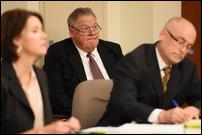
Ex-Utah County commissioner charged with posing as LDS Church officials
A former Utah County commissioner and a man whose company was once named Utah County Business of the Year were charged with communications fraud on Monday for allegedly posing as authorities from The Church of Jesus Christ of Latter-day Saints."In these kind of cases, restitution is paramount," she said. "I just don't see in the things before me that there's hope that six months from now, he’s going to pay more than $250 a month. At that rate, he's barely paying interest."
VanWagoner told the judge that Anderson was unemployed, was forced to surrender his law license, and was only receiving Social Security checks as a source of income. He also noted that Anderson was a victim of McKee.
"There's not some pile of money out there," he said.
But Trease said if the purpose of keeping Anderson out of jail was so that he could pay restitution, she not only wanted him to pay more each month, but she wanted assurance that the payments wouldn't stop for some unforseen reason six months from now.
"It is no comfort to a victim to say, 'Sorry, he can’t pay for restitution,'” she said. "There is still a chunk of change that needs to be paid."
Trease even suggested at one point that Anderson needs to "find a job, or two jobs, or three jobs."
"Everybody knew his (law) license was going by the wayside. And today you’re asking me to set restitution payments based on this," Trease continued. "I don’t think it is appropriate for me to do this if there’s no prospect of restitution."
Related:
Utahn pleads guilty to fraud scheme, impersonating LDS officials
A once lauded Utah County businessman has pleaded guilty in two separate fraud schemes, including one where he impersonated top LDS officials to lure investors.Attorneys for both sides then excused themselves as they tried to work out a new plan. About 30 minutes later, Anderson returned to the courtroom and said his children had agreed to help him make restitution payments of $1,000 each month.
Trease accepted the sentencing recommendations under those conditions, placing him on five years of probation and ordering him to repay all of the $162,606 in restitution that had been agreed upon as part of the plea deal. If it is not paid off after five years, his probation will be extended. Trease also ordered Anderson to get a job.
Outside the courtroom, VanWagoner said he wasn't sure where Anderson, based on his age and health issues, would get a job. But he said any business would be lucky to have him.
"He is such a likeable man. Such a generous, big-hearted guy, I don't think he'll have that much trouble finding a job, except that he has a felony conviction. And that's a problem."
A review hearing was scheduled for February to make sure Anderson will keep up with his payments.
McKee, considered the main conspirator in all of this, had earlier pleaded guilty to two fraud schemes, pleading guilty to engaging in a pattern of unlawful activity in one case, and theft, a second-degree felony, in the other.
Sentencing is scheduled for Nov. 28. McKee faces a potential sentence of one to 15 years in prison for each of the two charges.
Anderson was a longtime Utah County commissioner and a defense attorney. He was commissioner from 1983 to 1986 and was elected again in 2006 and served until 2014.