
Estimated read time: 4-5 minutes
This archived news story is available only for your personal, non-commercial use. Information in the story may be outdated or superseded by additional information. Reading or replaying the story in its archived form does not constitute a republication of the story.
BLUFFDALE — To his children, he was Pa. His co-workers at Kennecott knew him as Ernie.
To the nation, Ernest Yazhe was a hero, part of an elite group of Marines known as Code Talkers, who in World War II transmitted battlefield messages in an unbreakable Navajo-based radio code.
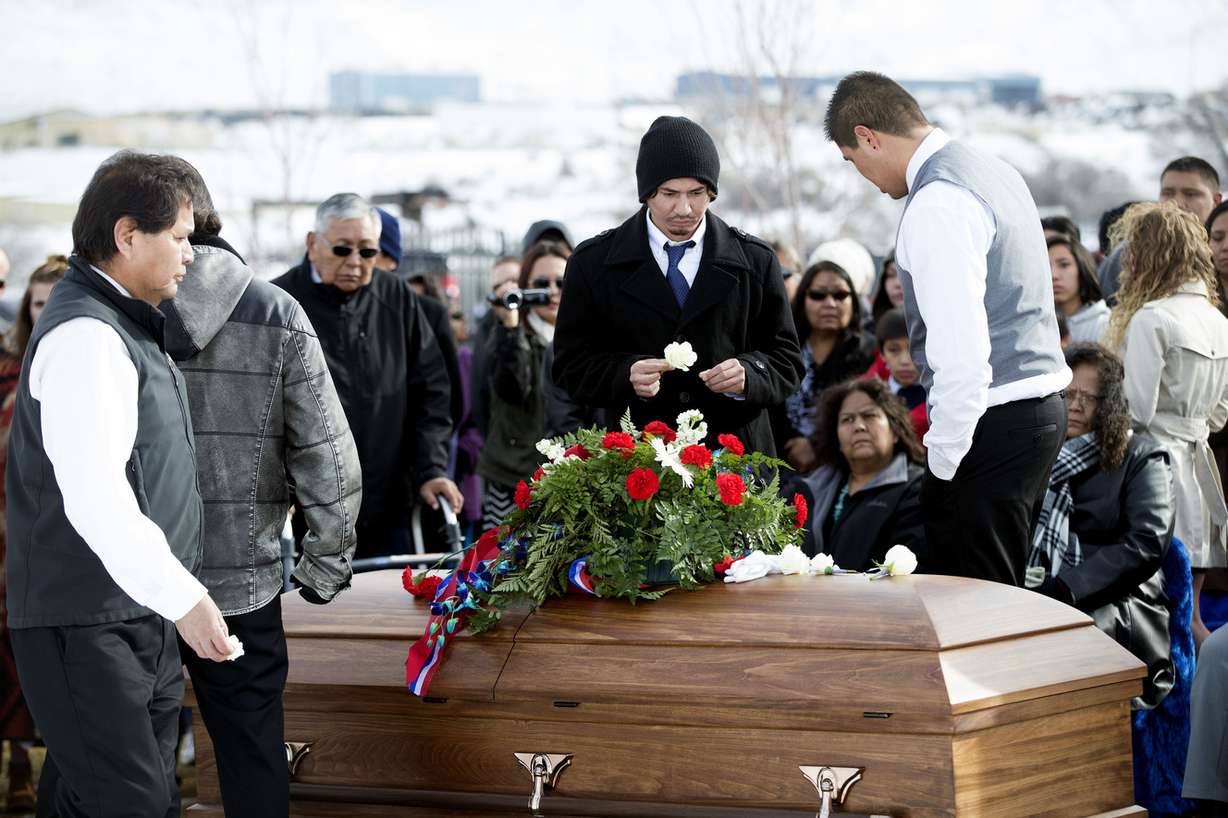
Yazhe, a longtime Sandy resident, received full military honors at his funeral Tuesday at Utah Veterans Memorial Park. He died Jan. 12 of kidney failure at age 92.
"The Navajo Nation has suffered the loss of another great Navajo Code Talker. He was a hero and a brave warrior," said Navajo Nation Vice President Jonathan Nez.
Flags were flown at half-staff on the Navajo Nation from Jan. 19 to Jan. 22 to honor Yazhe, Nez said.
Yazhe, born in northwestern New Mexico, volunteered to join the Marines at age 19. His military service took him from a tiny community on the Navajo Nation to New Caledonia, a Pacific island east of Australia, for training.
From there, Yazhe served on the front lines of campaigns in Guam and Okinawa.
Family members said he rarely spoke of his military service and didn't participate in Code Talker reunions. In 2001, he traveled to Window Rock, Arizona, for a ceremony when Code Talkers were presented the Congressional Silver Medal on the Navajo Nation.
"If you asked him who he was, I'm certain his reply would be, 'I'm a simple man,'" said family speaker Kirby Arrive.
He enlisted in the military because he felt it his duty to protect "America's way of life," Arrive said.
"He viewed his role as Code Talker as helping his comrades who depended upon him. Not until it was made public, he was unaware of his role in (what was) the principal reason America won the war."
After he was discharged from the military, Yazhe worked for the Intermountain Indian School in Brigham City, where he met his future wife, Katie Trujillo.
The couple had seven children, rearing them in Salt Lake County. Their son, Gary, preceded him in death.
In the late 1940s, Yazhe was hired by Kennecott Mining Corp., working there for 38 years.
Upon his retirement, Yazhe returned to New Mexico, living in Chaco Canyon in what the family calls "the blue house." He and his wife raised chickens and sheep, and many of the grandchildren spent their summers on the reservation, learning to tend animals and make do without utilities.
Grandson Donovan Baldwin said he had many fond memories of his grandfather, who liked his coffee with "one sugar," napped wearing one sock ("He would say, 'So my feet won't fight.'"), and his habit of falling asleep during bingo games.
"If we won, we had to wake him up to pick out the prize," he said.
Baldwin said his grandfather taught him about simple pleasures. At the end of each day, his grandparents sat outside and conversed in Navajo.
While he did not understand Navajo, Baldwin said he could tell when his grandfather had angered his grandmother.
Once, he cupped his hand over one ear as they spoke. When she asked what he was doing, he replied, "You always tell me that what you tell me goes in one ear and out the other.'
"Even she had to laugh about that," Baldwin said.
Baldwin was among many grandchildren who spent time on the ranch each summer. Their grandfather worked along with them herding and shearing sheep.
Once, when some of the children got toy walkie-talkies as gifts, their grandfather shared a few bits of Navajo code with them, Baldwin said.
After Yazhe's wife died in 2007, he returned to Utah to live closer to his children. He died last week at a hospice in Holladay.
LDS Bishop Reid Brinton read a brief statement written by Yazhe's daughter, Melissa Yahze.
"My father was a quiet man. He never liked to have attention drawn to him. In fact, my siblings and I talked and said he would not like having all this attention on him at this time. But he's not here to get after us.
"He was a kind man. He dearly loved his grandchildren and his nieces and nephews. He and mother looked forward each summer when several of the grandkids would spend their summer vacation at the blue house with them.
"Those who were lucky enough to get close to him were able to witness his humor firsthand. He truly loved my mother and missed her every day, but he was strong and kept going because he loved his children."
Other survivors include daughters Maxine K. Mountainlion, Marcia A. Picklesimer and Maureen Frank; sons Ernest J. and Kevin J. Yazhe; brothers, Herbert Yahze, of Gallup, New Mexico, and Albert Yahze, of Farmington, New Mexico; and sisters Marie Begay, Evelyn Billy, Helen Begay, all of Naschitti, New Mexico, and Clara Waska.