Estimated read time: 3-4 minutes
This archived news story is available only for your personal, non-commercial use. Information in the story may be outdated or superseded by additional information. Reading or replaying the story in its archived form does not constitute a republication of the story.
SALT LAKE CITY — When 7-year-old Elizabeth Zhang sits down at the concert grand piano in Libby Gardner Concert Hall Friday night and plays her concerto, a virtual orchestra will follow along.
"I think it's fun," she told KSL News earlier in the day. "I follow it like a metronome."
Elizabeth will be joined by the other youngest winners of the University of Utah Summer Arts piano competition to debut groundbreaking technology.
They'll play solo, but accompanied by a virtual orchestra. The grand piano is connected to a computer that enables students to hear the orchestra, and the orchestra follows them rather than the other way around.
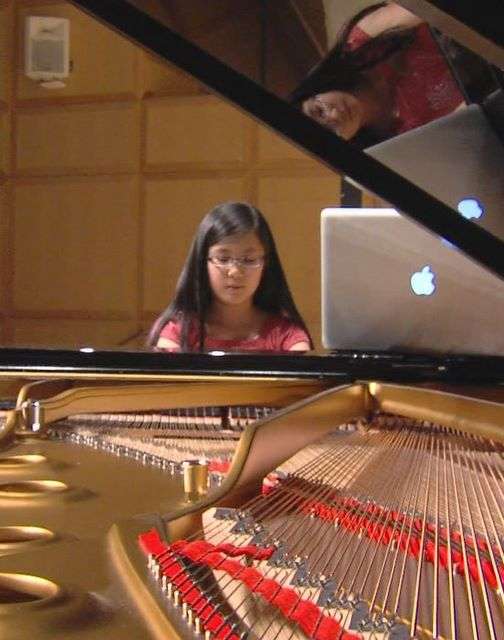
The technology is called PNOscan (pronounced "piano scan"). It lets students and performers use very powerful music software such as Home Concert Xtreme.
"It's very good if you want to practice with an orchestra, but you don't need to pay real people to do it," said 13-year-old Shayna Oh, who will also perform Friday night.
Developed as a practice tool for high-level performers, PNOscan evolved into a teaching program for all levels. Friday, it debuts as a concert phenomenon that's attracted the interest of Steinway and Sons Pianos and other music schools.
"I was like, 'Wow, this is awesome,'" said Caity Kwun, describing the first time she played with the program. "I was really excited because I've never played with something like this before."
PNOscan is a small optical strip installed underneath the 88 keys of the piano that sends a signal from the keys to the computer.
George Litterst developed the program with a partner. He says the score scanning technology that allows the computer orchestra to follow the performer has been around for a while, but faster computers now can create much better sound quality.
"Information as to which notes are being played goes right into the computer," Litterst explained. "The computer does a very fast comparison of those notes that are being played to the notes in the score, and it can figure out where the pianist is and how fast the pianist is going, and even how loud the pianist is playing."
If the soloist plays faster, the virtual orchestra follows. If the pianist plays softer, the orchestra responds. If the performer stops all together, the virtual orchestra stops too.
- Time: 7:30 p.m.
- Location: Libby Gardner Music Hall, University of Utah (view map)
- Admission:: Free
"They get a chance to try out what it would be like with an orchestra, before they ever rehearse with a real one," said Dr. Susan Duehlmeier, University of Utah Piano Area Chair.
It's $1,500 technology: affordable for music programs and even serious piano players to use at home.
The young piano prodigies may not know exactly how the orchestra follows along. But they know it helps take their performance to a higher level.
"Sometimes, I forget when I repeat, and then I just listen to it and I know," Elizabeth said.
The young musicians will perform with the virtual orchestra Friday night at 7:30 at Libby Gardner Hall on the campus of the University of Utah. Admission is free.
Email: jboal@ksl.com