- Over 70% of the Western U.S. is in drought, leading to multiple challenges.
- Most of the U.S. acres burned by active fires are in Utah and Colorado.
- Drought also impacts water resources, agriculture and recreation.
SALT LAKE CITY — Steve Pope isn't surprised by the water challenges he's seeing right now within the Uncompahgre Valley water system in western Colorado, especially after how the winter went.
The Uncompahgre snowpack basin peaked at record-low levels, which mostly melted after record heat in March and set up many of the issues that run through his mind months later.
Inflows into the Ridgeway Reservoir ended up a quarter of the median average. The nearby Blue Mesa Reservoir, within the Colorado River system, could reach dead pool status later this year, leading to some administrative challenges on the horizon, said Pope, general manager of the Uncompahgre Valley Water Users Association.
The dry conditions have also left the area tinder-dry, leaving water basins prone to mudslides and debris flows for the next few years if and when new fires break out, he adds.
"That's some of the challenges that I think every basin in the western slope of Colorado is facing, and they're all unique challenges," he said, speaking at a briefing about the Western drought convened by the National Integrated Drought Information System on Wednesday.
The same can be said nearly all across the West right now.
Over 70% of the 11 states that make up the region are in drought, with over half of the region in severe, extreme or exceptional drought, according to the U.S. Drought Monitor. That's after most of the region experienced record-low or extremely below-average snowpacks, thanks to record-warm temperatures leading to more rainfall in areas that normally receive snow.
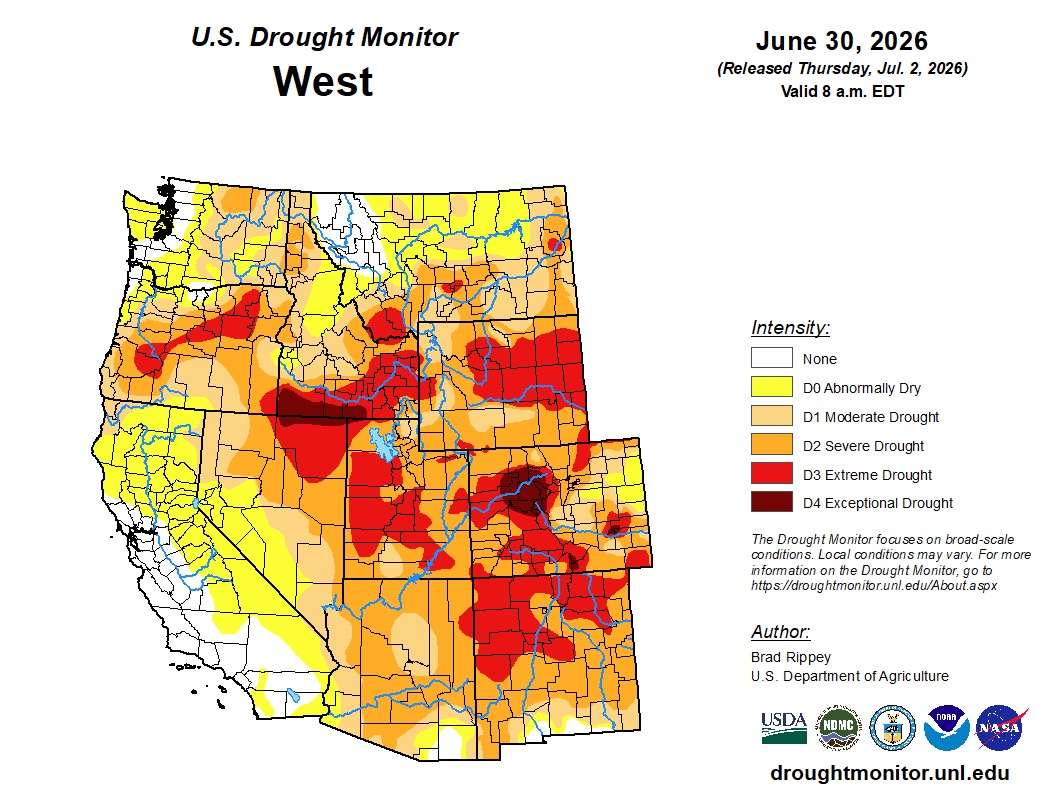
Western Colorado and southwestern Idaho have some of the worst conditions. All parts of Utah are in drought, with nearly 95% of the state in at least severe drought, including over 40% of the state remaining in extreme or exceptional drought. California is a rare exception, with only 5% of the Golden State in drought — although half of it remains "abnormally dry."
"Today's droughts are affecting water resources in many ways," said Tim Petty, deputy administrator for the National Oceanic and Atmospheric Administration, noting that those include changes in water availability and worsening hydroelectric capacity.
Fire growth
Some of the immediate, noticeable impacts of the record-low snowpack are playing out in the Intermountain West.
Large active fires in Utah and Colorado alone account for over three-fourths of all the nearly 550,000 acres burned by active large fires in the U.S., per the National Interagency Fire Center. More than 360,000 acres have burned in Utah this year, its most since 2018.
The Four Corners region is one of the biggest areas of concern in the nation right now, largely over that mix of record-low snowpack, record-warm temperatures, along with "little to no recovery" after most of the snow melted in March, said Kathleen Clough, Ph.D candidate at the Desert Research Institute and wildfire meteorologist for the Nevada Bureau of Land Management.
This has dried out grasses, trees and other vegetation, she explained, noting that precipitation collected this spring has been a drop in the bucket compared to the record-low snowpack's impact on grasses and trees.
"We have warmth and evaporative demand that's really driving this drying over the landscape and increased fire danger," added Dan McEvoy, a researcher with the Western Regional Climate Center.
Above-average fire potential persists throughout all of Utah and western Colorado this month, and also covers most of Nevada, as well as southern Idaho and the northern ends of Arizona and New Mexico, the National Interagency Fire Center notes.
While potential monsoons could lower threats later this month, slowly easing the potential back to normal by the end of summer, Clough cautions that does not mean there is no potential. Fire danger may also intensify across the Pacific Northwest toward the end of summer.
Other drought impacts
Other impacts may be less noticeable for those outside the farming and outdoor recreation industries, but they are there.
Nearly half of the country's hay, alfalfa and cattle industries are in drought, with many parts of Utah in the Intermountain West impacted, said Brad Rippey, a U.S. Department of Agriculture meteorologist.
That's been a long-term trend for most of this decade within a sector that doesn't usually recover quickly from drought. Rippey says it can take years for rangeland and pastures to fully recover from large-scale droughts, which is why many haven't recovered from the previous 2020-2022 Western drought.
"We've seen another drawdown in beef cow inventory. You notice that when you go to the restaurant, when you buy your beef in the store. It's expensive," he said. "Part of the factor is this long-term drought going back to late 2020."
Water recreation also tends to suffer following poor snowpack years. David Costlow, director of the Colorado River Outfitters Association, points to significant dropoffs in river rafting recreation that were recorded in 2002 and 2012, two of the previous years most similar to this year. Each led to large dropoffs in economic impact within an industry that has generated hundreds of millions of dollars for Colorado alone.
Lake Powell has experienced similar waves over the past few years, with visitation rising and falling with its water levels.
Outfitters have adjusted to the river's uncertainty, switching to smaller rafts during poor years to navigate the river, Costlow said. Still, he said many people just avoid the water when they see poor water conditions, even if there can still be enjoyable rapids.
These are some of the challenges that Utah and Western states are hoping to ease as the Western monsoon season nears. Summer storms won't save drained reservoirs, but they can help reduce demand from strained water systems in the region and improve soil moisture for the next snowpack.
"It's good news to hear that hopefully we have a robust — albeit slightly late — monsoon," Rippey said.