'%3e%3cpath%20d='M34.1406%205.85938C30.3906%202.10547%2025.3047%200%2020%200C14.6953%200%209.60938%202.10547%205.85938%205.85938C2.10938%209.61328%200%2014.6953%200%2020C0%2025.3047%202.10547%2030.3906%205.85938%2034.1406C9.61328%2037.8906%2014.6953%2040%2020%2040C25.3047%2040%2030.3906%2037.8945%2034.1406%2034.1406C37.8906%2030.3906%2040%2025.3047%2040%2020C40%2014.6953%2037.8945%209.60938%2034.1406%205.85938ZM37.0117%2023.543H31.1602V13.5391H27.6328V19.9414C28.1211%2020.6914%2028.3711%2021.582%2028.3711%2022.5625V22.625C28.3711%2023.668%2028.1172%2024.6055%2027.6328%2025.4297V26.6094H36.082C33.4883%2032.9375%2027.2891%2037.3789%2020.0039%2037.3789C10.3711%2037.3789%202.62109%2029.6289%202.62109%2020C2.62109%2010.3711%2010.3711%202.62109%2020%202.62109C29.6289%202.62109%2037.3789%2010.3711%2037.3789%2020C37.3789%2021.1484%2037.2617%2022.2656%2037.0508%2023.3477C37.0391%2023.4141%2037.0234%2023.4766%2037.0117%2023.543Z'%20fill='white'/%3e%3cpath%20d='M22.3086%2018.5352C20.4336%2018.125%2019.9531%2017.8398%2019.9766%2017.1836V17.1406C19.9766%2016.6992%2020.3477%2016.2148%2021.4023%2016.2148C22.582%2016.2148%2023.8867%2016.6797%2025.0781%2017.4766L26.8516%2015.0195C25.4453%2013.8906%2023.707%2013.3398%2021.5547%2013.3398C18.5195%2013.3398%2016.4375%2015%2016.4063%2017.4766V17.5352C16.3633%2020.2617%2018.5859%2020.9805%2021.293%2021.6016C23.0391%2021.9766%2023.5703%2022.3164%2023.5703%2022.9609L23.5469%2022.9766C23.5469%2023.3906%2023.2578%2023.7031%2022.7852%2023.8359C22.5742%2023.9062%2022.1289%2023.9727%2021.5156%2023.9727C20.7617%2023.9727%2019.7539%2023.8633%2018.6328%2023.4844C18.0898%2023.2891%2017.4727%2023.0039%2016.8047%2022.6133L20.1406%2026.625C20.2813%2026.6602%2021.0977%2026.8516%2021.7734%2026.8516C25.0039%2026.8516%2027.0859%2025.2461%2027.1094%2022.6328V22.5703C27.1602%2020.1133%2025.2148%2019.1719%2022.3086%2018.5352Z'%20fill='white'/%3e%3cpath%20d='M5.24219%2013.5664V26.6133H8.75391V23.7578L10.2969%2021.9531L14.2031%2026.6133H18.3867L12.3555%2019.5195L17.4023%2013.5664H13.4531L8.75391%2019.0586V13.5664H5.24219Z'%20fill='white'/%3e%3c/g%3e%3cdefs%3e%3cclipPath%20id='clip0_97_2430'%3e%3crect%20width='40'%20height='40'%20fill='white'/%3e%3c/clipPath%3e%3c/defs%3e%3c/svg%3e)



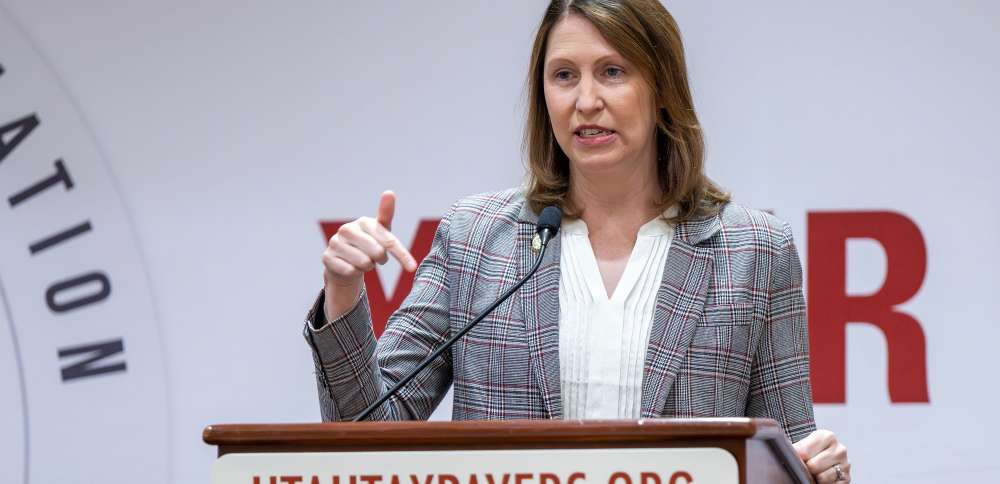
- Utah Rep. Karen Peterson's HB236 aims to increase transparency when cities, school districts and other entities are considering property tax hikes.
- The law, signed into law Monday, requires earlier public notification of proposed tax hikes and creation of detailed budget-impact statements.
- The aim is to better engage the public in the process of increasing property taxes.
SALT LAKE CITY — When budget time rolls around each year, some property owners are taken by surprise when they learn, late in the process, that local officials are mulling a tax hike, says Utah Rep. Karen Peterson.
Indeed, many attended truth-in-taxation hearings last August — when cities, school districts and other local taxing entities formally took feedback for tax hikes proposed in 2025 — wondering what they missed, she said Tuesday. Some "felt like the decision had already been made, and I think in many instances, it had because of the process we had," she said.
Of course, tax hikes rub many the wrong way every year, not just last year, and to alleviate some of the surprise, Peterson sponsored legislation during the 2026 session to add transparency to the process of implementing property tax hikes. HB236 passed unanimously in both the Utah House and Utah Senate, and Gov. Spencer Cox on Monday signed the bill into law.
One of the key goals of the measure is to better engage the public in the process taxing entities follow in deciding whether to boost taxes, long before a decision is made. "This just requires that they bring the public in earlier to the conversation when there's going to be a tax increase," said Peterson, a Republican from Clinton.
Parallel to that, she said, by involving the public earlier in the process of debating and considering whether to boost taxes, the law aims to bolster the sense that increases aren't "a forgone conclusion."
The new law builds on SB202, passed in 2025, and SB29, passed in 2024, which also placed new guardrails on the process of boosting taxes. The new guidelines outlined in those measures were behind the decision of the Utah State Tax Commission to deny tax hikes sought in 2025 by 35 taxing entities.
Here are some of the provisions of HB236, backed by the Utah Taxpayers Association, a tax watchdog group:
It requires local taxing entities to formally notify constituents in May, during the budget-crafting process, if tax hikes are under consideration for the coming year's spending plan. Officials are also required to offer an estimate of the increase under consideration and how it would impact an average household. The possibility must be included on the agenda for a public meeting and formally discussed at the meeting.
By the end of June, cities, fire districts, school districts, special districts and other entities mulling tax hikes must create "a budget impact statement" that pinpoints, department by department, where increased tax funds would be spent. The document is to be published online.
"They have to create a public-friendly document so you can look at it and actually see where those increases are getting plugged into the budget. You know, some of the budgets are 200, 300 pages long, so this helps the public actually be able to identify where the increases are going," said Peterson, a former Clinton City Council member who is familiar with the municipal budgeting process.
Same as always, property tax notices will be sent to property owners in July outlining proposed property tax hikes, which has typically been the first formal notice to the public that increases are under consideration.
Traditionally, entities considering property tax hikes could begin spending on July 1, the start of the fiscal year, as if a proposed increase were approved, even though approval typically doesn't come until August, after truth-in-taxation hearings. Under HB236, though, they'll have to wait until a tax hike is officially approved before they can bolster spending in line with the increase.
The measure goes into effect on May 6, and taxing entities will have to follow the new guidelines in budgeting for fiscal year 2027, which starts on July 1. Tax officials will monitor the process and offer feedback to individual entities on compliance. They won't necessarily deny any tax increases if entities slip up in applying the new guidelines, Peterson said, but next year, tax officials will be more strict about compliance.
"We want to build trust in government, and we want to build trust in the decisions, and earlier notice, more transparency through the (taxation) process and more chances to give meaningful input — that, I think, hopefully works out better for everyone," she said.