'%3e%3cpath%20d='M34.1406%205.85938C30.3906%202.10547%2025.3047%200%2020%200C14.6953%200%209.60938%202.10547%205.85938%205.85938C2.10938%209.61328%200%2014.6953%200%2020C0%2025.3047%202.10547%2030.3906%205.85938%2034.1406C9.61328%2037.8906%2014.6953%2040%2020%2040C25.3047%2040%2030.3906%2037.8945%2034.1406%2034.1406C37.8906%2030.3906%2040%2025.3047%2040%2020C40%2014.6953%2037.8945%209.60938%2034.1406%205.85938ZM37.0117%2023.543H31.1602V13.5391H27.6328V19.9414C28.1211%2020.6914%2028.3711%2021.582%2028.3711%2022.5625V22.625C28.3711%2023.668%2028.1172%2024.6055%2027.6328%2025.4297V26.6094H36.082C33.4883%2032.9375%2027.2891%2037.3789%2020.0039%2037.3789C10.3711%2037.3789%202.62109%2029.6289%202.62109%2020C2.62109%2010.3711%2010.3711%202.62109%2020%202.62109C29.6289%202.62109%2037.3789%2010.3711%2037.3789%2020C37.3789%2021.1484%2037.2617%2022.2656%2037.0508%2023.3477C37.0391%2023.4141%2037.0234%2023.4766%2037.0117%2023.543Z'%20fill='white'/%3e%3cpath%20d='M22.3086%2018.5352C20.4336%2018.125%2019.9531%2017.8398%2019.9766%2017.1836V17.1406C19.9766%2016.6992%2020.3477%2016.2148%2021.4023%2016.2148C22.582%2016.2148%2023.8867%2016.6797%2025.0781%2017.4766L26.8516%2015.0195C25.4453%2013.8906%2023.707%2013.3398%2021.5547%2013.3398C18.5195%2013.3398%2016.4375%2015%2016.4063%2017.4766V17.5352C16.3633%2020.2617%2018.5859%2020.9805%2021.293%2021.6016C23.0391%2021.9766%2023.5703%2022.3164%2023.5703%2022.9609L23.5469%2022.9766C23.5469%2023.3906%2023.2578%2023.7031%2022.7852%2023.8359C22.5742%2023.9062%2022.1289%2023.9727%2021.5156%2023.9727C20.7617%2023.9727%2019.7539%2023.8633%2018.6328%2023.4844C18.0898%2023.2891%2017.4727%2023.0039%2016.8047%2022.6133L20.1406%2026.625C20.2813%2026.6602%2021.0977%2026.8516%2021.7734%2026.8516C25.0039%2026.8516%2027.0859%2025.2461%2027.1094%2022.6328V22.5703C27.1602%2020.1133%2025.2148%2019.1719%2022.3086%2018.5352Z'%20fill='white'/%3e%3cpath%20d='M5.24219%2013.5664V26.6133H8.75391V23.7578L10.2969%2021.9531L14.2031%2026.6133H18.3867L12.3555%2019.5195L17.4023%2013.5664H13.4531L8.75391%2019.0586V13.5664H5.24219Z'%20fill='white'/%3e%3c/g%3e%3cdefs%3e%3cclipPath%20id='clip0_97_2430'%3e%3crect%20width='40'%20height='40'%20fill='white'/%3e%3c/clipPath%3e%3c/defs%3e%3c/svg%3e)


- The Sundance documentary "The Lake" raises awareness about the Great Salt Lake's decline.
- Subjects of the film say they believe it offers hope that the lake can be saved.
- Its debut follows large funding efforts for lake solutions and increased public support.
Editor's note: This article is published through the Great Salt Lake Collaborative, a solutions journalism initiative that partners news, education and media organizations to help inform people about the plight of the Great Salt Lake.
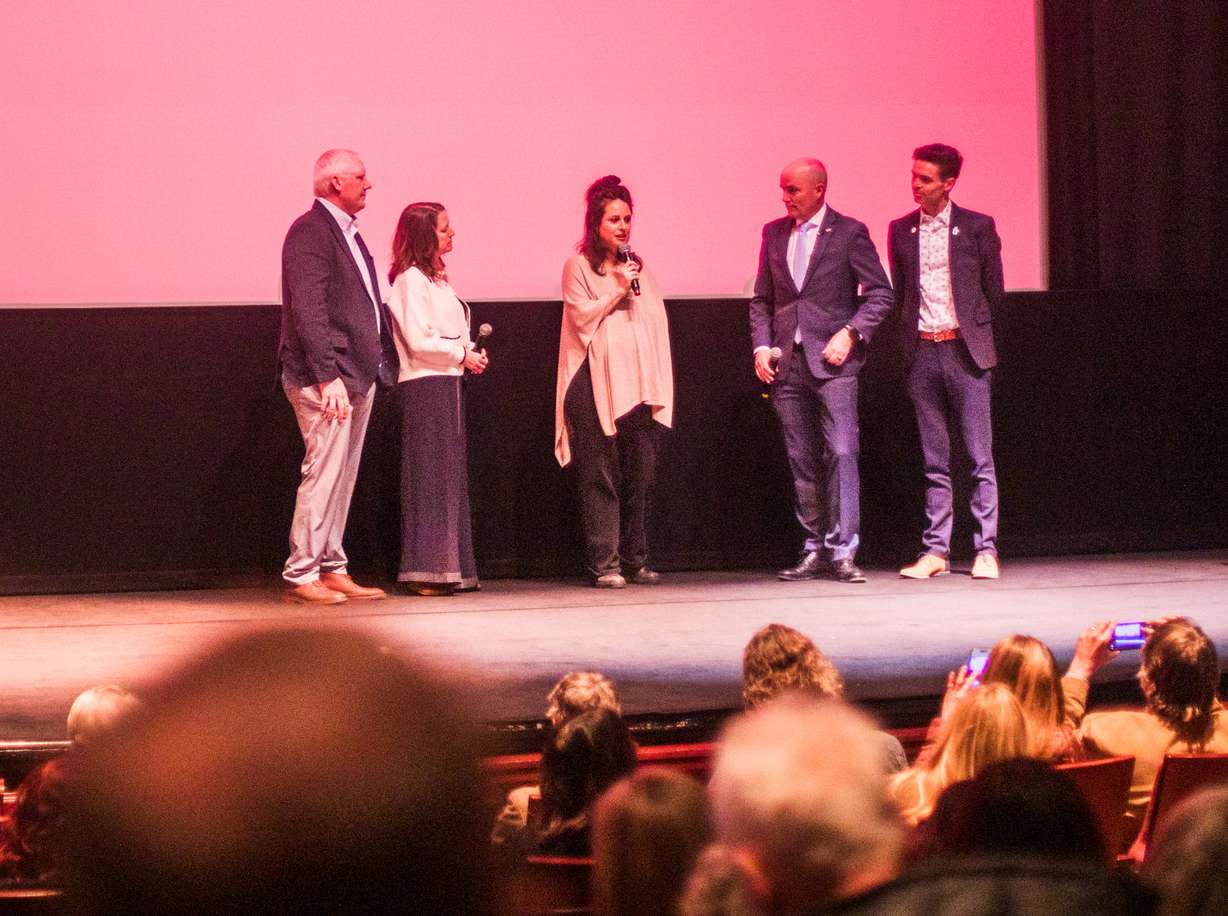
SALT LAKE CITY — Gov. Spencer Cox offered a bold prediction during a parting message for a Sundance Film Festival crowd at the end of a screening for a new documentary highlighting the fight to save the Great Salt Lake.
The Great Salt Lake will be "full" again by the time the Winter Olympics and Paralympics return to Utah in 2034, he said during a panel discussion about "The Lake" at the Rose Wagner Performing Arts Center on Friday. But getting there requires more long-term commitment.
"If you care about the Great Salt Lake, don't just watch a movie or send a terse email to a legislator. We need you here. We need you here supporting the changes that are happening," he said. "We need you advocating; we need you here donating. We need you here until the lake is full."
The Great Salt Lake has been in decline for decades, as a result of drought and overconsumption of the water that feeds into it. It reached its all-time lowest point in 2022, before receiving a welcome boost in 2023 and 2024. It's been back on the decline since then, falling back to concerning levels last year.
"The Lake," one of the films in Sundance's U.S. Documentary Competition this year, may serve as a starting point in getting people to think about the lake's decline again. The film is less about the lake and more about how it looms over the community beside it.
It's essentially the story's hero and villain, while the film's subjects — primarily three key Great Salt Lake researchers and Great Salt Lake Commissioner Brian Steed — grapple with the impacts of its current and future state. The film also captures efforts to save the lake from its decline, but some find themselves trapped between the growing concerns of the lake and the impacts that solutions may pose on the community.
Director Abby Ellis says she was inspired by how people of different expertise and political affiliations were equally committed to the lake. Part of the thrill is the story's incompleteness, which also drew her to it, even if she admits it was challenging to film.
"That makes this story so much bigger. It's not just about Utah; it's about survival, and it's about people," she said.
Alex Cabrero, KSLFinding a snapshot in the middle of an unfinished story ultimately yielded elements of the film that she didn't expect to feature. One of those is the importance that faith plays in the lake, even if different interpretations of it factor in some of the conflict depicted in the documentary.
Faith, Ellis says, is often portrayed as divisive in movies, but she saw a more uplifting tone, which she opted to include.
While the lake's story is being written, she and others associated with the film hope "The Lake" can help pen a happy ending — perhaps to the level that Cox predicted at the end of Friday's discussion.
Some big names attached themselves just before it premiered at Sundance on Thursday, including Leonardo DiCaprio and Jimmy Chin. Ellis said she's optimistic that landing a spot at the Sundance Film Festival, the addition of more executive producers and interest in the Great Salt Lake can result in a wider release after the festival.
It could then, in turn, bring more attention to the problem and more resources to solve it. It would follow a major year for investments that took place in 2025, including a public-private effort to raise $200 million for lake solutions, while Utah also received $50 million that the federal government pledged in 2024.
"Over the next six months, you're going to see some really big investments — some of them come from the state; some of them come from other places — that will dwarf anything you've seen in the past," Cox said, drawing applause from the audience.
The fact that there's still hope is what the documentary's subjects want people to take away from it.
It may inspire people to reduce their water use or show lawmakers that their work in recent years is "bearing fruit," said Ben Abbott, an associate professor of environmental science at BYU and one of the documentary's stars.
"We're at a moment where we can't waste a minute criticizing each other destructively," he told KSL after the screening. "We have to be working together constructively. ... Our job as the public is to get organized and be a helper."