
Estimated read time: 2-3 minutes
This archived news story is available only for your personal, non-commercial use. Information in the story may be outdated or superseded by additional information. Reading or replaying the story in its archived form does not constitute a republication of the story.
SALT LAKE CITY — Temperatures officially hit 100 degrees in Salt Lake City Thursday for the first time this year.
The National Weather Service reports the earliest 100-degree day was June 4, 2021.
But the measuring of the temperature isn't as cut and dried as you might think.
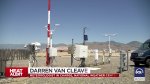
The NWS and Federal Aviation Administration have an expensive instrumentation located at the Salt Lake City International Airport called the Automated Surface Observing System, or ASOS, that measures all of the weather in Salt Lake City.
ASOS is also the technology behind those sun or storm cloud notifications that show up on your phone.
The unassuming gauges sit in a large field, off the ground, and measure everything from temperature and dew point, to water content of snow and cloud height.
"Generally, on a weather app, when you pull up the latest readings, it's going to either be coming from this (airport station) or the station at airport two," Darren Van Cleave, National Weather Service meteorologist in charge, said. "Those are the only stations in the the valley that have the collection of equipment that can, for example, sense the present weather," he said.
High-temperature readings are not as simple as just hitting a temperature and taking a reading.
A gauge takes a measurement once every 10 seconds and the daily high is recorded based on an average over five minutes. So, for example, the equipment would have to measure 100 degrees three times in five minutes to officially hit 100 degrees in Salt Lake City.
The instruments also measure wind speeds, if there's smoke or haze in the air, visibility, freezing rain and cloud heights. Planes also rely on ASOS to get current conditions and forecasts.
Records and historical data are maintained by the National Oceanic and Atmospheric Administration's National Climate Data Center in Ashville, North Carolina, while technicians from Salt Lake City's weather forecast office maintain the equipment.
The station has been at the airport since 1928 but has moved several times. The current ASOS instrumentation was installed in 1995.