
Estimated read time: 2-3 minutes
This archived news story is available only for your personal, non-commercial use. Information in the story may be outdated or superseded by additional information. Reading or replaying the story in its archived form does not constitute a republication of the story.
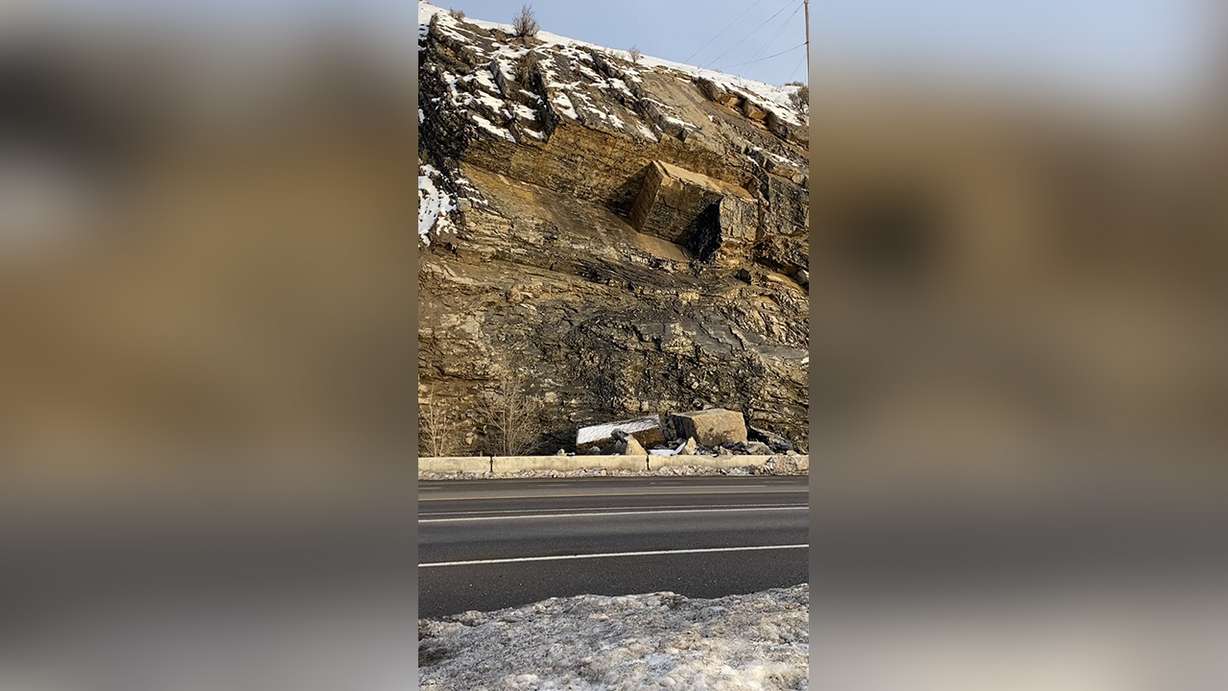
PROVO — A geotechnical team will evaluate a hillside near Provo Canyon's mouth after large chunks of rock fell next to U.S. Highway 189 over the weekend.
Utah Department of Transportation spokesman John Gleason said crews believe the car-sized rocks likely fell Saturday night, as winter weather was causing other issues in the canyon. A concrete barrier confined the rocks to an area just east of the road.
"Fortunately, they came down in an area that is set up to handle any rocks that come down," Gleason said.
He said a freeze-thaw pattern may have contributed to the massive rocks falling.
"With the freeze-thaw cycle, it contracts and expands again, and so when you have that ground that's frozen, when it loosens up a little bit, that can cause the ground underneath any of these rocks to become more unstable, and then gravity kind of takes over," Gleason said.
Gleason said a geotechnical team would be out to the area to gauge the hillside's stability. He also said maintenance crews would likely break the rocks up into smaller, more manageable pieces and haul them away.
Sometimes, crews have resorted to detonating large rocks for the same purpose.
Falling rocks have occasionally caused problems on Utah roads before, including in July 2022 near Helper, when a rock came through a windshield and injured a couple.
"We'll have, from time to time, rocks that come out onto the road," Gleason said. "If you look at Big and Little Cottonwood canyons, that's something that we deal with every spring."
Gleason said maintenance crews regularly monitored canyon areas for falling rocks. Still, he also encouraged drivers to report those rocks when they see them and to be particularly vigilant for the potential hazard as winter transitions toward spring.
"It's always something that you should be on alert for when you're driving through the canyons," Gleason said. "We can see it happen from time to time."