'%3e%3cpath%20d='M34.1406%205.85938C30.3906%202.10547%2025.3047%200%2020%200C14.6953%200%209.60938%202.10547%205.85938%205.85938C2.10938%209.61328%200%2014.6953%200%2020C0%2025.3047%202.10547%2030.3906%205.85938%2034.1406C9.61328%2037.8906%2014.6953%2040%2020%2040C25.3047%2040%2030.3906%2037.8945%2034.1406%2034.1406C37.8906%2030.3906%2040%2025.3047%2040%2020C40%2014.6953%2037.8945%209.60938%2034.1406%205.85938ZM37.0117%2023.543H31.1602V13.5391H27.6328V19.9414C28.1211%2020.6914%2028.3711%2021.582%2028.3711%2022.5625V22.625C28.3711%2023.668%2028.1172%2024.6055%2027.6328%2025.4297V26.6094H36.082C33.4883%2032.9375%2027.2891%2037.3789%2020.0039%2037.3789C10.3711%2037.3789%202.62109%2029.6289%202.62109%2020C2.62109%2010.3711%2010.3711%202.62109%2020%202.62109C29.6289%202.62109%2037.3789%2010.3711%2037.3789%2020C37.3789%2021.1484%2037.2617%2022.2656%2037.0508%2023.3477C37.0391%2023.4141%2037.0234%2023.4766%2037.0117%2023.543Z'%20fill='white'/%3e%3cpath%20d='M22.3086%2018.5352C20.4336%2018.125%2019.9531%2017.8398%2019.9766%2017.1836V17.1406C19.9766%2016.6992%2020.3477%2016.2148%2021.4023%2016.2148C22.582%2016.2148%2023.8867%2016.6797%2025.0781%2017.4766L26.8516%2015.0195C25.4453%2013.8906%2023.707%2013.3398%2021.5547%2013.3398C18.5195%2013.3398%2016.4375%2015%2016.4063%2017.4766V17.5352C16.3633%2020.2617%2018.5859%2020.9805%2021.293%2021.6016C23.0391%2021.9766%2023.5703%2022.3164%2023.5703%2022.9609L23.5469%2022.9766C23.5469%2023.3906%2023.2578%2023.7031%2022.7852%2023.8359C22.5742%2023.9062%2022.1289%2023.9727%2021.5156%2023.9727C20.7617%2023.9727%2019.7539%2023.8633%2018.6328%2023.4844C18.0898%2023.2891%2017.4727%2023.0039%2016.8047%2022.6133L20.1406%2026.625C20.2813%2026.6602%2021.0977%2026.8516%2021.7734%2026.8516C25.0039%2026.8516%2027.0859%2025.2461%2027.1094%2022.6328V22.5703C27.1602%2020.1133%2025.2148%2019.1719%2022.3086%2018.5352Z'%20fill='white'/%3e%3cpath%20d='M5.24219%2013.5664V26.6133H8.75391V23.7578L10.2969%2021.9531L14.2031%2026.6133H18.3867L12.3555%2019.5195L17.4023%2013.5664H13.4531L8.75391%2019.0586V13.5664H5.24219Z'%20fill='white'/%3e%3c/g%3e%3cdefs%3e%3cclipPath%20id='clip0_97_2430'%3e%3crect%20width='40'%20height='40'%20fill='white'/%3e%3c/clipPath%3e%3c/defs%3e%3c/svg%3e)


Estimated read time: 9-10 minutes
This archived news story is available only for your personal, non-commercial use. Information in the story may be outdated or superseded by additional information. Reading or replaying the story in its archived form does not constitute a republication of the story.
Editor's note: This article is a part of a series reviewing Utah and U.S. history for KSL.com's Historic section.
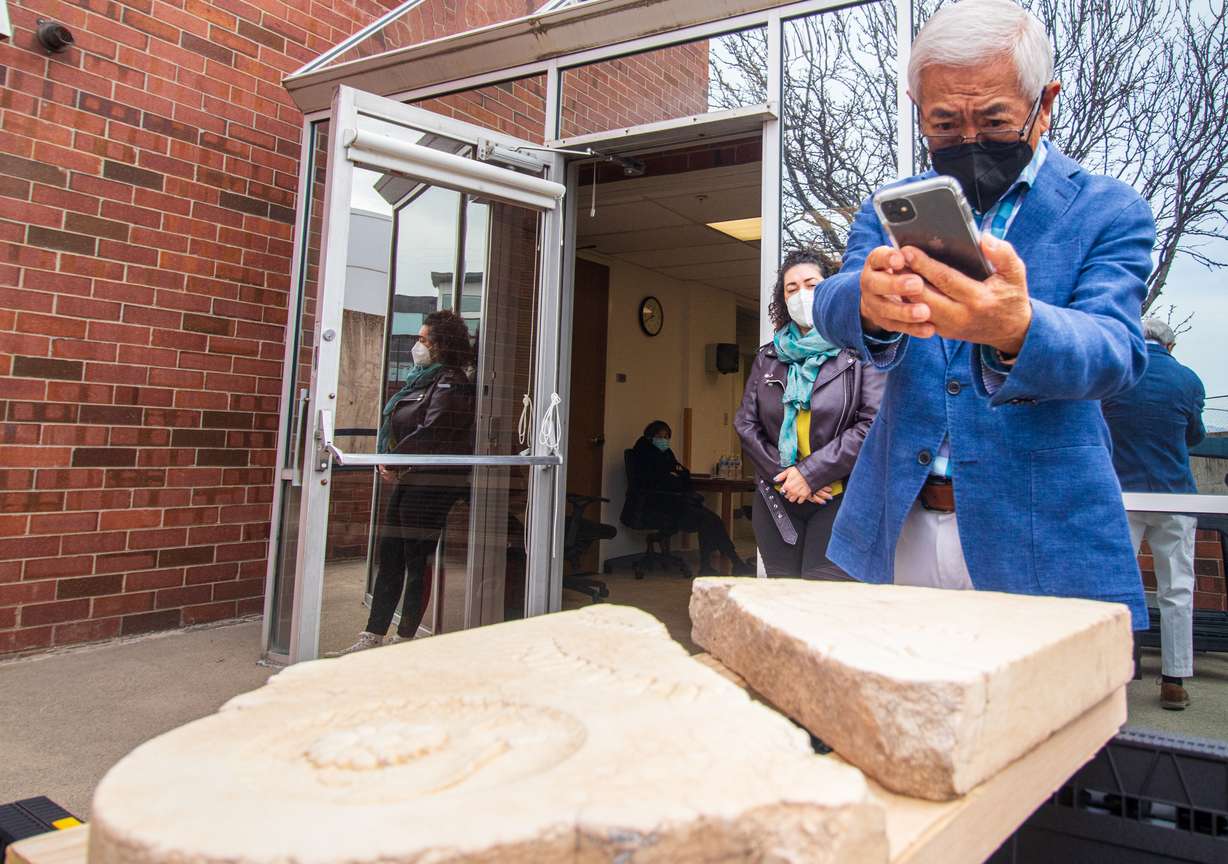
MILLCREEK — Floyd Mori's eyes fixated on a flower etched at the top of K. Kawanishi's fractured tombstone spread out in front of him inside a lab at the Utah Division of State History office Saturday morning.
It resonated with him, as he pointed it out to Amy Barry, the division's Utah cemeteries program manager.
"This is very Japanese with that flower," Mori said. "During that day and age, there were very few Japanese that were here (in Utah)."
State historians are fascinated by this tombstone, which was recently recovered from a site about a half-mile from an old railroad line out in the middle of nowhere in southeast Utah. This disintegrating marble slab not only remembers a man forgotten in time but tells a story of immigration, labor and racism at the turn of the 20th century in way history books cannot.
Barry, who is tasked with repairing Kawanishi's tombstone, will continue a tedious process of cleaning and repairing it before it is set to be returned to his gravesite in rural Grand County in the next few weeks. At the same time, she and her colleagues hope they can learn more about Kawanishi and his life.
After almost a year of searching already, they admit it may always be a mystery.
"We're still hunting; it's just there's not a lot of clues to go on," Barry said. "And I still wonder all the time: Why did they bury him there?"
Piecing together Kawanishi's life
Bureau of Land Management archeologists first came across Kawanishi's tombstone as they documented culturally significant sites in Grand County on federally managed land in the 1990s. The area draws in archeologists from around the globe because of its rich prehistoric findings.
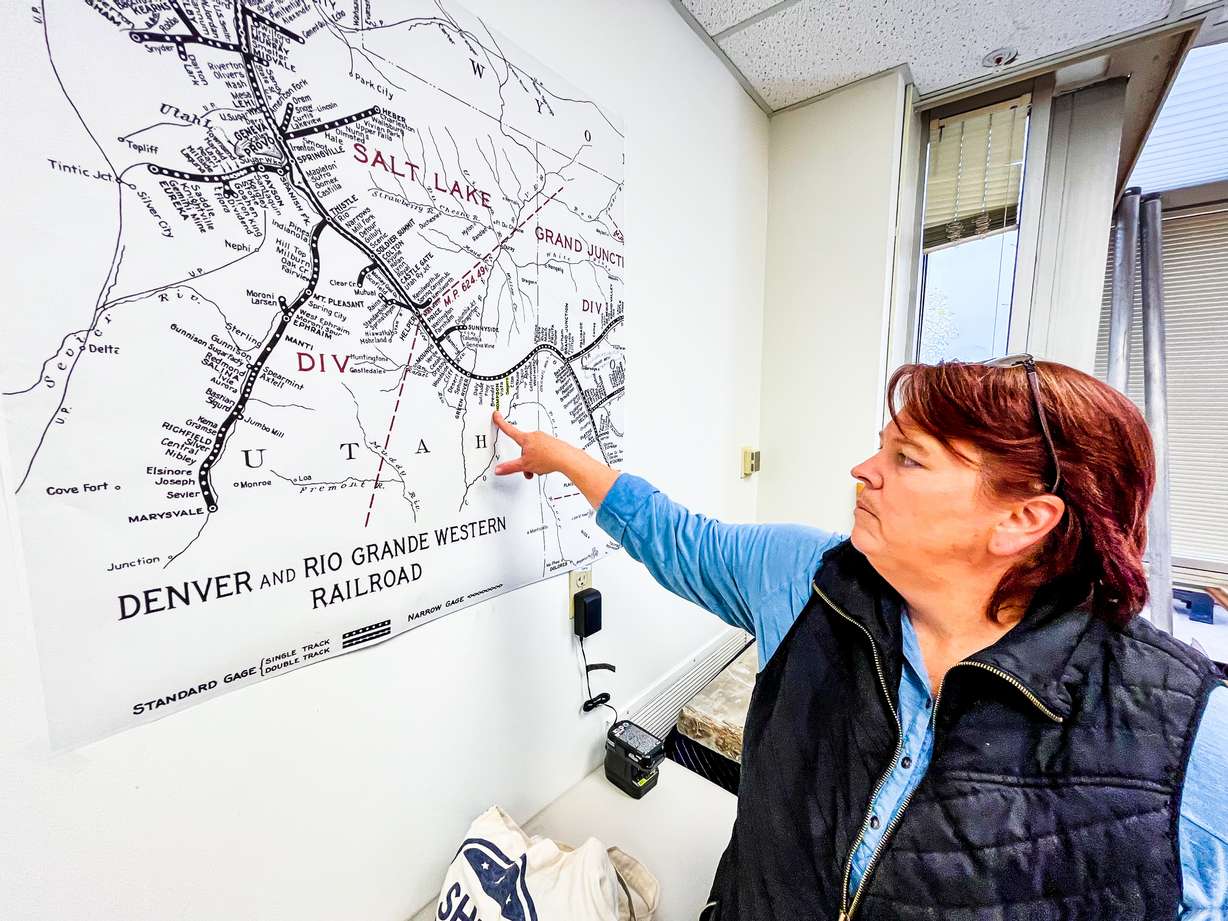
The tombstone was a peculiar discovery in its own right, found in the foothills of the Book Cliffs mountain range about a half-mile from where the Denver and Rio Grande Western Railway passed through.
There is evidence that people knew about this site well before archeologists documented it. Barry said there are signs that people tried repairing the grave decades ago.
Despite the knowledge it exists, there really weren't efforts to figure out who K. Kawanishi was until the tombstone's condition worsened in recent years. State historians met with BLM officials and picked up the case last year.
While staff started compiling paperwork to allow for the extraction of the tombstone, Barry started sifting through records and newspaper archives trying to find any clues about who K. Kawanishi was. But she found his life to be very mysterious as a result of poor recordkeeping.
The official 1900 census documents Kawanishi as a 24-year-old Japanese immigrant working on the Denver and Rio Grande Western Railway within the Thompson, Grand County enumeration area. But the document doesn't offer much more than that because, as Barry puts it, it's littered with racism.
All of the Japanese railroad workers in the area, including Kawanishi, are listed as servants to the Irish and English immigrant boarders. And, for some reason, all the Japanese workers are listed as having February birthdays. It only really notes he could read but couldn't write or speak English.
"Immigrant communities were just treated as ifthey didn't matter," Barry said, explaining the census records at the turn of the 20th century.
Edward Hashimoto, a Japanese labor agent based in Salt Lake City, compiled another census for the railroads, which offers a little more insight.
This railroad census, conducted at the same time, confirms the same information as the 1900 census, adding that Kawanishi was married in 1899 — something that the 1900 census omitted for unknown reasons. It lists him living in a boarding house in Thompson and provides a different birthdate: November 1877, likely meaning Kawanishi was 23 at the time of the census, not 24.
That's really all that's known of him. There aren't any records of his life, family or death in either government documents or public newspapers. And since his full name is incomplete on the census records, it's difficult to find him in Japan's records.
He was obviously well-liked because this was hand-carved by a stone carver somewhere nearby … so they forked out the money to pay for (it)."
– Amy Barry, Utah Division of State History cemeteries program manager
And the location of his grave doesn't offer much insight, either. It would have been easier to move his body closer to the railroad tracks if he died in the spot where he's buried, Barry says.
"What we (won't) ever really know — and I have no idea why — is why he's buried where he's buried," she said. "I don't know why he's buried there. He's not near anywhere (with) access to the railroad line."
Historians do know he died sometime in the early 1900s because his name doesn't appear on any 1910 census records.
The tombstone itself offers some clues, too. His grave is located by the old railroad community of Sagers, east of Thompson as the line heads toward the Utah-Colorado border. And given its marble structure, size and its deterioration, Barry believes Kawanishi died maybe a year or two after the census enumeration.
The Japanese flower detail — the one that caught Mori's attention — likely indicates that it was designed and paid for by Kawanishi's Japanese colleagues, which seems to indicate what he meant to the people who knew him.
"I think this says a lot," Barry says, staring down at the pieces of Kawanishi's tombstone in front of her. "Maybe it was surrounding how he died or the manner of it but he was obviously well-liked because this was hand-carved by a stone carver somewhere nearby … so they forked out the money to pay for (it)."
Repairing Kawanishi's tombstone
The headstone was already in poor shape when archeologists documented it back in the 1990s. A photo of it from 2013 matched with how state historians found it last year indicated it was getting worse quickly, which is why they decided to ask the BLM to recover the broken pieces for repair.
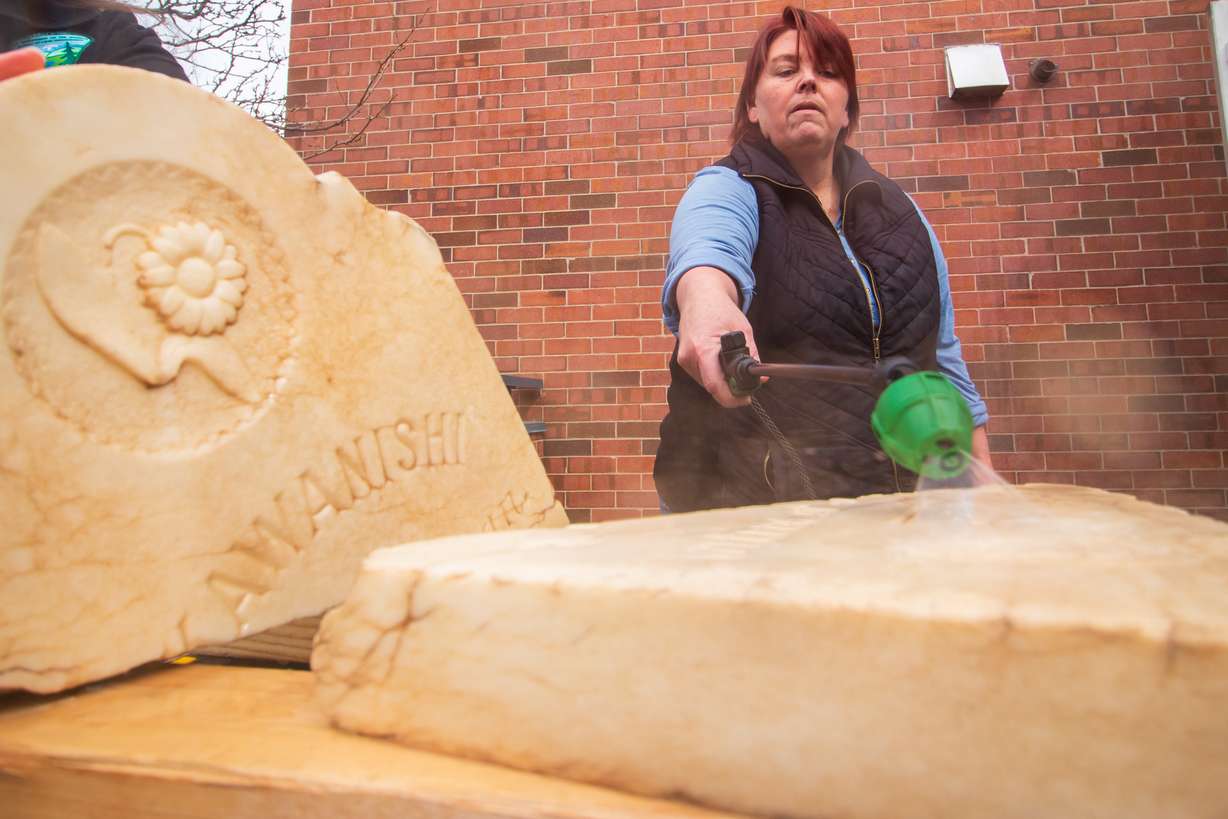
Barry and other state officials collected it and hauled it back to their offices in Millcreek last week. She did the initial cleaning Saturday morning, using cleaning devices that don't harm marble.
The heavy work is still ahead, where the two pieces brought back to Millcreek will be reconnected and a conditioner will be applied to help stop the ongoing deterioration during an extensive process.
"It's not rocket science, but a lot of it is in the sequence it's in to care for it properly, and then you have to give each step time to dry to cure it properly," she said. "You can't really rush it."
Once she's done, the headstone will be reconnected with a sandstone base that remains at Kawanishi's grave in Grand County. That is scheduled to happen next month.
Expanding on Utah's history
Mori, who once served as the president of the Japanese American Citizens League, finds a deep connection with Kawanishi's story.
While most of Kawanishi's life isn't known, his tombstone highlights many components of state and U.S. history. He was among dozens of Japanese-born railroad workers who lived and worked along the Denver and Rio Grande Western Railway between Green River and the Utah-Colorado border in different camps.
While Utah honored the history of Chinese railroad workers as it celebrated the sesquicentennial anniversary of the transcontinental railroad in 2019, there was a massive labor shift between 1869 and 1900 caused by the Chinese Exclusion Act.
Many Chinese railroad workers went back to China or began working in the mines. Railroad companies started bringing in Japanese immigrants instead, as noted by the 1900 census. This period is when Mori's father came to the U.S. from Japan to work on the railroads in California, Nevada and Utah before an injury caused him to change focus and go into farming all over the Beehive State.
"This is something that I think Utahns don't understand. … After the Exclusion Act that kept Chinese (workers) out, Japanese (workers) began working on the railroad," Mori said. "I was very surprised to learn that almost all the workers on this project down in southern Utah were all Japanese."
Jennifer Ortiz, the director of the Utah Division of State History, said the state plans on highlighting forgotten stories in Utah history, like Kawanishi's, in the next few years leading up to the massive U.S. Semiquincentennial in 2026, through a new initiative called "The Peoples of Utah Revisited." It's a more complex update of "The Peoples of Utah," collected during the country's bicentennial in 1976.
Though the tombstone is unrelated to the program, the update aims to paint a more complete picture of the people who have lived in Utah — even though the original work did include various racial and ethnic groups when it was published 46 years ago.
The initiative has three major components. There will be research on underrepresented communities in state history, a collection of oral histories and other documents from all groups of Utah people, and a new online resource to share the information gathered. It not only leads up to the country's 250th birthday but also the launch of a new state history museum slated to open around the same time.
The museum received some funding from the Utah Legislature earlier this year.
"Utah's a much more inclusive and diverse place than I think people think about," Ortiz said," and people are really excited to share their stories."
Assistant Senate Minority Leader Jani Iwamoto, D-Holladay, who helped piece together the funding, hopes that having a more inclusive collection of history will help educate people on both the good and bad parts of state history, so mistakes and issues from the past aren't repeated in the future.
With the rise of hate crimes against Asian American Pacific Islander people during the COVID-19 pandemic and recent racial injustice cases that were brought to national attention, it seems more topical than ever.
Reflecting on his time growing up in Utah schools during the 1940s and 1950s, Mori remembers learning about the hardships of the pioneers arriving in Utah back in 1847. But there wasn't much about everyone else who struggled to adapt to the land.
"(I) learned nothing of other groups of people who had similar hardships. So for me, it's very important," he said. "I think it's important that all aspects of Utah history be depicted and understood by all students."
Education has improved since then but expanding on Utah history also helps make it possible that marginalized people's lives aren't forgotten in time, which may very well have been the case with Kawanishi had his tombstone not been discovered.