'%3e%3cpath%20d='M34.1406%205.85938C30.3906%202.10547%2025.3047%200%2020%200C14.6953%200%209.60938%202.10547%205.85938%205.85938C2.10938%209.61328%200%2014.6953%200%2020C0%2025.3047%202.10547%2030.3906%205.85938%2034.1406C9.61328%2037.8906%2014.6953%2040%2020%2040C25.3047%2040%2030.3906%2037.8945%2034.1406%2034.1406C37.8906%2030.3906%2040%2025.3047%2040%2020C40%2014.6953%2037.8945%209.60938%2034.1406%205.85938ZM37.0117%2023.543H31.1602V13.5391H27.6328V19.9414C28.1211%2020.6914%2028.3711%2021.582%2028.3711%2022.5625V22.625C28.3711%2023.668%2028.1172%2024.6055%2027.6328%2025.4297V26.6094H36.082C33.4883%2032.9375%2027.2891%2037.3789%2020.0039%2037.3789C10.3711%2037.3789%202.62109%2029.6289%202.62109%2020C2.62109%2010.3711%2010.3711%202.62109%2020%202.62109C29.6289%202.62109%2037.3789%2010.3711%2037.3789%2020C37.3789%2021.1484%2037.2617%2022.2656%2037.0508%2023.3477C37.0391%2023.4141%2037.0234%2023.4766%2037.0117%2023.543Z'%20fill='white'/%3e%3cpath%20d='M22.3086%2018.5352C20.4336%2018.125%2019.9531%2017.8398%2019.9766%2017.1836V17.1406C19.9766%2016.6992%2020.3477%2016.2148%2021.4023%2016.2148C22.582%2016.2148%2023.8867%2016.6797%2025.0781%2017.4766L26.8516%2015.0195C25.4453%2013.8906%2023.707%2013.3398%2021.5547%2013.3398C18.5195%2013.3398%2016.4375%2015%2016.4063%2017.4766V17.5352C16.3633%2020.2617%2018.5859%2020.9805%2021.293%2021.6016C23.0391%2021.9766%2023.5703%2022.3164%2023.5703%2022.9609L23.5469%2022.9766C23.5469%2023.3906%2023.2578%2023.7031%2022.7852%2023.8359C22.5742%2023.9062%2022.1289%2023.9727%2021.5156%2023.9727C20.7617%2023.9727%2019.7539%2023.8633%2018.6328%2023.4844C18.0898%2023.2891%2017.4727%2023.0039%2016.8047%2022.6133L20.1406%2026.625C20.2813%2026.6602%2021.0977%2026.8516%2021.7734%2026.8516C25.0039%2026.8516%2027.0859%2025.2461%2027.1094%2022.6328V22.5703C27.1602%2020.1133%2025.2148%2019.1719%2022.3086%2018.5352Z'%20fill='white'/%3e%3cpath%20d='M5.24219%2013.5664V26.6133H8.75391V23.7578L10.2969%2021.9531L14.2031%2026.6133H18.3867L12.3555%2019.5195L17.4023%2013.5664H13.4531L8.75391%2019.0586V13.5664H5.24219Z'%20fill='white'/%3e%3c/g%3e%3cdefs%3e%3cclipPath%20id='clip0_97_2430'%3e%3crect%20width='40'%20height='40'%20fill='white'/%3e%3c/clipPath%3e%3c/defs%3e%3c/svg%3e)



Estimated read time: 4-5 minutes
This archived news story is available only for your personal, non-commercial use. Information in the story may be outdated or superseded by additional information. Reading or replaying the story in its archived form does not constitute a republication of the story.
VERNAL — Hummingbirds seem to be near the top of many people’s favorite birds. What’s not to like about a small, elusive creature that helps pollinate plants across Utah and the world?
But there is one problem: Wildlife biologists still have many questions as they try to understand hummingbirds.
“We know hardly anything,” said Tonya Kieffer-Selby, conservation outreach manager for the Utah Division of Wildlife Resources, Northeast Region Office, which is based in Vernal. That’s partly because there aren’t many biologists trained to band hummingbirds or that are willing to take the time to do it.
Biologists aren’t 100% sure about hummingbird migration patterns or their life cycles. They’re not even sure why hummingbirds choose the flowers they pollinate.
“Some of the work Utah is doing — they’re taking pollen samples off their beaks to see what kind of flowers they’re 'nectaring' on. That’s something that isn’t often studied,” Kieffer-Selby said.
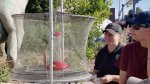
On Saturday, DWR biologists teamed up with Terry Tolbert, a biologist with Bureau of Land Management, and the Uinta Basin Birds & Butterflies to capture hummingbirds, and demonstrate how to place tiny bands on their legs and release them back into the wild. That can seem like a daunting task for a small bird that’s unpredictable. They used a net around a hummingbird feeder that quietly dropped down as they ate so it wouldn’t disrupt the birds after they land on the feeder.
Once in hand, biologists identified the species — all birds captured Saturday happened to be black-chinned hummingbirds — and took in each bird’s measurements (such as beak lengths and wingspans). They also checked for fat percentage to see how much food they consumed over the summer as preparation for possible migration trips.
In each case, a tiny band is placed around one of the bird’s legs that has an identification number. That way, if a bird is found dead or is captured somewhere else, the band info can be relayed back to the U.S. Department of the Interior and back to state and federal biologists who are tracking that bird.
“You’re basically looking to see where these birds are migrating, where they are feeding, how often they’re feeding, where they’re being recaptured — if captured at all," Kieffer-Selby explained. “We do these with all bird species, but doing it with hummingbirds is different because there are only about 200 banders in the nation that can do that.”
Biologists who previously tagged hummingbirds in Escalante, Garfield County, have discovered those birds to migrate to places as far away as Oregon and Sedona, Arizona.
“It’s pretty interesting to figure out what these birds are doing and how far they’re traveling when they’re migrating, and why,” Kieffer-Selby added.
Saturday’s event at the Utah Field House of Natural History State Park Museum was in part to teach residents of the Uintah Basin how to become "citizen scientists" and assist state and federal wildlife biologists in gathering data about pollinators in the region, Kieffer-Selby said. Those who attended didn’t just get to witness biologists capture hummingbirds, some even got a rare opportunity at holding them in their palms.

Hummingbirds, bees, butterflies and bats are among the top pollinators. According to pollinators.org, pollinators account for one-third of every “bite of food.” That’s why they are revered by wildlife biologists.
As autumn slowly nears, migration season for hummingbirds is coming up as well. Saturday’s event was also a way to educate the public about how to assist the birds on their journeys. Biologists say people who would like to help the birds as they migrate should put up hummingbird feeders and keep the birds well-fed. Kieffer-Selby urged people to not use red dye hummingbird food because it may not be healthy for them.
“As long as you use a red feeder or put a red flower on your feeder to attract them, they’ll find the feeders,” she said.
After Saturday’s event, biologists hope they can learn just a little more about hummingbirds. Kieffer-Selby said she hopes the event also helped Utah residents understand how important the tiny birds are.
“Even though hummingbirds are so beautiful and fun, and you can find them in almost every yard, they do serve a huge biological purpose,” she said. “It’s really important for us to pay attention to the little things in life like pollinators … make sure you’re planting plants in your yard that these animals can rely on so they do pollinate our food.”