'%3e%3cpath%20d='M34.1406%205.85938C30.3906%202.10547%2025.3047%200%2020%200C14.6953%200%209.60938%202.10547%205.85938%205.85938C2.10938%209.61328%200%2014.6953%200%2020C0%2025.3047%202.10547%2030.3906%205.85938%2034.1406C9.61328%2037.8906%2014.6953%2040%2020%2040C25.3047%2040%2030.3906%2037.8945%2034.1406%2034.1406C37.8906%2030.3906%2040%2025.3047%2040%2020C40%2014.6953%2037.8945%209.60938%2034.1406%205.85938ZM37.0117%2023.543H31.1602V13.5391H27.6328V19.9414C28.1211%2020.6914%2028.3711%2021.582%2028.3711%2022.5625V22.625C28.3711%2023.668%2028.1172%2024.6055%2027.6328%2025.4297V26.6094H36.082C33.4883%2032.9375%2027.2891%2037.3789%2020.0039%2037.3789C10.3711%2037.3789%202.62109%2029.6289%202.62109%2020C2.62109%2010.3711%2010.3711%202.62109%2020%202.62109C29.6289%202.62109%2037.3789%2010.3711%2037.3789%2020C37.3789%2021.1484%2037.2617%2022.2656%2037.0508%2023.3477C37.0391%2023.4141%2037.0234%2023.4766%2037.0117%2023.543Z'%20fill='white'/%3e%3cpath%20d='M22.3086%2018.5352C20.4336%2018.125%2019.9531%2017.8398%2019.9766%2017.1836V17.1406C19.9766%2016.6992%2020.3477%2016.2148%2021.4023%2016.2148C22.582%2016.2148%2023.8867%2016.6797%2025.0781%2017.4766L26.8516%2015.0195C25.4453%2013.8906%2023.707%2013.3398%2021.5547%2013.3398C18.5195%2013.3398%2016.4375%2015%2016.4063%2017.4766V17.5352C16.3633%2020.2617%2018.5859%2020.9805%2021.293%2021.6016C23.0391%2021.9766%2023.5703%2022.3164%2023.5703%2022.9609L23.5469%2022.9766C23.5469%2023.3906%2023.2578%2023.7031%2022.7852%2023.8359C22.5742%2023.9062%2022.1289%2023.9727%2021.5156%2023.9727C20.7617%2023.9727%2019.7539%2023.8633%2018.6328%2023.4844C18.0898%2023.2891%2017.4727%2023.0039%2016.8047%2022.6133L20.1406%2026.625C20.2813%2026.6602%2021.0977%2026.8516%2021.7734%2026.8516C25.0039%2026.8516%2027.0859%2025.2461%2027.1094%2022.6328V22.5703C27.1602%2020.1133%2025.2148%2019.1719%2022.3086%2018.5352Z'%20fill='white'/%3e%3cpath%20d='M5.24219%2013.5664V26.6133H8.75391V23.7578L10.2969%2021.9531L14.2031%2026.6133H18.3867L12.3555%2019.5195L17.4023%2013.5664H13.4531L8.75391%2019.0586V13.5664H5.24219Z'%20fill='white'/%3e%3c/g%3e%3cdefs%3e%3cclipPath%20id='clip0_97_2430'%3e%3crect%20width='40'%20height='40'%20fill='white'/%3e%3c/clipPath%3e%3c/defs%3e%3c/svg%3e)



Estimated read time: 5-6 minutes
This archived news story is available only for your personal, non-commercial use. Information in the story may be outdated or superseded by additional information. Reading or replaying the story in its archived form does not constitute a republication of the story.
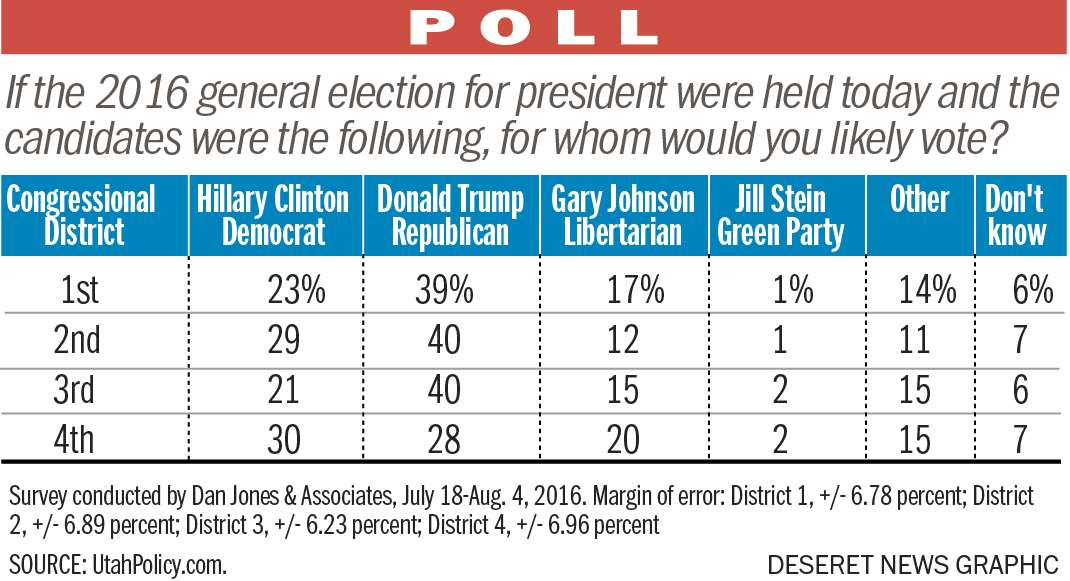
SALT LAKE CITY — Utah may not be so reliably Republican this presidential election, with Democrat Hillary Clinton slightly ahead of Republican Donald Trump in the 4th Congressional District, according to poll results released Tuesday by UtahPolicy.com.
Clinton, the former secretary of state, is up two points over Trump, the former reality TV star, 30 percent to 28 percent, in the poll conducted July 18-Aug. 4 by Dan Jones & Associates.
But even though the Democrats have an edge in the district that includes western portions of Salt Lake and Utah counties, this is the same poll that gave Mia Love, the district's GOP congresswoman, a double-digit lead over Democrat Doug Owens.
"What I would draw from that is Utahns are willing to split their ticket," said UtahPolicy.com publisher LaVarr Webb, who writes a column for the Deseret News. "I think it does show many voters are not going to simply vote straight party."
Trump still leads Clinton 37 percent to 25 percent in previously released results from the poll. The latest results made public put him in front in each of the state's other three congressional districts by as much as 19 points.
The margin of error in the 4th District poll is plus or minus 6.96 percent, a little higher than in the other districts. The poll was done before Utah native Evan McMullin jumped in the race, billing himself as the only conservative choice.
Neither Love nor Owens have endorsed in the presidential race, and both have been avoiding any association with the top of the ticket.
"Doug's focused entirely on his race, not national politics," Owens' campaign spokesman Taylor Morgan said when asked about Clinton's showing in the 4th District. "I'm going to decline to comment."
Dave Hanson, Love's campaign manager, said he believes the poll shows the presidential race "is not having that big of an impact" on the rematch between Love and Owens.
"What it really shows is the strength Mia has in the district, the fact that she is leading really quite handily now," Hansen said, referring to her 13-point lead in the poll despite the district being labeled a toss-up by national political rating entities.
While Trump and Clinton are both unpopular with Utah voters, each finishing far behind the winners of the state's presidential preference caucus votes in March, Trump's troubles here have drawn national attention.
Utahns, who haven't elected a Democrat for president since 1964, have raised concerns about the Republican presidential pick's temperament and his attitudes toward Muslims and other minorities, especially when it comes to immigration.
Clinton appealed directly to Utah voters in an op-ed written for the Deseret News, citing a comparison between Trump's proposed ban on Muslims to the extermination order issued against Mormons in the 1800s.
The Democratic nominee has also sent surrogates to the state, including her husband, former President Bill Clinton. Trump, too, has stepped up his efforts in Utah, with an appearance last week by his running mate, Indiana Gov. Mike Pence.
"I think what will happen in Utah will be a more dramatic version of something that will be a national phenomenon," Matthew Wilson, a political science professor at Southern Methodist University in Dallas, said.
There's "a certain core of Republicans so repulsed by Trump" they're willing to consider other candidates in the election's top race, Wilson said. "I think you'll notice it in a pronounced way in Utah."
Besides McMullin, a Republican running as a independent candidate for president, Utah voters are also looking at Libertarian Gary Johnson and, to a lesser extent, the Green Party's Jill Stein.
Johnson received the support of 20 percent of the voters polled in the 4th District, and Stein, 2 percent. Fifteen percent of respondents said they'd prefer another choice and 7 percent said they didn't know who they'd choose.
The 4th District was represented by the last Utah Democrat to serve in Congress, now-retired Rep. Jim Matheson. Matheson beat Love in 2012 and chose not to run again in 2014.
Four years ago, President Barack Obama did better in the 4th District against adopted favorite son candidate Mitt Romney than he did statewide, winning more than 30 percent of the vote there compared to nearly 25 percent.
Chris Karpowitz, co-director of BYU's Center for the Study of Elections and Democracy, cautioned that the time that's passed since the poll was taken is "a lifetime" in a presidential campaign.
Still, the poll suggests "Mia Love should stay as far away from Donald Trump as she possibly can," he said. "The one thing that could change the dynamic of this race in a big way is if she were to endorse Donald Trump."
Hansen said Love did not talk with Pence during his visit to Utah, and he is not aware of any plans she has to meet with the Trump campaign.
"I don't know what's going to happen on it," he said.
But Hansen said it's not just Trump that's casting a shadow over the rest of the ticket. Bill Clinton came in third place in Utah's 1992 presidential election, behind third-party candidate Ross Perot.
"There's so much focus on the 'Trump effect' on candidates," he said. "The Hillary effect is as great if not greater."