Estimated read time: 7-8 minutes
This archived news story is available only for your personal, non-commercial use. Information in the story may be outdated or superseded by additional information. Reading or replaying the story in its archived form does not constitute a republication of the story.
SALT LAKE CITY — In 1944, Alden Higgs was a senior at Davis High in Kaysville, Utah. For several years he had watched friends join the military to fight in World War II. Now, two days before his 18th birthday, he decided to drop out of school and serve his country in the Air Force.
In those days, a teenager approaching his 18th birthday knew military service was inevitable. He had two options. He could either wait to be drafted by a random branch of the armed forces, or he could choose where he served by signing up, before he reached the legal age of service, himself.
When Higgs arrived at the recruiting office he was given bad news. Since his birthday was on a Sunday, and it took two days to process the paperwork, he couldn’t join the Air Force. He would need to wait to be drafted.
The idea of being powerless over which branch he served in was unappealing to Higgs, so he walked over to the recruiting office of his second choice: the Merchant Marines.
Two weeks later he was sent to train in Los Angeles. Although he had discounted joining the Navy, the preparation he received was the same as those who attended Navy boot camp. Little did he know that, while he was under the impression he was serving his country, for decades many would deem him and his comrades as draft-dodgers and non-military.
A great need
There was a reason Higgs didn’t know the Merchant Marines weren’t considered part of the armed forces. The U.S. Merchant Systems “did not stress its civilian status to candidates for the training schools. Instead, it concentrated on publicizing the critical role that the merchant marine played in the war effort, emphasizing that the enrollees would be fulfilling a patriotic duty in signing up.”
Indeed, Higgs was filling a drastic need. The requirement for trained seamen to ship supplies to the troops was so great that training schools were allowed to admit teens as young as 16. Accepting from a pool too young to serve in the other branches of the military was one of the ways the USMS could fill its quota of needed seamen. And that quota was large; from 1942 through 1954, more than 180,000 personnel were put into service.
At first, the need for men to man the supply ships was so great that they received a mere three weeks of preparation before being shipped to sea. Eventually, once immediate shortages were taken care of, a more extensive training was given to them.
The most dangerous branch of the military
Related:
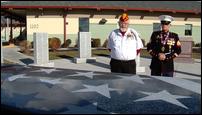
2 veterans work to honor all Utah Purple Heart recipients
Outside the George E. Wahlen Veterans Home in Ogden sits a monument to soldiers from Utah who earned Purple Heart medals. There are more than 1,500 names etched in granite tablets, and hundreds more in waiting.During World War II, the Merchant Marines constituted the lifeblood of the armed forces. Because their ships ferried everything from food, medical supplies and ammunition to the fighting forces, they were usually the vessels most targeted by the enemy.
The casualty rate of Merchant Mariners was so high that during the war it was kept secret so men wouldn’t be dissuaded of joining. Even the newspapers didn’t report the massive losses of Merchant Marine vessels. At its peak, in 1942, there was an average of 33 Allied mariner ships sunk each week.
When comparing the United States Merchant Marines with the other major branches in the U.S. military, the Merchant Marines not only served the longest, but also suffered the highest rate of casualty. It is estimated that 1 in 26 Merchant Marines died during World War II, as opposed to the Marines, who had the second highest rate with 1 in 34 perishing.
Serving as a Merchant Marine
Just because their main job was ferrying supplies didn’t mean the Merchant Marines were untrained sailors on powerless boats. Higgs was one of those trained to man the 20mm antiaircraft guns. Others worked the 3”/50 gun mounted on the ship’s fantail. Their gun skills were put to use often in defending their ships and cargo.
Higgs' shipping duties took him through enemy territory and his ship experienced several close calls. His experiences in Manila and Nagasaki filled his mind with images he would never forget and that would haunt his mind forever.
Service after the war
Even though many saw an end to their military service with the Japanese surrender in 1945, the U.S. government continued to ask men to join the Merchant Marines. These mariners were used to bring soldiers home from the different fronts, as well as freighting supplies throughout newly occupied and war-devastated areas. With all this work to do, Higgs wouldn’t return home until more than a year after the war’s end.
The GI Bill
On June 22, 1944, the GI Bill was signed into law by President Franklin D. Roosevelt. This bill helped finance veterans’ educations, home and business loans and unemployment pay. When Roosevelt signed the bill, he made a lengthy statement, describing the importance of the new law. He said it would give “servicemen and women the opportunity to resume their education or technical training after discharge.” He went on to say that the bill gave “emphatic notice to the men and women in our armed forces that the American people do not intend to let them down.”
The GI Bill had a pronounced effect on servicemen’s lives. Over 2.2 million veterans took advantage of its education provision. By the time the first veterans exited college in 1949, they made up 70 percent of graduates. Buying a home was also paramount for veterans. Between the years 1944 to 1952, 2.4 million home loans were backed by the Veterans Administration.
Higgs' survival made him luckier than many of his fellow mariners. However, his buddies who served in the Air Force, Navy, Marines and Army returned home with the title of veterans and all the considerations that went with it. Those who served in the Merchant Marines, like Higgs, came home to the realization that their nation did not consider them veterans or candidates for the GI Bill. Instead, the boy who dropped out of high school to serve his country was refused the same aid to purchase a home or attend college.
Veterans, finally
Higgs and other mariners were surprised that their services weren’t seen as veteran-worthy. For years many pled with leaders for the same benefits their friends enjoyed. Finally, in 1988, the federal government agreed to extend the title veteran to those who served in the U.S. Merchant Marines. At last, these men could partake of benefits long withheld. But, more importantly, they would now hold the honored and long-deserved title of veteran.
This Veterans Day, as we ponder the sacrifices made by those both living and dead, may we reach beyond the traditional branches of the military and appreciate those who served in one of the most dangerous military branches of World War II: the Merchant Marines.
Elizabeth Reid has bachelor's degrees in economics and history. She has worked in retail, medical billing, catering, education and business fields. Her favorite occupation is that of wife and mother. She blogs at www.agoodreid.blogspot.com.