Estimated read time: 2-3 minutes
This archived news story is available only for your personal, non-commercial use. Information in the story may be outdated or superseded by additional information. Reading or replaying the story in its archived form does not constitute a republication of the story.
Ed Yeates reportingThough the diagnosis for "white matter disease" has been around for a while, 35-year-old Barry Squires doesn't know exactly what it means for him. The young radio engineer today went through some rather unique testing at Neurological Associates in Orem.
In our brains, we have both gray and white matter. In fact, there's more white matter because it, in part, is the stuff that provides the coating around the extensions of our neurons.
Squires, a radio engineer for Bonneville Corporation, said, "The fact that when you first hear you have an issue, a health issue, it's like, well, what's wrong?"
What's wrong is what neurologist Mohammad Taher is trying to find out. Some of the white matter in Barry's brain has died. One of three things could be causing it.
So today, he went through a test not many people are familiar with. A helmet with ultrasound transducers is tightened in place around his head.
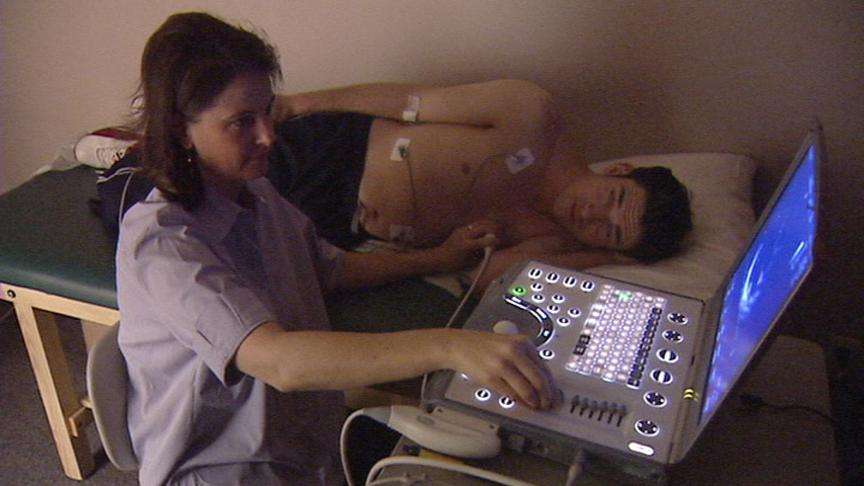
Cardiac sonographer Valerie Lucking then agitates two 9-cc syringes of saline with 1 cc of air, to create micro bubbles. She quickly injects the solution into his arm so the ultrasound can see it if it flows toward his brain.
Barry may have a hole in his heart that's allowed small blood clots to cross the divide.
Lucking said, "If there is a hole in his heart, that saline is going to travel up and go into his heart. If there is a hole in his heart, it's going to cross over in that hole and go up into his brain, and we'll be able to see it on each one of these transducers."
Barry also blows into a mouthpiece to increase pressure on his heart, thus forcing the micro bubbles to shoot through the hole.
But that hole may not be there. If so, Barry's headaches may be the villain. "They've been severe headaches. I mean it wakes me from rest, from sleeping. Sometimes there's light-headedness, dizziness," Barry explained.
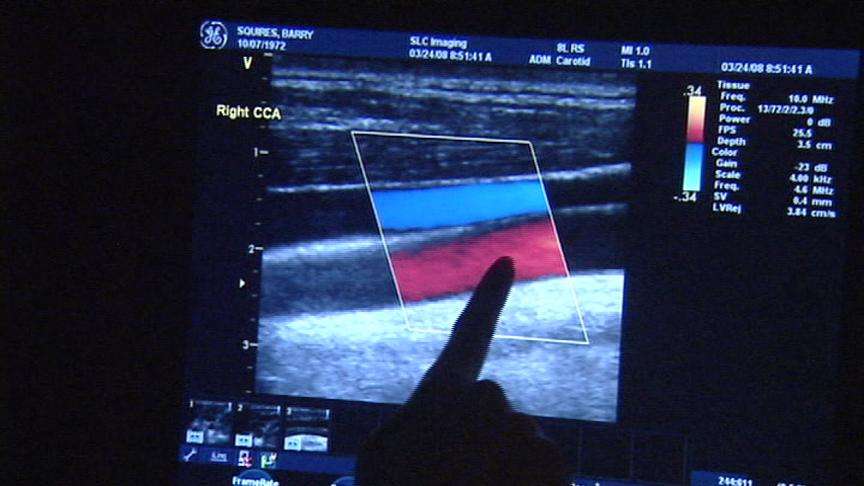
Severe headaches, like migraines which constrict vessels, can destroy white matter. The ultrasound also maps the carotid artery to see if it's thickening with plaque, plaque that could break off and travel to the brain.
The early diagnosis here is critical. Losing too much white matter can affect memory and balance.
Dr. Taher will look at the ultrasound data. Once doctors know what's behind the "white matter disease," hopefully they can stop it. Incidentally, multiple sclerosis also destroys white matter, but it is unlikely that is what is happening to Barry.
E-mail: eyeates@ksl.com