

Estimated read time: 3-4 minutes
This archived news story is available only for your personal, non-commercial use. Information in the story may be outdated or superseded by additional information. Reading or replaying the story in its archived form does not constitute a republication of the story.
NORTHERN UTAH -- In northern Utah, the snowpack keeps getting deeper, and there are more storms on the way. Places like Garden City and Pickleville have already seen flooding, and water managers across the state are already releasing water from many dams.
Flooding in Garden City and Pickleville
Utahns living near Bear Lake spent the weekend mopping up after several days of flooding. The worry in towns like Pickleville and Garden City is that this is only the start of serious problems as spring runoff starts to flow.
Wet Fall: An extremely wet fall in 2011 saturated the soil. Typically the soil is dry enough to soak up the winter moisture, but not this year. That means the water just runs off.
Above-average snowpack:Several storms have brought a lot of snow to the mountains this winter. Snowpack in some areas is currently sitting at 133% of average.
Cool and wet spring:: The combination of the recent warmer weather and more moisture has kicked the spring runoff into high gear a bit early.
-Kevin Eubank, Live 5 Weather HD
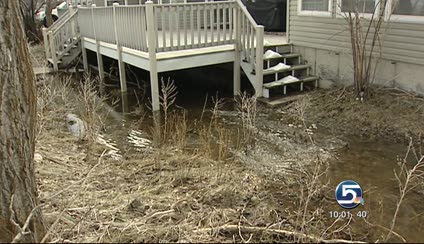
Water began pouring from a canal Friday and cascaded down the hill in several places. It was snowmelt coming off lower slopes near Bear Lake and into the canal, which was jammed with ice and snow.
"(The water) hit the ice and snow, dammed itself up, and then basically breached and started running over the canal top," said Bryce Neilson, emergency manager for Rich County.
In the back of Celia Loosle's dream vacation home, water filled up a sunken patio while her family was out to dinner. When they, returned there was 3 to 4 feet of water in the basement.
"I come in the house, my dog's standing up there with this worried look on his face, and I hear, like, a river running in our house," Loosle said. "Basically the side of our house, it was like a river just rushing in."
Several other homes were believed to be flooded as well, but officials aren't sure because they are summer homes and the owners aren't around to let them in. County officials are asking the homeowners to check their properties, and then make flood preparations where necessary.
With 10 feet of snow piled up in the mountains, the worry is what comes next when it really warms up. "We're fortunate in the fact that we've had a wake-up call," Nielson said.
Water managers working to prevent more flooding
To prevent flooding in other areas of the state, water managers have begun strategically releasing water from many dams.
In a normal year, water managers would be in storage mode, capturing all of the runoff in reservoirs. But this is not a normal year.
"We have record-high snowpacks. We have unbelievably high soil moisture," said Randy Julander, hydrologist for the National Resources Conservation Service.
Julander helps put together the runoff forecast that water managers rely on across the state. "You're creating some space in the upper reservoirs to be able to control the water as it comes down later in the year," he explained.
The Weber River is really flowing at the mouth of the canyon, in part because water managers are releasing two to three times the normal rate upstream.
Mountain snowpack totals
| Snow depth (in feet) | Water equivalent (in inches) | % of Average | |
|---|---|---|---|
| Ben Lomond Peak | 10 | 55 | 130% |
| Farmington Canyon | 11 | 58 | 166% |
| Snowbird | 12 | 62 | 169% |
| Cedar Breaks | 9 | 43 | 166% |
"The runoff forecasts are as high as they've been in 30 years," said Mark Anderson, assistant general manager at Weber Basin Water. "We're trying to make room for all that water that's going to come down."
That's why water is already gushing from Pineview Reservoir.
At the Jordanelle Reservoir, the Central Utah Water Conservancy District is releasing water at a rate of 600 cubic feet per second -- four times the normal rate. Water managers there need to make room for 100,000 acre feet of water, which is more than 32.5 billion gallons.
More snow will make it even tougher to manage. "It's going to be an interesting scenario," Anderson said. "We're hoping that Mother Nature cooperates and doesn't add too much additional snow."
When the runoff ends, water managers want full reservoirs, but not spilling over. Regardless how the weather plays out, Utah will have high flows.
-----
Story written with contributions from John Hollenhorst and Jed Boal.
---






