
Estimated read time: 3-4 minutes
This archived news story is available only for your personal, non-commercial use. Information in the story may be outdated or superseded by additional information. Reading or replaying the story in its archived form does not constitute a republication of the story.
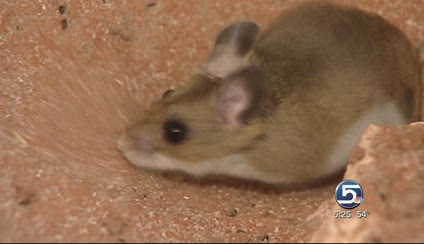
SALT LAKE CITY -- Utah's deer mouse population is getting supervision from outer space. University of Utah scientists are using satellites track the deadly hantavirus carried by the rodents.
Biology professor Denise Dearing says her lab uses satellite images to track the growth of deer mouse food, because they've found it's a good predictor hantavirus outbreaks.
Hantavirus kills 42% of its victims and is contracted by inhaling dust containing mouse urine or feces.
"The satellite measures the greenness of the earth, and we found that greenness predicts deer mouse population density," said Dearing, who co-authored a study set to be published online Wednesday.
The study found that mice populations increase substantially during the year after a particularly wet season, also resulting in an increase of hantavirus infections, of which 42 percent are deadly.
While humans contract hantavirus from inhaling dust or particles containing mouse urine or feces -- from areas where infected mice have nested like garages or empty cabins -- scientists believe the technology could pinpoint where that dust may be concentrated as well as help health officials fight other rodent-borne diseases such as rat-bite fever, Lyme disease, bubonic plague, Lassa fever, salmonella infection and various hemorrhagic fevers.
Hantavirus was discovered in 1993 after several young and otherwise healthy individuals in the Four Corners area of Utah, Colorado, New Mexico and Arizona died of a mysterious respiratory illness. Had the mice tracking data been available then, researchers would have known to alert humans of the mouse habitats and increased potential of contracting the disease.
Scientists were then able to watch the numbers and determine when the hantavirus risk was highest. "You can think of it as a kind of air drop of food for the mice," said another co-author and Utah geography professor, Thomas Cova. "It's rained and suddenly there's just so much food that they're rich. They get fat, population density goes up, and about a year-and-a-half later, population peaks."
The number of infected mice increased along with the mouse population, resulting in more opportunities for humans to get sick, indicating a greater risk.
Dearing says using satellites is the future of disease prevention because of its low cost and accessibility.
"It was a multi-million dollar study to go out there in the desert season after season and year after year to capture mice, collect blood samples and measure hantavirus," she said.
The study indicates people are at greatest risk of catching hantavirus a little over a year after peaks in plant growth, and it pinpoints the best methods for measuring those peaks, according to the U. The outcome provides a way for researchers to create maps showing where and when outbreaks are likely to occur.
Story written by Wendy Leonard with contributions from Logan Daniels.