- The Museum of Utah opens Saturday, showcasing diverse stories of Utah's history.
- It features artifacts from indigenous history to modern times, including rare items.
- The museum is part of a $320 million North Capitol project, highlighting Utah's cultural heritage and completing Capitol complex.
SALT LAKE CITY — Jennifer Ortiz opens a door inside the new Museum of Utah, where a large photo immediately stops her in her tracks.
It's a portrait of a family that migrated from Mexico to Brigham City for mining opportunities shortly after the turn of the 20th century, whose roots remain in Utah a century later. A family descendant now works for the Utah Division of Multicultural Affairs, where they recommended the photo as one of many unique stories of Utah to be included in the new museum.
A wall dedicated to the many stories of Utah's Indigenous tribes, compiled by the tribes themselves, is located to the left of this photo. A handcart is located to the right, with stories of early pioneers featured nearby. Other migration stories, from work opportunities to refugees, are nearby.
This is deliberate, she explains, to showcase how stories of people who came to Utah are very similar across generations. It sets the stage for the rest of the museum, which aims to tell the story of Utah's people, from how different groups got here to what occurred here, scattered throughout a four-section museum. It spans time periods, grabbing everything from Indigenous history to modern times.
It's what she hopes people see when its doors officially open on Saturday.
"Every image, every sentence and every object that you see is somehow connected to present-day demographics in the state," said Ortiz, director of the Utah Historical Society. "That was very intentional. ... As you walk through here, you're going to see that."
What's inside the museum?
The museum's four sections reflect Utah's many human connections, as well as the things Utahns have built, inspirations from Utah and personal connections with the past. Visitors can choose their own adventure on where to start, but Ortiz recommends starting with the "Becoming Utah" section.
By starting there, visitors can learn about Utah's Native American history and the different stories of how people ended up in Utah, all while viewing rare artifacts from multiple eras. It helps set the stage for the rest of the exhibits.
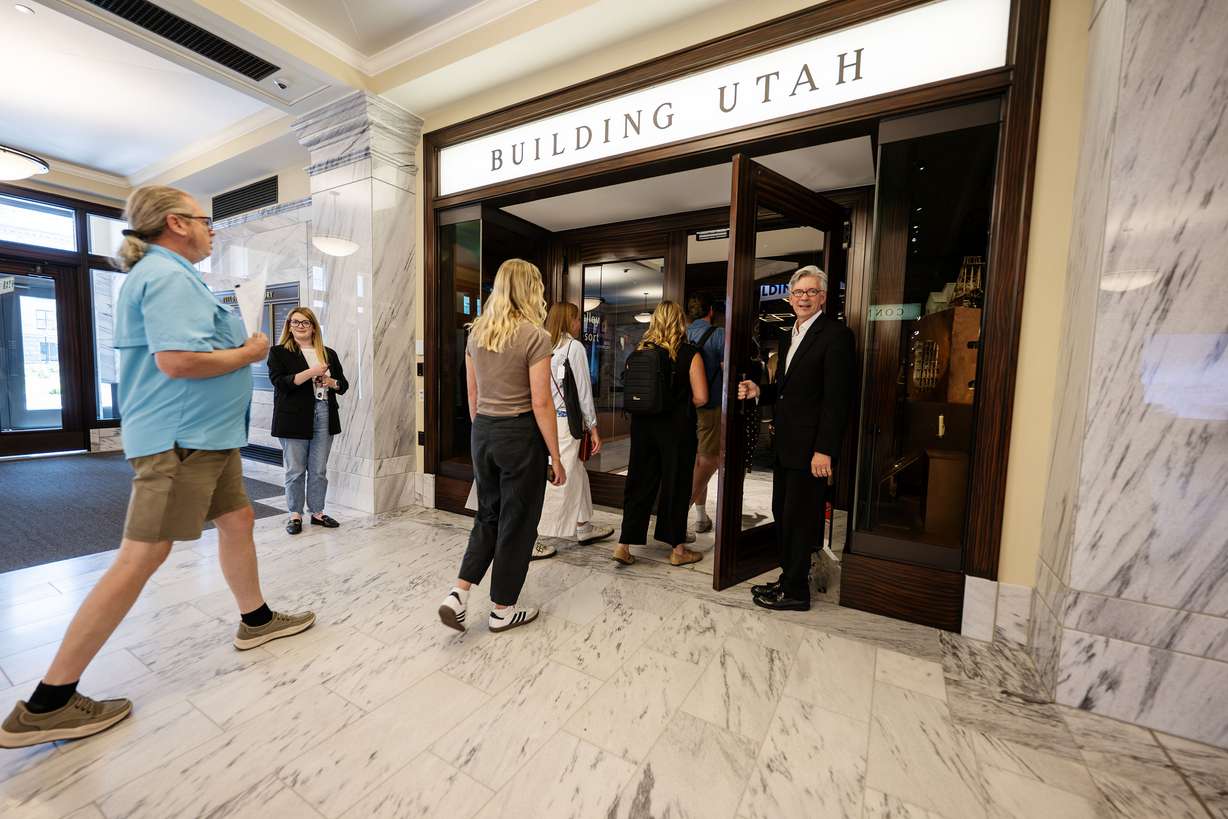
Some stories are more sobering than others. Ortiz lifts the cover of a makeshift suitcase that shows the items that Japanese Americans would have taken with them when forced to the Topaz War Relocation Center in Utah during World War II. It's located next to a child's diary that's helped teachers tell the story of Topaz.
"It really pulls at your heartstrings," Ortiz says, as she guides KSL on a tour.
The room eventually morphs into the creation of the state today. Utah's first state flag, designed over a century ago, is displayed not far from President Grover Cleveland's declaration that made Utah the 45th state, the latter of which is temporarily located before it goes back to storage for protection.
It all folds into other sections, which celebrate how people forged the state. Utah got one of the golden spikes from 1869 on loan for the museum's debut, which proudly stands next to several ceremonial spikes made for anniversaries over the past 157 years.
What's in the new Museum of Utah?
— Carter Williams (@cwilliamsKSL) June 26, 2026
Utah Historical Society director Jennifer Ortiz gave me a tour of it the other day, and there are so many stories packed into 4 sections.
The museum opens to the public on Saturday. pic.twitter.com/WsD0V2L5AP
There are tubes that Philo Farnsworth used to help invent television, a letterman jacket once owned by University of Utah hoops great Wat Misaka, who was also the first person of color in the NBA's history, and various Sundance Film Festival items.
Gear that the late Salt Lake City Mayor Ted Wilson used to blaze trails in Utah's mountains, Mormon Meteor III and various items from movies shot in Utah can be found here, too, adding to the range on display.
There are several interactive exhibits scattered throughout the museum, too, explaining how Utah got its shape or showcasing how Salt Lake City's blocks are colossal compared with those in other U.S. cities.
Others tell the stories of its people, including one where people can learn about dishes that are native to Utah, like cherry choke pudding or Sanpete County marinade. It even allows visitors to send the recipe to themselves to make it at home.
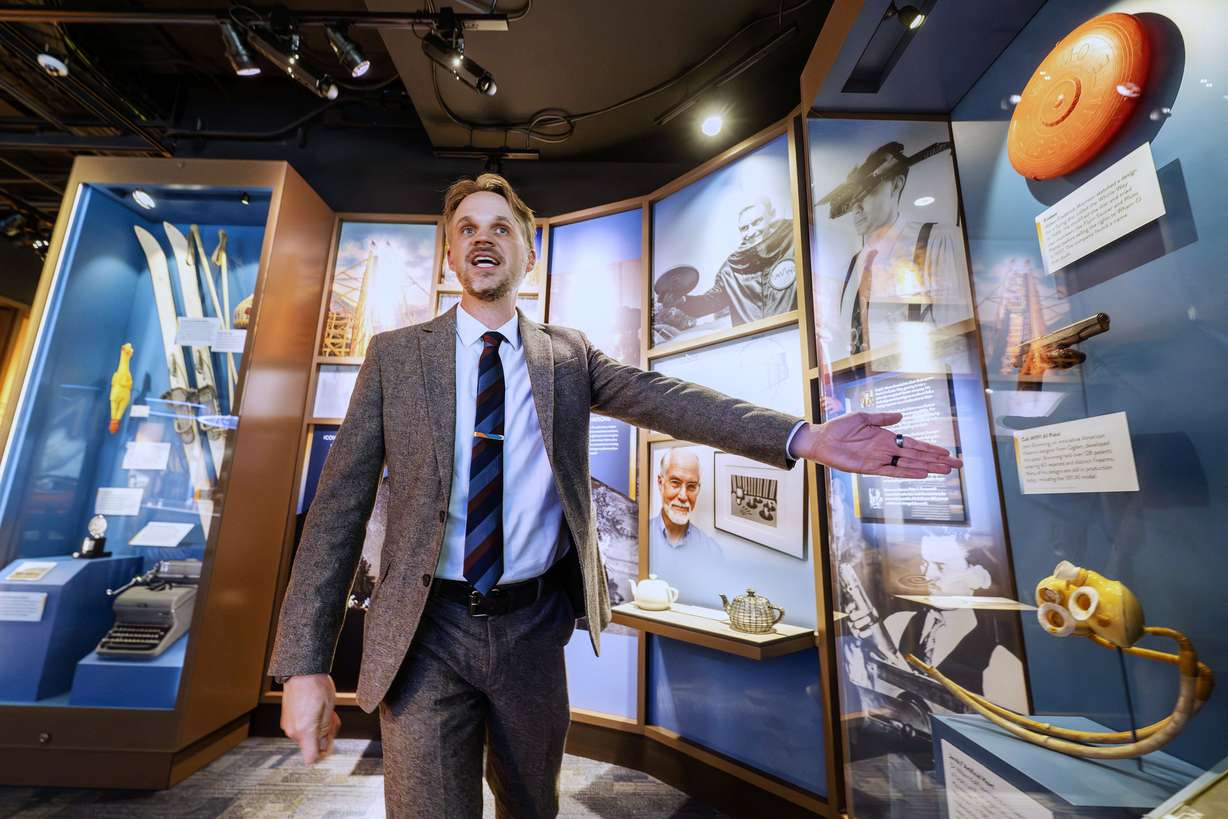
In all, close to 1,000 items are on display in the museum's initial iteration. They were picked after reaching out to residents all across the state through focus groups and online feedback, collecting diverse stories that tied back to all of Utah's corners.
Items will change over time, and there is a rotating exhibit space that will change three or four times every year. State historians hope that Utahns may see a piece of themselves and their community in the museum at all times, though.
"I think what people are going to experience when they come here to the Museum of Utah is probably surprise at how many stories we're telling but also the objects that reflect those stories, communities and people here in the state — not just things collected in the 1800s," Ortiz said.
Creating a state museum
It wasn't long ago that many of these items Utah holds were locked away from public view.
The Utah Historical Society and Utah Department of Cultural and Community Engagement spent seven years planning out the museum after seeking and receiving the funds for it from the Utah Legislature, but there had been sporadic discussions about creating a state history museum over the past century.
It is a gateway to our past, but also a gateway to our future.
–Gov. Spencer Cox
The need for a new facility had become abundantly clear over the past decade, as historians feared that Utah's vast historic collection of more than 30,000 objects and 1 million photos — valued at approximately $100 million in 2018 — was at risk because it was stored inside the aging Rio Grande Depot.
The basement was warm and unstable, leaving artifacts in danger of being damaged by conditions or building damage. Large plastic sheets were placed over the top of some of the boxes to prevent any leaks from reaching precious artifacts.
Concerns were amplified in 2020, when a 5.7-magnitude earthquake rattled the building. The artifacts survived, but it showed how quickly they could be lost.
That's why historians are equally excited about what's not visible at the new museum. It's located on top of a modern space for storing historic collections, which takes up a chunk of the over 40,000-square-foot basement.
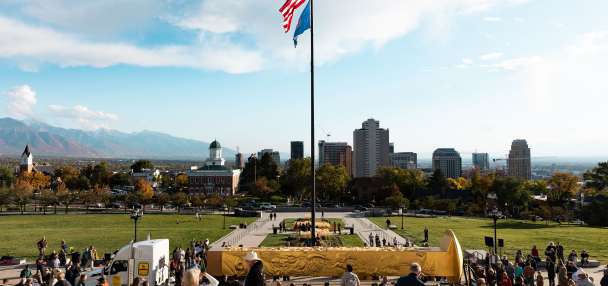
The whole thing is now officially the crown jewel of the $320 million Michael O. Leavitt North Capitol Building, which opened in January. It's also Utah's gift to America 250, said Gov. Spencer Cox.
"It is the story of us," he said. "It is a gateway to our past, but also a gateway to our future."
A grand opening
Everything will be visible for visitors and residents alike, beginning on Saturday.
A community ribbon-cutting event is planned for 9 a.m., with the galleries officially opening 15 minutes later. Live music, food trucks and other activities are planned throughout the day, until the museum closes at 8 p.m.
The event is free, as is admission to the museum every day of the week. Officials say gallery access could be briefly limited at times, if building capacity is reached. More details are available on a webpage that the state set up.
It'll be open seven days a week afterward, following Saturday's extravaganza.
"It's really incredible to be part of this moment in time," Ortiz said, as the state finally opens a history museum. "It's a little surreal, sometimes overwhelming in the best of ways. We're really excited."