'%3e%3cpath%20d='M34.1406%205.85938C30.3906%202.10547%2025.3047%200%2020%200C14.6953%200%209.60938%202.10547%205.85938%205.85938C2.10938%209.61328%200%2014.6953%200%2020C0%2025.3047%202.10547%2030.3906%205.85938%2034.1406C9.61328%2037.8906%2014.6953%2040%2020%2040C25.3047%2040%2030.3906%2037.8945%2034.1406%2034.1406C37.8906%2030.3906%2040%2025.3047%2040%2020C40%2014.6953%2037.8945%209.60938%2034.1406%205.85938ZM37.0117%2023.543H31.1602V13.5391H27.6328V19.9414C28.1211%2020.6914%2028.3711%2021.582%2028.3711%2022.5625V22.625C28.3711%2023.668%2028.1172%2024.6055%2027.6328%2025.4297V26.6094H36.082C33.4883%2032.9375%2027.2891%2037.3789%2020.0039%2037.3789C10.3711%2037.3789%202.62109%2029.6289%202.62109%2020C2.62109%2010.3711%2010.3711%202.62109%2020%202.62109C29.6289%202.62109%2037.3789%2010.3711%2037.3789%2020C37.3789%2021.1484%2037.2617%2022.2656%2037.0508%2023.3477C37.0391%2023.4141%2037.0234%2023.4766%2037.0117%2023.543Z'%20fill='white'/%3e%3cpath%20d='M22.3086%2018.5352C20.4336%2018.125%2019.9531%2017.8398%2019.9766%2017.1836V17.1406C19.9766%2016.6992%2020.3477%2016.2148%2021.4023%2016.2148C22.582%2016.2148%2023.8867%2016.6797%2025.0781%2017.4766L26.8516%2015.0195C25.4453%2013.8906%2023.707%2013.3398%2021.5547%2013.3398C18.5195%2013.3398%2016.4375%2015%2016.4063%2017.4766V17.5352C16.3633%2020.2617%2018.5859%2020.9805%2021.293%2021.6016C23.0391%2021.9766%2023.5703%2022.3164%2023.5703%2022.9609L23.5469%2022.9766C23.5469%2023.3906%2023.2578%2023.7031%2022.7852%2023.8359C22.5742%2023.9062%2022.1289%2023.9727%2021.5156%2023.9727C20.7617%2023.9727%2019.7539%2023.8633%2018.6328%2023.4844C18.0898%2023.2891%2017.4727%2023.0039%2016.8047%2022.6133L20.1406%2026.625C20.2813%2026.6602%2021.0977%2026.8516%2021.7734%2026.8516C25.0039%2026.8516%2027.0859%2025.2461%2027.1094%2022.6328V22.5703C27.1602%2020.1133%2025.2148%2019.1719%2022.3086%2018.5352Z'%20fill='white'/%3e%3cpath%20d='M5.24219%2013.5664V26.6133H8.75391V23.7578L10.2969%2021.9531L14.2031%2026.6133H18.3867L12.3555%2019.5195L17.4023%2013.5664H13.4531L8.75391%2019.0586V13.5664H5.24219Z'%20fill='white'/%3e%3c/g%3e%3cdefs%3e%3cclipPath%20id='clip0_97_2430'%3e%3crect%20width='40'%20height='40'%20fill='white'/%3e%3c/clipPath%3e%3c/defs%3e%3c/svg%3e)




- Utah's Stratos project faces scrutiny from data center experts in Virginia.
- Concerns include noise, power, water, emissions and proximity to neighborhoods.
- Kevin O'Leary promises minimal impact but lacks specific data on key issues.
LEESBURG, Va. — Roughly 2,000 miles away from Utah, Loudoun County, Virginia, is home to 253 data centers.
"That data center is the cloud," Sterling resident Jessica Medeiros said, pointing to a data center across the street from her neighborhood that makes noise at all hours of the day.
"There's not been a single day in 16 years where a data center was not under construction in Loudoun County," said Mike Turner, vice chair of the Loudoun County Board of Supervisors.
People living in Loudoun County, known as the data center capital of the world, are following news of the Box Elder County Stratos project, a massive AI data center backed by celebrity investor Kevin O'Leary. They're also watching the pushback from Utahns.
"They have a right to be concerned," said Lindsay Shaw, another Sterling resident whose view from her front yard now includes a data center.
"From the outside, it looks like people in Utah are having a huge impact," said Christopher Miller, president of the Piedmont Environmental Council.
That perceived impact is exemplified in Utah Gov. Spencer Cox's shifting response to public criticism.
"I'm so tired of our country taking years to get stuff done," Cox said during a news conference in April. "It's the dumbest thing ever."
A few weeks later, Cox's tone had changed as he acknowledged, "The public has brought up some concerns that some of us didn't think about that are important, and that matters."
"They're having an effect," Turner said.
During his time serving on the Loudoun County Board of Supervisors and studying the data center industry, Turner said he's learned firsthand that any proposed data center project raises questions about six key factors that demand answers.
"Noise, power, water, emissions, appearance and setback from residential neighborhoods," he said. "Answer those."
The KSL Investigators took questions about those factors and more directly to Kevin O'Leary, who said he wants Box Elder County's buy-in for his project.
"This needs to be supported by the community eventually. It has to be," O'Leary said.
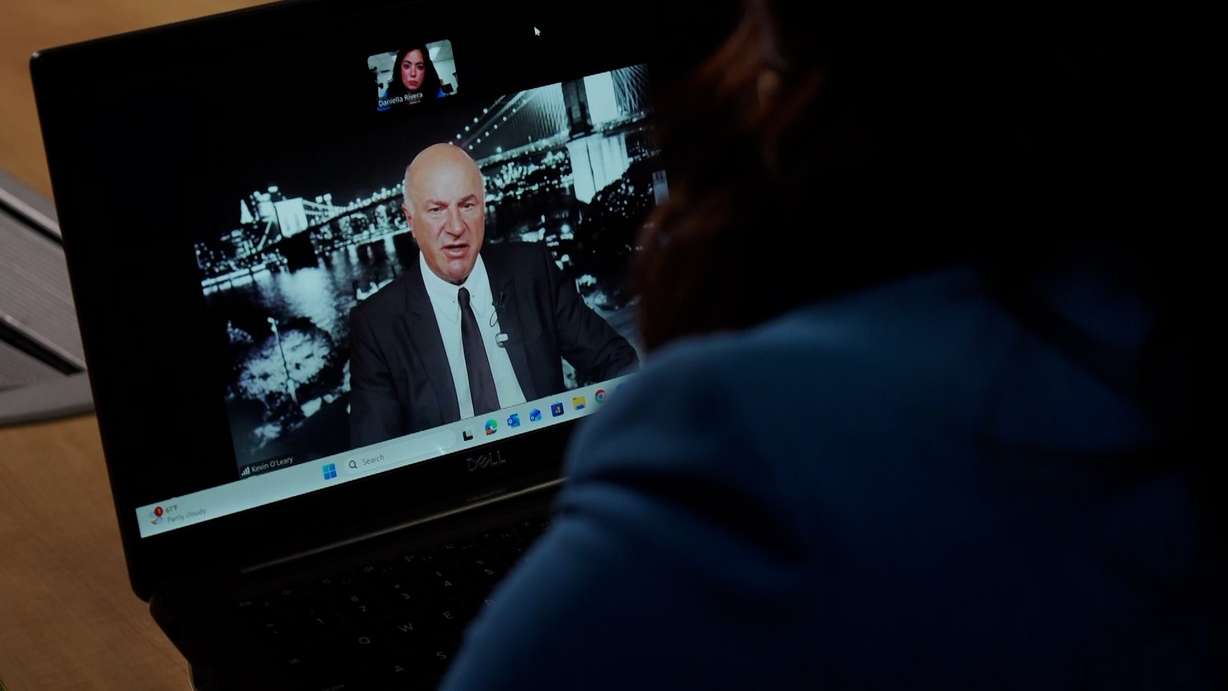
Some questions have been answered. As for appearance, O'Leary's team released renderings. On distance from residential neighborhoods, he's promising a 1,000-foot property buffer.
When asked about noise, he said, "The noise won't be much more than the decibel level between you and I having this conversation. So no, you're not going to hear it."
But when it comes to water and emissions, Utahns are still waiting for numbers.
According to a fact sheet released this month by O'Leary's team, the Stratos data center's water use would be the equivalent of about six golf courses at full buildout.
"We don't think we're going to be using even the amount of water that's permitted with this land now," O'Leary said.
But he would not provide specific numbers or a working estimate.
"I'd rather just wait until the design and the application's put forward," he said, when pushed for details.
Asked about projected annual emissions for the project at max capacity, O'Leary said, "The answer to that depends on the actual design based on the tenant."
O'Leary's team has said the facility will be powered through a mix of natural gas, battery storage and solar power.
"We're not using any power from the Utah grid," O'Leary said. "We're bringing all our own power."
With crucial details still in flux, Turner is skeptical of the true impact of a concession made by O'Leary last month to cut the project area from 40,000 acres down to a 10,000-acre campus.
"If you haven't accurately defined what it is, cutting it down doesn't mean anything," Turner said. "Does cutting it down mean use less power?"
O'Leary said he believes it's likely the center will ultimately use 7.5 gigawatts of power, but he confirmed the project could still have a maximum use of 9 gigawatts, a figure Turner called staggering.
"We have nothing to compare with this scale of a project in Loudoun County," Turner said.
To put 9 gigawatts in context, that's more than two times the current average electricity use of the entire state of Utah, and one and a half times the power used by all of Loudoun County's 200-plus data centers combined.
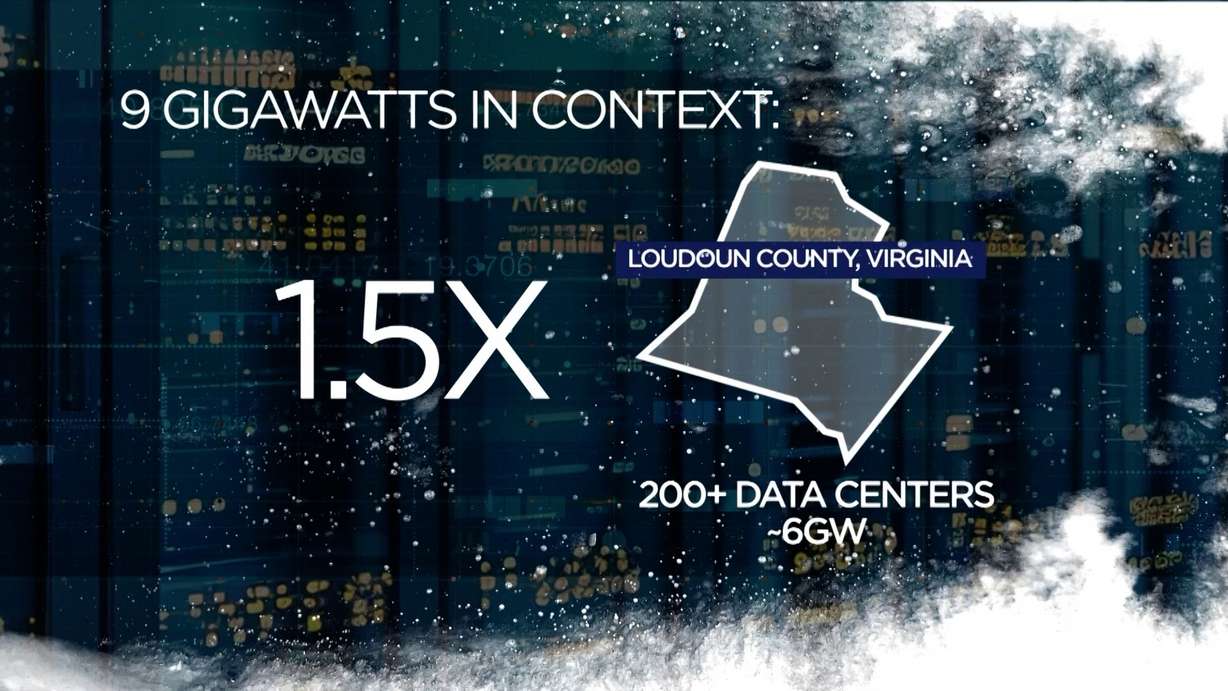
"Twenty-five years of data center growth, the largest data center market on planet Earth, and we're using 6 gigawatts," Turner said. "And this project's going to use 9."
While the Commonwealth of Virginia offers a sales tax exemption for data center development, in Loudoun County, 45% of the 2027 operating budget, $1.3 billion, is revenue coming from data centers.
"We didn't design the tax structure around the data centers," Turner said. "We designed the tax structure for our community, and the data centers came and had to play by our rules."
Box Elder County has been promised more than $100 million in tax revenue annually once the Stratos project is at full capacity, more than its current budget.
But Utah's Military Installation Development Authority, or MIDA, which approved the project, reduced its standard 6% energy tax to 0.5% for the Stratos project. The agreement will also send 80% of key property tax revenue back to O'Leary's company, leaving 20% for MIDA and the state.
When asked whether that sounds like a good deal for Utah, Turner replied, "No. It keeps getting worse and worse."
In response to criticism that Utah leaders left money on the table and questions about whether they should have tried harder to reach a better deal, O'Leary said, "I think it's a fair criticism, but it's an open market."
In that open market, Turner urges caution.
"A facility this size, if mistakes are made, is a community-destroying entity," he said. "It could easily do permanent damage to the community that is irrecoverable."
Even people who call Virginia's "data center alley" home are watching what Utah does next.
"The impacts are not confined to the site," Miller said. "It's going to spread out over the whole state."
This story is part of a special series of reports airing on KSL this week that will look beyond Box Elder County to search for information to inform decisions about data centers in Utah. "Beyond Box Elder: The Bet on Data Centers" airs Monday through Thursday night at 10 p.m. on KSL.