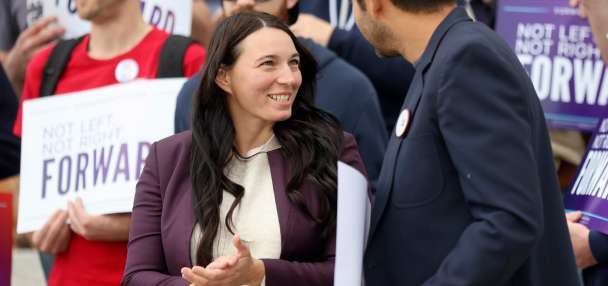
- Democrats warn Utahns of impacts if COVID-era insurance subsidies expire next year.
- Sen. Amy Klobuchar highlights small businesses' reliance on Affordable Care Act plans.
- Fifteen-thousand Utahns risk losing insurance and 80,000 may lose subsidized coverage if subsidies end, according to Urban Institute.
SALT LAKE CITY — A pair of national Democrats warned of impacts to Utahns if COVID-era tax credits for insurance premiums under the Affordable Care Act are allowed to expire at the end of the year in a call with local reporters on Wednesday.
Sen. Amy Klobuchar, D-Minnesota, drew comparisons between Salt Lake City and the Twin Cities: Both house airports that serve as hubs for Delta Air Lines, and both have "some pretty successful companies and a lot of entrepreneurs."
While the high number of entrepreneurs may be good for the economies of both states, Klobuchar said small business owners and employees are more likely to rely on Affordable Care Act plans and are more vulnerable as premiums for many are expected to skyrocket next year.
"If they're an entrepreneur, (if) they're small business, rancher, farmer — they are the ones that really rely on these Affordable Care Act plans," she said. "And this is the difference between them being able to go to the doctor and worry about losing their savings or actually losing their savings, or are they going to be able to get the prescription drugs they need? ... That's why we are pushing our colleagues to come to the table, the negotiating table, so that we can make sure these tax credits don't expire."
Democrats in Washington have made the expiring premium subsidies, which were passed in 2021 and later extended during the Biden administration, at the center of the ongoing government shutdown and have urged the Republican majority to extend them.
The number of Utahns who buy insurance through the marketplace established by the Affordable Care Act, or Obamacare, has more than doubled since 2021, with about 421,000 Utahns enrolled in marketplace plans this year, according to KFF.
Related

These Utahns could see skyrocketing premiums if Obamacare tax credits expire
Some Americans who buy insurance through the Affordable Care Act could face high premiums when Biden-era tax credits expire at the end of this year.That means 11.8% of Utahns are enrolled in marketplace plans, the fourth-highest share among all states, according to the University of Utah's Kem C. Gardner Policy Institute. The majority of marketplace enrollees live along the Wasatch Front and in Washington County, according to the institute, but the counties with the highest shares of enrollees are Wayne County, 19.4%, Rich County, 17.9%, and Juab County, 17.2%
A report from the Urban Institute estimates 15,000 Utahns could lose insurance altogether if subsidies expire, and up to 80,000 Utahns would no longer be covered by subsidized marketplace plans. The majority of those who would become uninsured make between 138% and 400% of the federal poverty level — or between $44,367 and $128,600 annually for a family of four in 2025 — meaning they would likely not qualify for health insurance through Medicaid.
Klobuchar tied the expiring subsidies to Trump administration policies she said are also hitting Americans' wallets, such as tariffs. She said a farmer from her state described the current situation as a "perfect storm of ugly."
Klobuchar spoke on a virtual call Wednesday along with Sen. Ron Wyden, D-Oregon, Utah state Sen. Jen Plumb, D-Salt Lake City, and Stan Clawson, a Salt Lake City resident who was paralyzed from the "mid-torso down" after falling 49 feet while rock climbing nearly three decades ago.
Clawson, a freelance filmmaker, said he relies on catheters, which can cost up to $1,400 per month without insurance. His out-of-pocket medical expenses can range from $7,000 to $10,000 each year, and he worries about how he will make ends meet if his premiums double next year.
"I, like so many others, am very fearful, and my hope is that we can figure out a solution so that people who do need health insurance and who are at risk of losing their health insurance and also worse, potentially dying, can find affordable health care," he said.
Plumb, who works as a pediatric trauma doctor when she is not on Capitol Hill, said she gets a firsthand look at the health care system each day and warned that the loss of insurance for many will mean they will put off preventive care and only seek medical attention when issues become an emergency.
"That's why the potential loss of the Affordable Care Act subsidy credits should alarm every single one of us," she said. "It's mission-critical that the federal government reopens and restores these supports before more people fall through the cracks. Health care is not a luxury."
Several Utah Republicans in Congress have said they are open to discussing the premium subsidies, but only after Senate Democrats provide enough votes to reopen the government. They point out that Democrats themselves put an expiration date on the subsidies and accused the other side of holding Congress "hostage" to accomplish a policy goal.
"There's a willingness on Republicans to look big picture at some of these issues that the Democrats want to discuss, like the ACA subsidies, but ... that's not even a part of the appropriations process, so you can't really negotiate the two with each other," Utah Rep. Blake Moore told reporters on a call last month.
Sen. John Curtis said the enhanced subsidies, enacted during the COVID-19 pandemic, were "temporary" when they were put in place, and "now all of a sudden, it's Republicans' fault, right, that they're expiring? ... That's why I say it's a kind of a half truth. They put the expiration date on there."
Asked about Curtis' argument, Klobuchar said the credits were expanded during the COVID-19 pandemic to combat high health care costs. And while the pandemic is over, she said high costs still persist and make insurance unattainable for many Americans.
"Our job is to make this affordable, and it's not affordable when the premiums double," she said. "And there's a very simple way to solve it with these premiums and just with this tax credit."