
- A Utah judge will soon decide on a new congressional map after hearing arguments.
- The map, drawn by the GOP-controlled Legislature, faces challenges for alleged partisan bias.
- A ruling is expected by Nov. 10 to meet the 2026 midterm deadline.
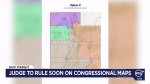
SALT LAKE CITY — A Utah judge said she will rule in the coming days on proposed maps that redraw the state's congressional boundaries.
During a hearing on Tuesday, Utah's 3rd District Judge Dianna Gibson heard additional arguments about tests and standards the Republican-controlled Legislature used in drawing its map, which lawmakers approved last month.
Attorneys for the League of Women Voters of Utah and Mormon Women for Ethical Government — whose lawsuit prompted Gibson to throw out the state's congressional map, kicking off a hurried process to create a new one — argued the Legislature's new map inappropriately relied on several tests that don't work in a politically lopsided state like Utah.
"I think the evidence has shown in this case that the standards that the Legislature has proposed here work directly in opposition to a prohibition on partisan gerrymandering," said Aseem Mulji, attorney for the plaintiffs.
But Tyler Green, an attorney representing lawmakers, rejected that argument.
"At this point," Green said, "the Legislature has every reason to think that it has done what it was supposed to do."
Gibson is now weighing three maps — one from the Legislature and two submitted by plaintiffs in the case. The judge said she will rule on the issue "on or before" Nov. 10, which is the day Lt. Gov. Deidre Henderson's office has said any new congressional map needs to be in place for use in the 2026 midterm elections.
How did we get here?
The ongoing case ties back to a 2018 voter-approved initiative, Proposition 4, which created an independent commission to recommend new political boundaries to lawmakers every 10 years. The initiative also established several standards for new maps, including minimizing the division of cities and counties and prohibiting the drawing of maps to favor one party over another.
The initiative passed with narrow margins, but the Legislature replaced it with SB200 in 2021, which made the commission's role advisory. Lawmakers then selected their own congressional map over those recommended by the commission.
That map split Salt Lake County into each of the state's four congressional districts, prompting outcries from Salt Lake voters who said the map diluted their voting power. Mormon Women for Ethical Government, the League of Women Voters of Utah and several individuals sued the Legislature in 2022, saying the maps were an illegal partisan gerrymander and that lawmakers violated the people's power by repealing and replacing Proposition 4.
The plaintiffs won a major victory with the Utah Supreme Court last summer when the justices ruled lawmakers had overreached by changing Proposition 4. The court said the Legislature had violated a clause in the Utah Constitution that grants voters the right to "alter or reform" their government through the initiative process.
The case then reached a fever pitch in August when Gibson threw out the 2021 map and told lawmakers to adopt a new one to comply with the redistricting standards. Republican leaders in the House and Senate criticized that ruling, promising to appeal it while pointing out that the Utah Constitution gives redistricting power to the Legislature. President Donald Trump also weighed in, calling Gibson's order "unconstitutional."
Still, lawmakers begrudgingly approved a new congressional map last month, which prompted new legal challenges from the plaintiffs who said it still disproportionately favors the GOP.
Judge hears arguments
Tuesday's hearing centered on a new law the Legislature approved alongside the new congressional map, which codifies three statistical tests to evaluate the map's fairness. Gibson previously stated that Proposition 4 requires lawmakers to select the "judicial standards and the best available data and scientific and statistical methods, including measures of partisan symmetry."
But during the hearing, Mulji, the plaintiffs' attorney, argued the Legislature's tests — including the partisan bias test and mean-median difference test — act as a "partisan filter to disqualify any map that doesn't sufficiently crack the state's concentrated Democratic population into multiple districts … fighting the state's inherent political geography and the application of Prop 4 neutral criteria."
Plaintiffs have also argued the methods lawmakers approved don't work in states like Utah that don't have competitive statewide elections — and would actually allow lawmakers to gerrymander in favor of Republicans.
But Green, the attorney for lawmakers, argued the Legislature's metrics were fair and part of a public process to follow the court order and adopt a neutral map in line with Proposition 4.
He also alleged the plaintiffs want a guaranteed seat for Democrats.
"There's no reason to think that Utah's natural political geography demands a guaranteed Democratic district," Green said.
Outside the courtroom on Tuesday, leaders of the groups suing over the maps disputed that.
"This is a nonpartisan effort from the beginning, from 2018, when the voters of Utah voted for Proposition 4," said Katharine Biele, president of the League of Women Voters of Utah. "We will continue to believe that and go forward with it."