'%3e%3cpath%20d='M34.1406%205.85938C30.3906%202.10547%2025.3047%200%2020%200C14.6953%200%209.60938%202.10547%205.85938%205.85938C2.10938%209.61328%200%2014.6953%200%2020C0%2025.3047%202.10547%2030.3906%205.85938%2034.1406C9.61328%2037.8906%2014.6953%2040%2020%2040C25.3047%2040%2030.3906%2037.8945%2034.1406%2034.1406C37.8906%2030.3906%2040%2025.3047%2040%2020C40%2014.6953%2037.8945%209.60938%2034.1406%205.85938ZM37.0117%2023.543H31.1602V13.5391H27.6328V19.9414C28.1211%2020.6914%2028.3711%2021.582%2028.3711%2022.5625V22.625C28.3711%2023.668%2028.1172%2024.6055%2027.6328%2025.4297V26.6094H36.082C33.4883%2032.9375%2027.2891%2037.3789%2020.0039%2037.3789C10.3711%2037.3789%202.62109%2029.6289%202.62109%2020C2.62109%2010.3711%2010.3711%202.62109%2020%202.62109C29.6289%202.62109%2037.3789%2010.3711%2037.3789%2020C37.3789%2021.1484%2037.2617%2022.2656%2037.0508%2023.3477C37.0391%2023.4141%2037.0234%2023.4766%2037.0117%2023.543Z'%20fill='white'/%3e%3cpath%20d='M22.3086%2018.5352C20.4336%2018.125%2019.9531%2017.8398%2019.9766%2017.1836V17.1406C19.9766%2016.6992%2020.3477%2016.2148%2021.4023%2016.2148C22.582%2016.2148%2023.8867%2016.6797%2025.0781%2017.4766L26.8516%2015.0195C25.4453%2013.8906%2023.707%2013.3398%2021.5547%2013.3398C18.5195%2013.3398%2016.4375%2015%2016.4063%2017.4766V17.5352C16.3633%2020.2617%2018.5859%2020.9805%2021.293%2021.6016C23.0391%2021.9766%2023.5703%2022.3164%2023.5703%2022.9609L23.5469%2022.9766C23.5469%2023.3906%2023.2578%2023.7031%2022.7852%2023.8359C22.5742%2023.9062%2022.1289%2023.9727%2021.5156%2023.9727C20.7617%2023.9727%2019.7539%2023.8633%2018.6328%2023.4844C18.0898%2023.2891%2017.4727%2023.0039%2016.8047%2022.6133L20.1406%2026.625C20.2813%2026.6602%2021.0977%2026.8516%2021.7734%2026.8516C25.0039%2026.8516%2027.0859%2025.2461%2027.1094%2022.6328V22.5703C27.1602%2020.1133%2025.2148%2019.1719%2022.3086%2018.5352Z'%20fill='white'/%3e%3cpath%20d='M5.24219%2013.5664V26.6133H8.75391V23.7578L10.2969%2021.9531L14.2031%2026.6133H18.3867L12.3555%2019.5195L17.4023%2013.5664H13.4531L8.75391%2019.0586V13.5664H5.24219Z'%20fill='white'/%3e%3c/g%3e%3cdefs%3e%3cclipPath%20id='clip0_97_2430'%3e%3crect%20width='40'%20height='40'%20fill='white'/%3e%3c/clipPath%3e%3c/defs%3e%3c/svg%3e)




- Utah's Legislature approved a new congressional map and hinted that they might pursue impeachment if a judge doesn't accept it.
- Republicans plan to appeal the court ruling that invalidated previous maps from 2021.
- Democrats argue the new map, "Option C," still disadvantages them by splitting communities.
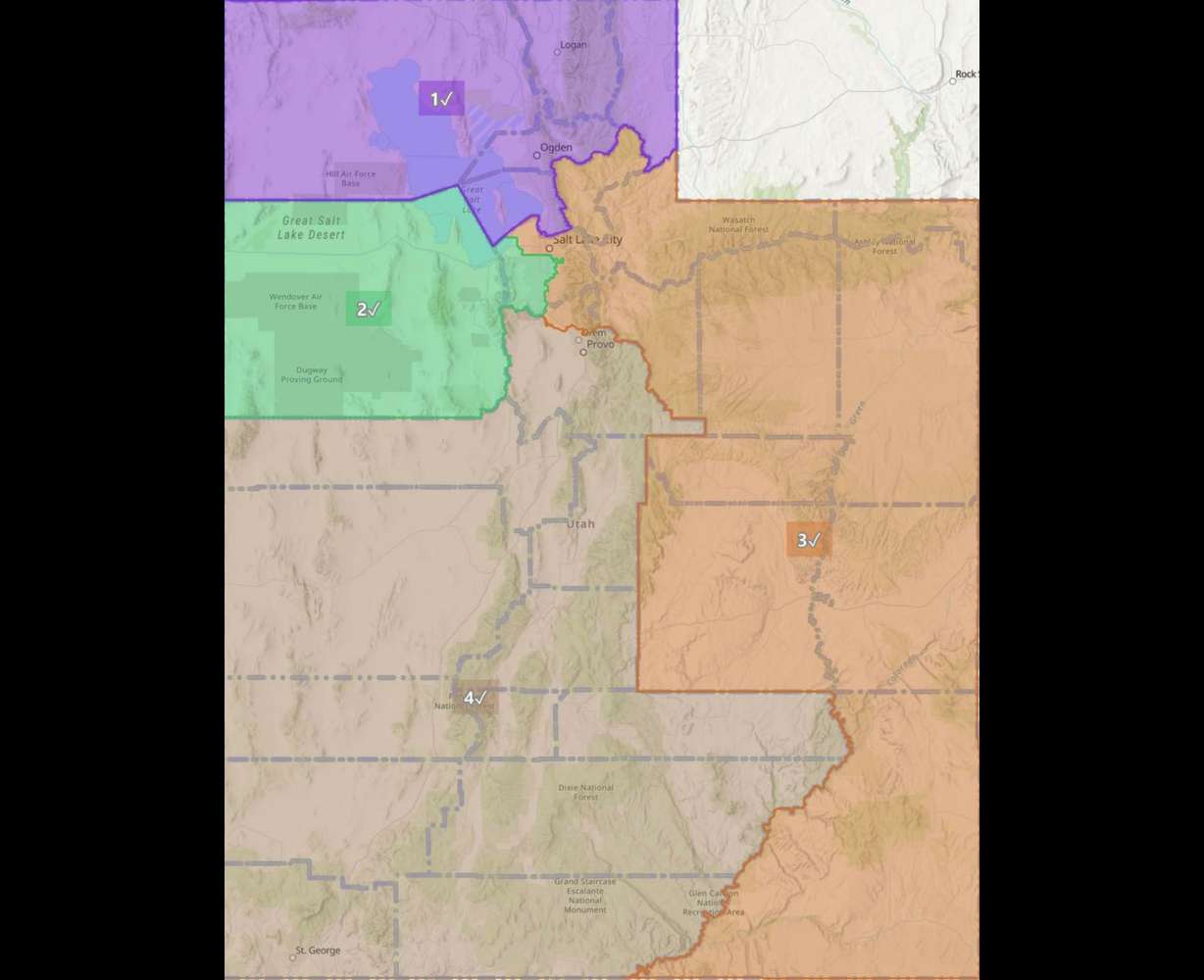
SALT LAKE CITY — Utah's Legislature adopted a new congressional map Monday, but Republicans reiterated that they were only doing so at the behest of the courts and railed against the short timeline to have new maps in place by Nov. 10.
"This is not the way we want to be doing this," said Sen. Scott Sandall, R-Tremonton, one of the chairs of the redistricting committee. He added that lawmakers "fully intend" to appeal the ruling, and they kept the 2021 maps in code in hopes that their litigation will be successful in overturning an August ruling that invalidated the previous maps.
While most Republicans voted for the new maps, a handful voted in opposition in protest of the court's ruling. Sen. Dan McCay, R-Riverton, voted no, after calling the process a "farce" and a "joke."
Utah House Speaker Mike Schultz, R-Hooper, criticized the rushed process put in place by the court, saying the judge took away the opportunity for many voters' voices to be heard.
"This process has been extremely frustrating for the Legislature," he told reporters. "The judge heard this eight months ago. Now, to give us 30 days to redraw maps, to go through a public process, it's wrong. ... It is just absolutely mind-blowing, and it should concern the public."
Democrats also weighed in, crying foul on the new map — dubbed "Option C" — which was backed by Republican Party leaders, questioning whether its adoption was free from politics and expressing concern that it splits up communities of interest.
The process of drawing the remedial maps is supposed to be done without any partisan considerations, but the Utah Republican Party last week urged voters to comment in favor of "Option C" proposed by the Legislative Redistricting Committee, urging them to reject a "blue takeover" in Washington, D.C.
"We urgently need you to submit comments supporting Map C," the party wrote in an email last week. "This is the only map proposed that contains the redistricting criteria and legislative boundaries needed to stop the Democrats."
Democrats said the new map doesn't meet the requirements of Proposition 4 and claim it is still designed to "disadvantage" their party. The 2021 maps infamously split Salt Lake County into four separate districts, and although "Option C" only splits the county twice, Democrats say the divide still has the effect of diluting their voting power in any one district.
"If the split is such that the minority party can never approach a competitive level, it's just as effective to split Democrats into two districts as it is to split them into four," said Rep. Doug Owens, D-Millcreek.
Salt Lake County's population is too large to fit into its own congressional district, but Democrats say the split separates communities of interest by dividing Millcreek into two separate congressional districts in several places along 3300 South and I-215.
GOP leaders on the committee maintained that they had not considered partisan comments when reviewing the thousands of submissions received online during the public comment period before the committee voted along party lines to recommend "Option C" to the full Legislature.
"Like I commented when we first reviewed these maps: I really, really like the distribution on military installations that this map has, and I think that it's a great map to maximize our representation there," said Rep. Stephanie Gricius, R-Eagle Mountain.
Sen. Don Ipson, R-St. George, motioned to recommend the map, saying it "suits the people best" and alludes to past efforts to maintain a mix of urban and rural voters within each of Utah's four congressional districts.
The map was approved by the full Legislature on Monday afternoon, mostly along party lines.
Not everyone was pleased with the decision, however, as the leader of the group behind the 2018 ballot initiative to create an Independent Redistricting Commission said she was "disappointed" by the committee's recommendation.
"With the GOP inserting themselves into this blatantly, recommending it because it helps their party, it's frustrating because we've been very clear that we want full representation for Utahns," Elizabeth Rasmussen, executive director of Better Boundaries, told KSL.com. "And all we've done is help Utahns engage in the process, and yet we're seeing partisanship injected into this process, and it's just really disappointing."
The process of redistricting underway is the result of an August court ruling that invalidated the maps created after the 2020 census, stating that they stemmed from an unconstitutional process after lawmakers altered the 2018 Proposition 4.
Lawmakers and plaintiffs in the lawsuit had until Monday to submit proposals, after which the judge will decide which map will be in place for next year's midterm elections. But at least one Republican appeared to suggest lawmakers might try to take action against Judge Dianna Gibson if she selects any map other than the one they voted for.
"Because it is our duty as a Legislature to approve a map — otherwise, there is no other means by which a map may be used, even if parties ask for it. It'd be a malfeasance in office for a court to attempt to accept a map that has not been approved by the Legislature, or for the lieutenant governor to certify and use a map that has not been approved by the Legislature," said Sen. Brady Brammer, R-Highland.
Utah code outlines that judges and elected officials are "liable to impeachment for high crimes and misdemeanors or malfeasance in office."
Asked about his remarks after the vote, Brammer said the courts don't have authority to adopt a new map; they can only issue a permanent injunction blocking a current map from taking effect.
"It would not be within the statutory or constitutional framework if a court, or anyone else other than the Legislature, were to attempt to adopt it," he told reporters.
Schultz said he wouldn't "get into" what the House would do in a hypothetical situation.
Asked for his thoughts on potentially looking to remove the judge from office, Owens said it would be a "very sad encroachment on the separation of powers."
"I don't think, in a constitutional system like we have in our state, that we should be bashing the weakest branch of government that's just trying to follow the law," he said. "The proper response to a decision you don't like from a judge is to appeal it; it's not to try to blow up the judiciary or try to impeach judges who are trying to do their duty conscientiously."
Changes to bill for evaluating maps
Under Proposition 4, lawmakers are tasked with establishing criteria to measure how well the proposed maps fit the redistricting standards by selecting the "judicial standards and the best available data and scientific and statistical methods, including measures of partisan symmetry." A Republican bill proposed last month would have codified only a single test — the partisan bias test — which critics said was flawed and asked to be supplemented with other measures to determine whether the new map favors one political party over the other.
Brammer, the bill's sponsor, announced changes to the bill on Friday, adding an additional two tests — the ensemble analysis and the mean-median difference test — to be used.
Brammer said the changes came after feedback from the public and his legislative colleagues and will "ensure the analysis of maps is more robust to identify undue favoring or disfavoring of any party — whether that party be Republicans or Democrats."
He added that the tests will help establish clear standards for evaluating maps, which he hopes will help the Legislature avoid continued legal battles over the new maps.
"It is not the role of the court to pick political winners or losers," he said on the Senate floor ahead of a vote on his bill. "In fact, most courts, when confronted with that issue, say, 'This is a political question of which we do not have jurisdiction.' And I think that the judge was wisely trying to say, 'I need some real standards so that I can decide whether or not the process was followed,' as opposed to just being perceived as picking a political winner or loser."
Rep. Nelson Abbott, R-Orem, proposed a change to the bill to remove the mean-median test from the bill, saying he doesn't "think it's scientifically valid." The substitution was rejected after one of the chairs of the redistricting committee said that having all three tests would strengthen the Legislature's hand as it appeals the initial redistricting decision in hopes of rolling back Proposition 4.
"One of the things that we have reviewed, in working at redistricting the past few weeks, is that it strengthens our legal argument by having all three tests in," said Rep. Candice Pierucci, R-Riverton. "If our goal is to protect the Legislature's ability to draw our own maps, this strengthens our argument as we move forward with litigation."
But even with the changes, Rasmussen remained opposed to Brammer's bill because it includes the partisan bias test, which she said is not a good measure of partisan symmetry in a state like Utah, which has a strong Republican lean.
"Any bill that codifies the partisan bias test as a legitimate measure of fairness in a lopsided state is not a serious bill," she told KSL.com before the floor votes.
Brammer's bill passed the Senate 22-7, with all six Democrats and the one Forward Party member voting against it. It cleared the House 55-18, with a handful of Republicans joining all House Democrats in voting "no."
Gov. Spencer Cox signed the bill into law shortly after it was passed by the Legislature, and before the new map was adopted by lawmakers.
Lawmakers adopt changes to Supreme Court appointments
Utah lawmakers also approved a bill that would grant the governor power to appoint the chief justice of the Utah Supreme Court, subject to the advice and consent of the Senate. The five justices have previously voted among themselves for the chief justice — an administrative role that carries the same voting power as the other justices — but SB1003 would let the governor appoint the chief for an eight-year term.
The bill is similar to one passed earlier this year and was vetoed by Gov. Spencer Cox, which would have made the chief justice subject to reappointment every four years. But Cox said that risked making the Supreme Court wary of opposing the Legislature or governor and eroding traditional checks and balances in the system.
SB1003 is a "compromise" reached between lawmakers and the governor's office, increasing the term length by four years, according to House Majority Leader Casey Snider, R-Paradise.
The bill passed on mostly partisan lines, with one House Republican, Rep. Anthony Loubet of Kearns, voting against.
Contributing: Caitlin Keith