'%3e%3cpath%20d='M34.1406%205.85938C30.3906%202.10547%2025.3047%200%2020%200C14.6953%200%209.60938%202.10547%205.85938%205.85938C2.10938%209.61328%200%2014.6953%200%2020C0%2025.3047%202.10547%2030.3906%205.85938%2034.1406C9.61328%2037.8906%2014.6953%2040%2020%2040C25.3047%2040%2030.3906%2037.8945%2034.1406%2034.1406C37.8906%2030.3906%2040%2025.3047%2040%2020C40%2014.6953%2037.8945%209.60938%2034.1406%205.85938ZM37.0117%2023.543H31.1602V13.5391H27.6328V19.9414C28.1211%2020.6914%2028.3711%2021.582%2028.3711%2022.5625V22.625C28.3711%2023.668%2028.1172%2024.6055%2027.6328%2025.4297V26.6094H36.082C33.4883%2032.9375%2027.2891%2037.3789%2020.0039%2037.3789C10.3711%2037.3789%202.62109%2029.6289%202.62109%2020C2.62109%2010.3711%2010.3711%202.62109%2020%202.62109C29.6289%202.62109%2037.3789%2010.3711%2037.3789%2020C37.3789%2021.1484%2037.2617%2022.2656%2037.0508%2023.3477C37.0391%2023.4141%2037.0234%2023.4766%2037.0117%2023.543Z'%20fill='white'/%3e%3cpath%20d='M22.3086%2018.5352C20.4336%2018.125%2019.9531%2017.8398%2019.9766%2017.1836V17.1406C19.9766%2016.6992%2020.3477%2016.2148%2021.4023%2016.2148C22.582%2016.2148%2023.8867%2016.6797%2025.0781%2017.4766L26.8516%2015.0195C25.4453%2013.8906%2023.707%2013.3398%2021.5547%2013.3398C18.5195%2013.3398%2016.4375%2015%2016.4063%2017.4766V17.5352C16.3633%2020.2617%2018.5859%2020.9805%2021.293%2021.6016C23.0391%2021.9766%2023.5703%2022.3164%2023.5703%2022.9609L23.5469%2022.9766C23.5469%2023.3906%2023.2578%2023.7031%2022.7852%2023.8359C22.5742%2023.9062%2022.1289%2023.9727%2021.5156%2023.9727C20.7617%2023.9727%2019.7539%2023.8633%2018.6328%2023.4844C18.0898%2023.2891%2017.4727%2023.0039%2016.8047%2022.6133L20.1406%2026.625C20.2813%2026.6602%2021.0977%2026.8516%2021.7734%2026.8516C25.0039%2026.8516%2027.0859%2025.2461%2027.1094%2022.6328V22.5703C27.1602%2020.1133%2025.2148%2019.1719%2022.3086%2018.5352Z'%20fill='white'/%3e%3cpath%20d='M5.24219%2013.5664V26.6133H8.75391V23.7578L10.2969%2021.9531L14.2031%2026.6133H18.3867L12.3555%2019.5195L17.4023%2013.5664H13.4531L8.75391%2019.0586V13.5664H5.24219Z'%20fill='white'/%3e%3c/g%3e%3cdefs%3e%3cclipPath%20id='clip0_97_2430'%3e%3crect%20width='40'%20height='40'%20fill='white'/%3e%3c/clipPath%3e%3c/defs%3e%3c/svg%3e)




Estimated read time: 3-4 minutes
This archived news story is available only for your personal, non-commercial use. Information in the story may be outdated or superseded by additional information. Reading or replaying the story in its archived form does not constitute a republication of the story.
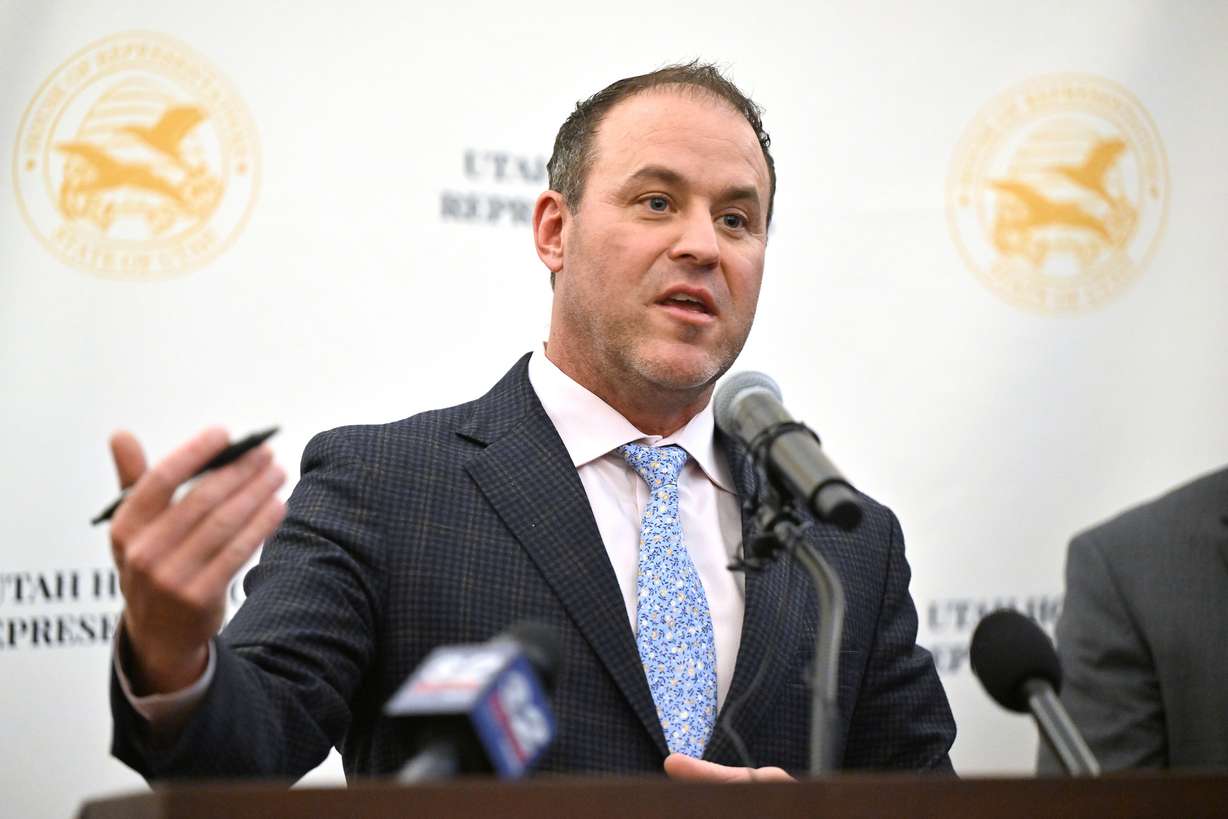
SALT LAKE CITY — With less than a week before the start of the 2024 legislative session, top Utah House Republicans met with reporters Wednesday to highlight their key priorities, which include changes to diversity, equity and inclusion programs in higher education, bolstering affordable housing and potentially cutting income taxes yet again.
The press conference was light on specific policy proposals, and instead focused on what House Speaker Mike Schultz, R-Hooper, described as "high-level" goals — many of which mirrored similar points of emphasis for Senate Republicans.
Schultz said he sees the Utah House of Representatives as the most reactionary branch of government, but he doesn't want his caucus to lost sight of long-term goals and growth for the state.
"We're at a pivotal time in the state's history," he said. "As we transition from a small state to a medium state, the decisions that we make today will have generational impacts."
Housing affordability is one of those issues that will reverberate across future generations, and Schultz said he's committed to working on policies to ensure that younger generations have the opportunity to become homeowners. Although many cities have zoning laws that limit the supply of more affordable housing, the speaker said state policy should encourage collaboration with local leaders to solve the problem.
"I think it's best; let's work to create opportunities and incentives to work with the cities," Schultz said, when asked what lawmakers can do if city officials are unwilling to change restrictive zoning.
In his annual budget proposal, Gov. Spencer Cox outlined a $150 million proposal to build 35,000 new starter homes by 2028.
When it comes to tax cuts, the Legislature's Executive Appropriations Committee last month set aside $160 million for a potential income tax cut this year, after lawmakers approved more than $400 million in cuts in 2023. Voters will also have the opportunity this year to vote on a proposed constitutional amendment that would end the state sales tax on groceries.
A $160 million tax cut is still far from certain — lawmakers will use revenue estimates provided later on in the session to determine how much is feasible — but Schultz said he thinks it's a "realistic number." He said lawmakers are still looking at places where they can "take a scalpel to the budget," which needs to be approved by both the House and Senate before the session adjourns.
Schultz said $160 million may not be a huge decrease in the tax burden for families in Utah each month, but he said combined with cuts from previous years it adds up to about a 10% cut.
"These things add up to our constituents," he said.
Utah's first-in-the-nation social media regulations were among the key accomplishments for the Republican-led Legislature and Cox last year, and Schultz said lawmakers will see a bill "likely coming forward fairly quick" to adjust the regulations before they are to go into effect in March. The speaker said he is unaware of the specifics, but it has been long expected that lawmakers will continue to hammer out the details of the regulations ahead of their effective date.
Utah has joined with several other states in suing major tech platforms over the alleged harms social media use can have on teenagers, and a tech industry group sued the state last month in an attempt to block the social media regulations from going into effect.
With many lawmakers seeking reelection or higher office in 2024, the upcoming legislative session is also expected to include discussions on hot-button social issues such as abortion and gender, among other things.
The 2024 general legislative session begins Tuesday and runs through March 1.