'%3e%3cpath%20d='M34.1406%205.85938C30.3906%202.10547%2025.3047%200%2020%200C14.6953%200%209.60938%202.10547%205.85938%205.85938C2.10938%209.61328%200%2014.6953%200%2020C0%2025.3047%202.10547%2030.3906%205.85938%2034.1406C9.61328%2037.8906%2014.6953%2040%2020%2040C25.3047%2040%2030.3906%2037.8945%2034.1406%2034.1406C37.8906%2030.3906%2040%2025.3047%2040%2020C40%2014.6953%2037.8945%209.60938%2034.1406%205.85938ZM37.0117%2023.543H31.1602V13.5391H27.6328V19.9414C28.1211%2020.6914%2028.3711%2021.582%2028.3711%2022.5625V22.625C28.3711%2023.668%2028.1172%2024.6055%2027.6328%2025.4297V26.6094H36.082C33.4883%2032.9375%2027.2891%2037.3789%2020.0039%2037.3789C10.3711%2037.3789%202.62109%2029.6289%202.62109%2020C2.62109%2010.3711%2010.3711%202.62109%2020%202.62109C29.6289%202.62109%2037.3789%2010.3711%2037.3789%2020C37.3789%2021.1484%2037.2617%2022.2656%2037.0508%2023.3477C37.0391%2023.4141%2037.0234%2023.4766%2037.0117%2023.543Z'%20fill='white'/%3e%3cpath%20d='M22.3086%2018.5352C20.4336%2018.125%2019.9531%2017.8398%2019.9766%2017.1836V17.1406C19.9766%2016.6992%2020.3477%2016.2148%2021.4023%2016.2148C22.582%2016.2148%2023.8867%2016.6797%2025.0781%2017.4766L26.8516%2015.0195C25.4453%2013.8906%2023.707%2013.3398%2021.5547%2013.3398C18.5195%2013.3398%2016.4375%2015%2016.4063%2017.4766V17.5352C16.3633%2020.2617%2018.5859%2020.9805%2021.293%2021.6016C23.0391%2021.9766%2023.5703%2022.3164%2023.5703%2022.9609L23.5469%2022.9766C23.5469%2023.3906%2023.2578%2023.7031%2022.7852%2023.8359C22.5742%2023.9062%2022.1289%2023.9727%2021.5156%2023.9727C20.7617%2023.9727%2019.7539%2023.8633%2018.6328%2023.4844C18.0898%2023.2891%2017.4727%2023.0039%2016.8047%2022.6133L20.1406%2026.625C20.2813%2026.6602%2021.0977%2026.8516%2021.7734%2026.8516C25.0039%2026.8516%2027.0859%2025.2461%2027.1094%2022.6328V22.5703C27.1602%2020.1133%2025.2148%2019.1719%2022.3086%2018.5352Z'%20fill='white'/%3e%3cpath%20d='M5.24219%2013.5664V26.6133H8.75391V23.7578L10.2969%2021.9531L14.2031%2026.6133H18.3867L12.3555%2019.5195L17.4023%2013.5664H13.4531L8.75391%2019.0586V13.5664H5.24219Z'%20fill='white'/%3e%3c/g%3e%3cdefs%3e%3cclipPath%20id='clip0_97_2430'%3e%3crect%20width='40'%20height='40'%20fill='white'/%3e%3c/clipPath%3e%3c/defs%3e%3c/svg%3e)


Estimated read time: 8-9 minutes
This archived news story is available only for your personal, non-commercial use. Information in the story may be outdated or superseded by additional information. Reading or replaying the story in its archived form does not constitute a republication of the story.
SOUTH SALT LAKE — Two South Salt Lake police officers have been determined to be legally justified in shooting and killing a man armed with a rifle who fired at the officers.
Salt Lake County District Attorney Sim Gill announced Friday that Sgt. Clayton Anderson and officer Zayne Ruth were justified when they shot 44-year-old Jebb Muir.
But while praising the work of officers — particularly the actions of Anderson — Gill also shared frustrations expressed by Muir's family who knew their loved one was struggling with his mental health, but they couldn't find help for him, and now it's too late.
"Their frustration was that for families like themselves, trying to access mental health services and getting mental health support for their loved ones was a frustrating task for them," Gill said during a press conference Friday. "They struggled as a family trying to find meaningful mental health services for their son and they wanted to share that frustration and they wanted to implore that we have more services for families like them."
The fatal incident began to unfold on Sept. 26 about 6:50 p.m. when South Salt Lake police were called to assist with a civil situation. Muir's wife wanted to gather her belongings from their residence but was concerned that Muir was "in psychosis" and angry, and she wanted officers standing by in case something happened, according to Gill's final report on the police shooting.
"Jebb was suffering with psychosis, suicidal ideation, and had previously barricaded himself in a house and prepared firearms during an encounter with police," a statement released in December by the South Salt Lake Civilian Review Board states. "At that time of the standby, police did not observe significant signs of mental illness or violence."
Muir's wife was able to collect what she needed without incident. Several hours later, however, about 11:10 p.m., Muir called 911 saying he had accidentally shot his gun and feared a round may have gone into his neighbor's house, the district attorney report states.
But Muir did not fully cooperate with dispatchers. He claimed he was unarmed and at a neighbor's house, but would not give his location. As the call continued, Muir said that "if SWAT was sent, he would kill them, and at another point threatened that if police tried to fight him, they would regret it," according to the report.
Muir's neighbors called 911 about the same time, saying he was on their porch and was "banging on the door and ringing the doorbell," the report states.
Officers responded to the area and set up surveillance on Muir's residence. They called him on his phone and tried to convince him to come outside.
"It's not important where I'm at," Muir told the officer who called him. "It doesn't matter where I'm at, just know I'm unarmed and that I will reveal myself when you guys come."
A few minutes later, police saw a man run across the street who they assumed was Muir.
About 11:40 p.m., while police were still watching Muir's residence and discussing their next move, a neighbor called 911 and reported that there "was a man in his driveway with a rifle who just asked him if he wanted to die," the report states. That man was determined to be Muir.
Anderson then saw a man he believed was Muir riding off on a bicycle and holding a rifle. Anderson told Ruth to get in his patrol car with him, handed Ruth his rifle, and the two drove toward the the man, the report states.
In a written statement, Anderson said they spotted Muir about two blocks away. The officers turned the patrol car spotlight on him. In body camera videos released Friday, as soon as the officers step out of their patrol car, shots are fired.
"The exchange of gunfire is almost immediate at that point," Gill said.
In his written statement, Anderson said as soon as they arrived at the scene, "an exchange of gunfire erupted and I felt myself get struck in the side of the head with a projectile. I knew immediately that I was in grave danger."
The sergeant said he dropped to the ground and fired one round at Muir from under his car door.
"I feared greatly that he had transitioned to a prone position to better engage and kill us. After I fired my round, I assessed the threat. There was no response from him, so I assumed it was effective," he said, according to the statement.
Gill gave high praise to the way Anderson handled the situation. He noted that Anderson intentionally stopped his patrol car some distance away from Muir because he knew of the reports of him having weapons. In the bodycam videos, Gill also noted that despite immediately being fired upon, Anderson kept his composure and was able to give commands to his officers about taking cover and approaching Muir in a safe manner.
"What really struck out was the excellent way that Sgt. Anderson took incident command here. And you'll notice there's not a lot of noise and not a lot of other people yelling, but there is a single person who is taking incident command ... both from a safety perspective as well as giving directions to the others officers, that was really critical here," Gill said.
After Muir was down, Anderson drove his patrol car slowly toward him while other officers walked behind it as cover. When they reached Muir, his rifle was kicked away form his body. Officers then pulled a large knife from his waistband before attending to him.
The investigation into the shooting showed that Anderson fired once, Ruth fired 12 rounds from the rifle and Muir fired three rounds from a shotgun. An autopsy determined that Muir had been shot four times. The report also notes that his blood-alcohol content at the time was 0.129%.
Anderson was taken to a local hospital to be treated for a minor injury, which in photos shown Friday appeared to be a shotgun pellet that had hit his head.
In December, South Salt Lake's Civilian Review Board determined the officers' actions "reasonable" and noted that the department's own internal affairs investigation concurred with the board's findings and that Chief Jack Carruth had already recommended both officers be allowed to return to full duty.
Before Friday's press conference, Gill said he had a chance to speak with Muir's parents and widow.
"They wanted to say that's not who their son was," Gill said. "That this was his mental illness and the psychosis that he struggled with."
They could see that he was struggling, and their frustration was that there are not sufficient community-based resources that are available to families like theirs. And that is a sad, tragic commentary.
–Salt Lake County District Attorney Sim Gill
Gill said the family understands why police used deadly force and have no animosity toward the officers. However, they also want to encourage law enforcement to continue giving officers the best training on how to deal with suspects who have a mental illness, and want to publicly express their frustrations on the lack of services available for people struggling with mental health.
"There are far too many families like them in our community who have loved ones who can benefit from having the access to mental health services and they did not get that available to them," Gill said.
He called mental health crisis and guns a "toxic mix."
"But as family members that recognize that and struggle for resources, they have very few options that are available to them," he said.
There have been several recent confrontations involving police and a person allegedly having a mental health crisis.
- On March 17, Alex Stewart Boren, 34, was shot by Taylorsville police after officers said he advanced on them with a knife. Boren survived. Friends and family members say Boren served in the U.S. Marine Corps and was shot during the Iraq War and was having "an acute post-traumatic stress disorder episode" during the confrontation with police.
- On March 19, Mathew Scott Nielsen, 46, "ambushed" officers responding to what appeared to be a traffic accident, shooting at least one in the leg before being shot and killed by officers. Friends say Nielsen had been experiencing mental health issues in recent years.
- On March 26, a Sandy police officer shot and killed 33-year-old Dylan William Murphy after Murphy continuously rushed at the officer and kept his hands covered. Police were originally called to the area to help look for Murphy who was "reported to be suffering a mental health episode and possibly suicidal."
Like other families in the community, Gill said Muir's family knew he was battling mental illness.
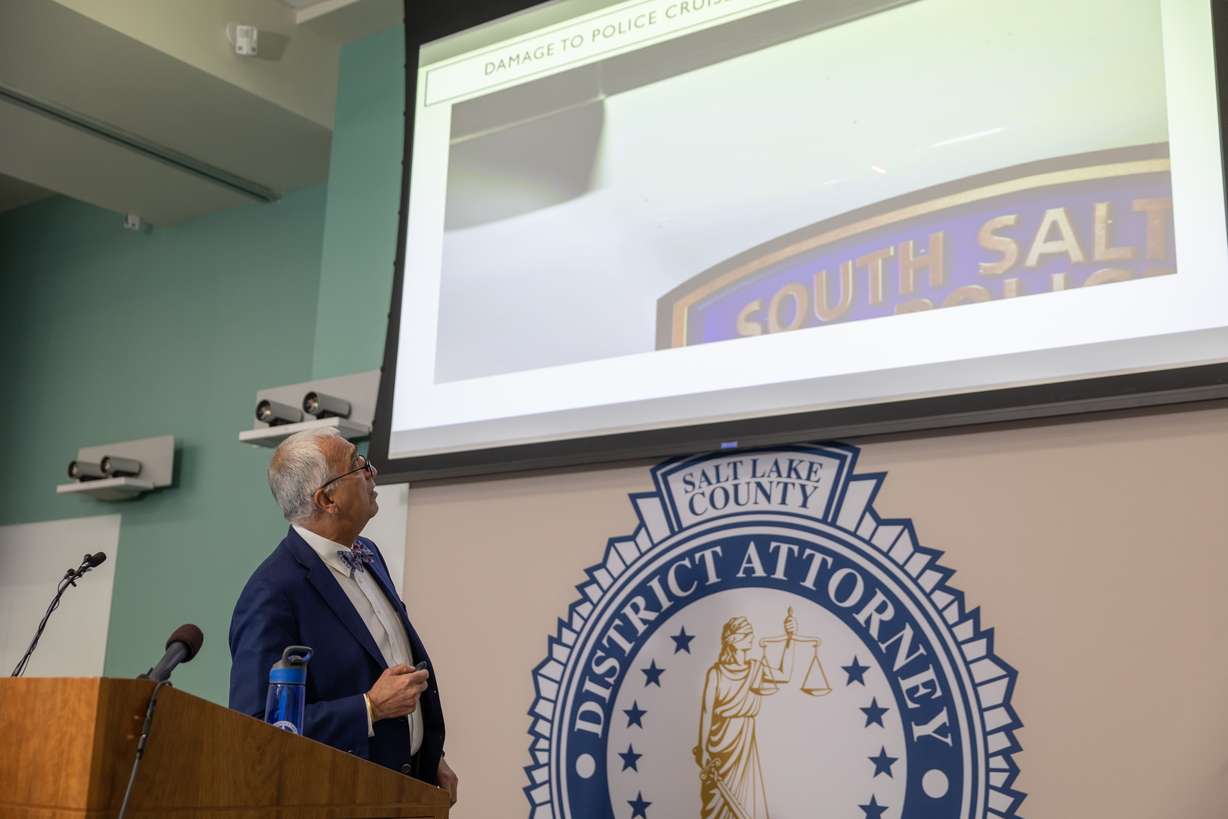
"They could see that he was struggling, and their frustration was that there are not sufficient community-based resources that are available to families like theirs. And that is a sad, tragic commentary," said Gill. "It is a tragedy for all of us. I don't like these kind of scenarios. It's not a win for anyone,"
Gil said police officers have the right to defend themselves using deadly force, but it also needs to be recognized that mental health services are not being properly funded.
"Many times, these (police confrontations) are avoidable if we can make those interventions early on," he said.
Carruth also called the Muir confrontation a "tragic situation" and says his officers want to avoid outcomes like that. He also agrees that more mental health resources are needed so it doesn't reach that point.
"I think District Attorney Sim Gill nailed it right on the head. There needs to be some better resources on the front end to avoid these types of situations, especially when there's a history of mental illness," he said. "How do we elemininate, take those elements, remove those ingredients for this type of disaster in an early stage and get them into the proper mental health care that they need prior to law enforcement response?"