'%3e%3cpath%20d='M34.1406%205.85938C30.3906%202.10547%2025.3047%200%2020%200C14.6953%200%209.60938%202.10547%205.85938%205.85938C2.10938%209.61328%200%2014.6953%200%2020C0%2025.3047%202.10547%2030.3906%205.85938%2034.1406C9.61328%2037.8906%2014.6953%2040%2020%2040C25.3047%2040%2030.3906%2037.8945%2034.1406%2034.1406C37.8906%2030.3906%2040%2025.3047%2040%2020C40%2014.6953%2037.8945%209.60938%2034.1406%205.85938ZM37.0117%2023.543H31.1602V13.5391H27.6328V19.9414C28.1211%2020.6914%2028.3711%2021.582%2028.3711%2022.5625V22.625C28.3711%2023.668%2028.1172%2024.6055%2027.6328%2025.4297V26.6094H36.082C33.4883%2032.9375%2027.2891%2037.3789%2020.0039%2037.3789C10.3711%2037.3789%202.62109%2029.6289%202.62109%2020C2.62109%2010.3711%2010.3711%202.62109%2020%202.62109C29.6289%202.62109%2037.3789%2010.3711%2037.3789%2020C37.3789%2021.1484%2037.2617%2022.2656%2037.0508%2023.3477C37.0391%2023.4141%2037.0234%2023.4766%2037.0117%2023.543Z'%20fill='white'/%3e%3cpath%20d='M22.3086%2018.5352C20.4336%2018.125%2019.9531%2017.8398%2019.9766%2017.1836V17.1406C19.9766%2016.6992%2020.3477%2016.2148%2021.4023%2016.2148C22.582%2016.2148%2023.8867%2016.6797%2025.0781%2017.4766L26.8516%2015.0195C25.4453%2013.8906%2023.707%2013.3398%2021.5547%2013.3398C18.5195%2013.3398%2016.4375%2015%2016.4063%2017.4766V17.5352C16.3633%2020.2617%2018.5859%2020.9805%2021.293%2021.6016C23.0391%2021.9766%2023.5703%2022.3164%2023.5703%2022.9609L23.5469%2022.9766C23.5469%2023.3906%2023.2578%2023.7031%2022.7852%2023.8359C22.5742%2023.9062%2022.1289%2023.9727%2021.5156%2023.9727C20.7617%2023.9727%2019.7539%2023.8633%2018.6328%2023.4844C18.0898%2023.2891%2017.4727%2023.0039%2016.8047%2022.6133L20.1406%2026.625C20.2813%2026.6602%2021.0977%2026.8516%2021.7734%2026.8516C25.0039%2026.8516%2027.0859%2025.2461%2027.1094%2022.6328V22.5703C27.1602%2020.1133%2025.2148%2019.1719%2022.3086%2018.5352Z'%20fill='white'/%3e%3cpath%20d='M5.24219%2013.5664V26.6133H8.75391V23.7578L10.2969%2021.9531L14.2031%2026.6133H18.3867L12.3555%2019.5195L17.4023%2013.5664H13.4531L8.75391%2019.0586V13.5664H5.24219Z'%20fill='white'/%3e%3c/g%3e%3cdefs%3e%3cclipPath%20id='clip0_97_2430'%3e%3crect%20width='40'%20height='40'%20fill='white'/%3e%3c/clipPath%3e%3c/defs%3e%3c/svg%3e)


Estimated read time: 3-4 minutes
This archived news story is available only for your personal, non-commercial use. Information in the story may be outdated or superseded by additional information. Reading or replaying the story in its archived form does not constitute a republication of the story.
SALT LAKE CITY — People have reported seeing the northern lights, or aurora borealis, in Utah in recent days.
Patrick Wiggins, a NASA local ambassador from Tooele, said the northern lights seen around here are not exactly rare, but very unusual. He said he even had reports of sightings in northern Arizona.
He explains the sun flare that causes the phenomena as a "burp" from the sun.
"Basically the sun burps, and this time it burped really well and that was able to push it further south," he said. "What happens to cause this in the first place, not just here on Earth, we've seen it on other planets as well, you get this stuff coming from the sun and when it interacts with our upper atmosphere — depending on what gas is activated — you get these different colors."
Earlier in March, there were reports of sightings in Colorado, and pilots turned planes over New York for passengers to see the lights from the air. It's happened again in recent days.
"The last time we had a really good burp visible from Utah was around the year 2000," Wiggins said.
We don't want the burps to be too powerful though. He referenced an event in the fall of 1859, remembered as "the Carrington event," one of the biggest ones that have ever been recorded in human history, he said.
"It literally shorted out telegraph wires; people were electrocuted because of all the electricity that was in the air from this thing," he said.
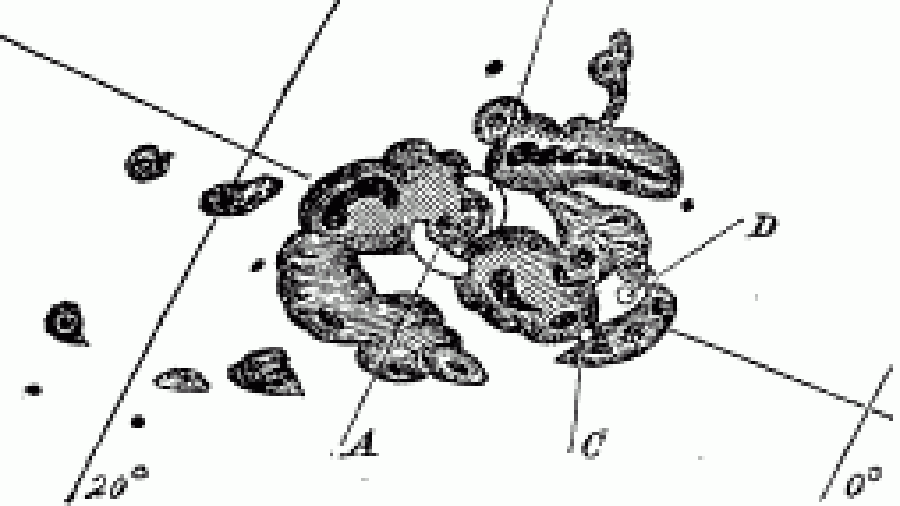
It was a sunny Sept. 1, 1859, when Richard Carrington was looking through his telescope like he usually did.
As he looked through his telescope, according to NASA, he saw "two brilliant beads of blinding white light appeared over the sunspots, intensified rapidly." He realized he was witnessing a historical event, and went to grab a second witness.
When they returned within less than a minute, Carrington wrote, "I was mortified to find that it was already much change enfeebled." The witnesses saw the white spots minimize to mere pinpoints before they disappeared before five minutes passed.
It was later determined that what they saw was a "white-light solar flare, a magnetic explosion on the sun."
Early the next morning before the sun broke dawn, skies all over the world were illuminated in colors — red, green, purple — auroras so brilliant that "newspapers could be read as easily as in daylight," according to NASA.
Auroras were pulsating everywhere, near tropical latitudes over Cuba, the Bahamas, Jamaica, all across the globe.
It was a shock to the world, literally. That's when telegraph systems worldwide went down and spark discharges shocked telegraph operators, setting telegraph paper on fire. Even after disconnecting from power, NASA solar physicist David Hathaway said "aurora-induced electric currents in the wires still allowed messages to be transmitted."
That's why Wiggins said we don't want those "burps" to be too powerful.
"If that was to happen today, a lot of our satellites would be wiped. They're pretty, we like to see them, but please not too strong," he chuckled.
It's not certain when or if the lights will illuminate Utah skies again, but the Space Weather Prediction Center offers an aurora forecast on its website.
To see the lights, the Space Weather Prediction Center says you should have a clear view of the northern horizon in the dark, with the best hours for viewing being within a couple hours of midnight. The website states that the best viewing times are near the spring and fall equinox, so now may just be the chance for Utahns to view the glimmering skies.