Estimated read time: 4-5 minutes
This archived news story is available only for your personal, non-commercial use. Information in the story may be outdated or superseded by additional information. Reading or replaying the story in its archived form does not constitute a republication of the story.
SALT LAKE CITY — Native Americans in Utah have a disproportionally high cigarette usage rate compared to the general population, reflecting a nationwide phenomenon.
In Utah, 17% of Native American adults reported smoking in 2021 — more than double the state average of 7%, according to the Utah Department of Health.
Experts say the disparity trails back, in large part, to Big Tobacco's history of targeted marketing to tribal communities and cultural appropriation of their spiritual and medicinal practices. Different from commercial tobacco — which includes harmful added chemicals linked to death, cancer and other diseases — traditional tobacco has been a part of many Native American cultures for thousands of years. Traditional tobacco, which is sometimes used in mixtures with other native plants, has no added chemicals.
"Traditional tobacco is a medicine, which is really to promote physical, spiritual and ceremonial well-being. It's more of an offering toward the creator or giving thanks to those blessings that are received or to be passed on to loved ones," said Penelope Pinnecoose with the Urban Indian Center of Salt Lake. "Every tribe is different when it comes to the beliefs within tobacco use, and sometimes tobacco isn't used."
Media depictions of Native Americans smoking tobacco out of a pipe are a stereotype, she added. In fact, many tribes' traditions around tobacco don't actually involve smoking. The plant can be used instead as a prayer offering, sprinkled on the bed of an ill person for healing, and burned in a bowl before growing food among other uses, according to the Centers for Disease Control and Prevention.
Aubri Devashrayee, with the state Health Department's Tobacco Prevention and Control Program, said commercial tobacco profits off of marginalized communities.
"Not only are they experiencing historical trauma and generational trauma, but there are big companies that make a lot of money off of their dependencies," Devashrayee said. "What you typically think of as tobacco products — like cigarettes, e-cigarettes, vapes and cigars that come from retailers — those are the types of tobacco that we're wanting to limit as opposed to tobacco that is grown and sourced from Native communities themselves."
Historical health disparities among Native communities also play a role in the disproportionally high cigarette usage, said Pinnecoose, who is Ute (Uncompahgre), Eastern Shoshone and Northern Arapaho.
"A lot of times, when it comes to historical trauma, a lot of these individuals may have experienced disparities within their families, poverty, but also going even social acceptance," she said. "A lot of these health disparities behind tobacco use — it could be more than just utilizing it just to fit in with your friends. It has a lot to do with the individual health of the person."
According to an Urban Indian Center of Salt Lake report, Native Americans around Salt Lake City are more likely to experience poverty, poor housing and unemployment — factors that have been identified as enablers for smoking tobacco.
Native Americans also have a higher risk of developing tobacco-related diseases and death. According to the CDC:
- Cardiovascular disease is the leading cause of death among Native Americans.
- Lung cancer is the leading cause of cancer deaths among Native Americans.
- Diabetes is the fourth-leading cause of death among Native Americans (the risk of developing diabetes is 30-40% higher for smokers than nonsmokers).
Finding solutions
The Tobacco Prevention and Control Program is currently partnering with the Urban Indian Center of Salt Lake, which in turn partners with tribal governments, to make sure information about smoking is packaged in a culturally relevant way.
"We try to work together to find new ways that are actually effective and not just ideas that come up from the government and are imposed because that has historically been a thing, and that's not great," Devashrayee said, adding that the two organizations are working toward translating more of their outreach materials into Indigenous languages.
Their efforts also include classes, presentations, pamphlets and, soon, a billboard in Salt Lake City. Pinnecoose said the Urban Indian Center is also able to provide opportunities for youth and elders to use traditional tobacco or a ceremonial smudge before each of its classes.
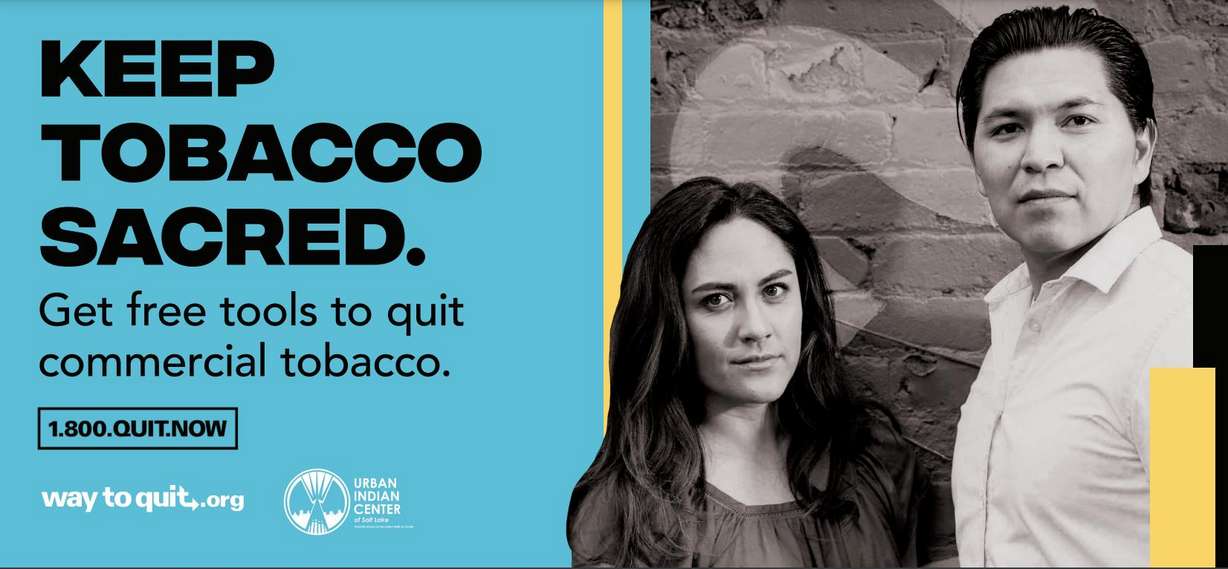
The two organizations have been involved in a national campaign called "Keep Tobacco Sacred." The campaign highlights the traditional uses of tobacco, the predatory nature of Big Tobacco and the dangers of commercial tobacco.
Pinnecoose added that Utah tribal governments have also been working to address tobacco use, including not selling tobacco products at community events, creating smoke-free zones at tribal buildings and conducting more informational outreach.
"I feel like tribal councils have also provided that opportunity to make positive change with commercial tobacco use within their own communities," Pinnecoose said.
Overall, Pinnecoose said the efforts are making headway.
"We're providing that opportunity for the American Indian/Alaskan Native community to connect with us in a way where it's OK to ask us questions," she said. "Also I've had individuals who have concerns about their aunt or uncle, and so having this resource for them, it really provides that opportunity to not just reach that individual but it reaches their family."
Resources to quit smoking
If you or someone you know is struggling to quit smoking, the following resources are available:
- Utah Tobacco Quit Line: 1-800-QUIT-NOW
- Way to Quit
- Utah Tobacco Prevention and Control Program (801-538-6754)
- Urban Indian Center of Salt Lake (801-486-4877)
- Way to Quit
- Smokefree.gov

Most recent Multicultural Utah stories
Related topics
 Sydnee Chapman Gonzalez