'%3e%3cpath%20d='M34.1406%205.85938C30.3906%202.10547%2025.3047%200%2020%200C14.6953%200%209.60938%202.10547%205.85938%205.85938C2.10938%209.61328%200%2014.6953%200%2020C0%2025.3047%202.10547%2030.3906%205.85938%2034.1406C9.61328%2037.8906%2014.6953%2040%2020%2040C25.3047%2040%2030.3906%2037.8945%2034.1406%2034.1406C37.8906%2030.3906%2040%2025.3047%2040%2020C40%2014.6953%2037.8945%209.60938%2034.1406%205.85938ZM37.0117%2023.543H31.1602V13.5391H27.6328V19.9414C28.1211%2020.6914%2028.3711%2021.582%2028.3711%2022.5625V22.625C28.3711%2023.668%2028.1172%2024.6055%2027.6328%2025.4297V26.6094H36.082C33.4883%2032.9375%2027.2891%2037.3789%2020.0039%2037.3789C10.3711%2037.3789%202.62109%2029.6289%202.62109%2020C2.62109%2010.3711%2010.3711%202.62109%2020%202.62109C29.6289%202.62109%2037.3789%2010.3711%2037.3789%2020C37.3789%2021.1484%2037.2617%2022.2656%2037.0508%2023.3477C37.0391%2023.4141%2037.0234%2023.4766%2037.0117%2023.543Z'%20fill='white'/%3e%3cpath%20d='M22.3086%2018.5352C20.4336%2018.125%2019.9531%2017.8398%2019.9766%2017.1836V17.1406C19.9766%2016.6992%2020.3477%2016.2148%2021.4023%2016.2148C22.582%2016.2148%2023.8867%2016.6797%2025.0781%2017.4766L26.8516%2015.0195C25.4453%2013.8906%2023.707%2013.3398%2021.5547%2013.3398C18.5195%2013.3398%2016.4375%2015%2016.4063%2017.4766V17.5352C16.3633%2020.2617%2018.5859%2020.9805%2021.293%2021.6016C23.0391%2021.9766%2023.5703%2022.3164%2023.5703%2022.9609L23.5469%2022.9766C23.5469%2023.3906%2023.2578%2023.7031%2022.7852%2023.8359C22.5742%2023.9062%2022.1289%2023.9727%2021.5156%2023.9727C20.7617%2023.9727%2019.7539%2023.8633%2018.6328%2023.4844C18.0898%2023.2891%2017.4727%2023.0039%2016.8047%2022.6133L20.1406%2026.625C20.2813%2026.6602%2021.0977%2026.8516%2021.7734%2026.8516C25.0039%2026.8516%2027.0859%2025.2461%2027.1094%2022.6328V22.5703C27.1602%2020.1133%2025.2148%2019.1719%2022.3086%2018.5352Z'%20fill='white'/%3e%3cpath%20d='M5.24219%2013.5664V26.6133H8.75391V23.7578L10.2969%2021.9531L14.2031%2026.6133H18.3867L12.3555%2019.5195L17.4023%2013.5664H13.4531L8.75391%2019.0586V13.5664H5.24219Z'%20fill='white'/%3e%3c/g%3e%3cdefs%3e%3cclipPath%20id='clip0_97_2430'%3e%3crect%20width='40'%20height='40'%20fill='white'/%3e%3c/clipPath%3e%3c/defs%3e%3c/svg%3e)




Estimated read time: 4-5 minutes
This archived news story is available only for your personal, non-commercial use. Information in the story may be outdated or superseded by additional information. Reading or replaying the story in its archived form does not constitute a republication of the story.
SALT LAKE CITY — The majority of Utah's degree-granting public higher education institutions — six of the eight — fall below peer and national averages when it comes to graduation rates, according to findings of a recent audit.
"Utah seems to fall far below many other states," said audit supervisor Jesse Martinson.
The legislative audit, assessing the efficiency and effectiveness of the Utah System of Higher Education, found "several occurrences of insufficient board governance" within the Utah Board of Higher Education.
"The Legislature has made it clear in code how they would like the board to govern the system of higher education," Martinson said. "They've also prioritized the system of higher education to the tune of $1.3 billion dollars ... So, clearly, higher education is highly prioritized by the Legislature."
Board members said they've been working on turning the tide.
"Utah taxpayers and Utah students deserve a system that works and those completion numbers are not working and we know that and we have initiatives underway to change it," said Board of Higher Education chairwoman Lisa Church.
The audit identified three specific areas of improvement that the board can work on, including tuition approval, presidential evaluations and operational efficiency monitoring.
As far as tuition approval, Martinson said that the board looked at this issue in a 2018 audit, where it found that the board didn't have "a lot of discussion (and) didn't really have independent, objective information to make a determination whether or not tuition needed to be increased."
"Unfortunately, we haven't found a lot of improvement," Martinson said.
The audit also pointed to problems with presidential evaluations at degree-seeking institutions.
When looking at annual presidential evaluations from 2016 to 2022, the audit found that only nine evaluations had been completed "when there should have been at least 40 of them," Martinson said.
He added that the Office of the Commissioner of Higher Education could better support the board with its "mounds" of data that is being underutilized, pointing out that most of the board is a volunteer board, made up of people who are "being asked to make very big decisions on a very large system with the limited time that they have."
The audit also asked the Legislature to affirm its governance desires for the board.
Institutions are spending lots of money, not being held accountable, they weren't able to determine if they were being efficient with the funds they were using.
–Jesse Martinson, audit supervisor
When looking at where the board currently stands on the spectrum of governance, Martinson said it's not where it needs to be.
"Instead of being a consolidating board, they're closer to a coordinating board," Martinson said. "Institutions are spending lots of money, not being held accountable, they weren't able to determine if they were being efficient with the funds they were using."
A coordinating board, according to the audit, is when a single coordinating board and/or agency is responsible for key aspects of the state's role with public postsecondary institutions and in some cases, independent colleges.
Conversely, the audit says that a consolidating board — what the auditors are urging the board to be — is a statewide governing board that manages and oversees most functions of the public higher education system and typically has broad authority over institutions.
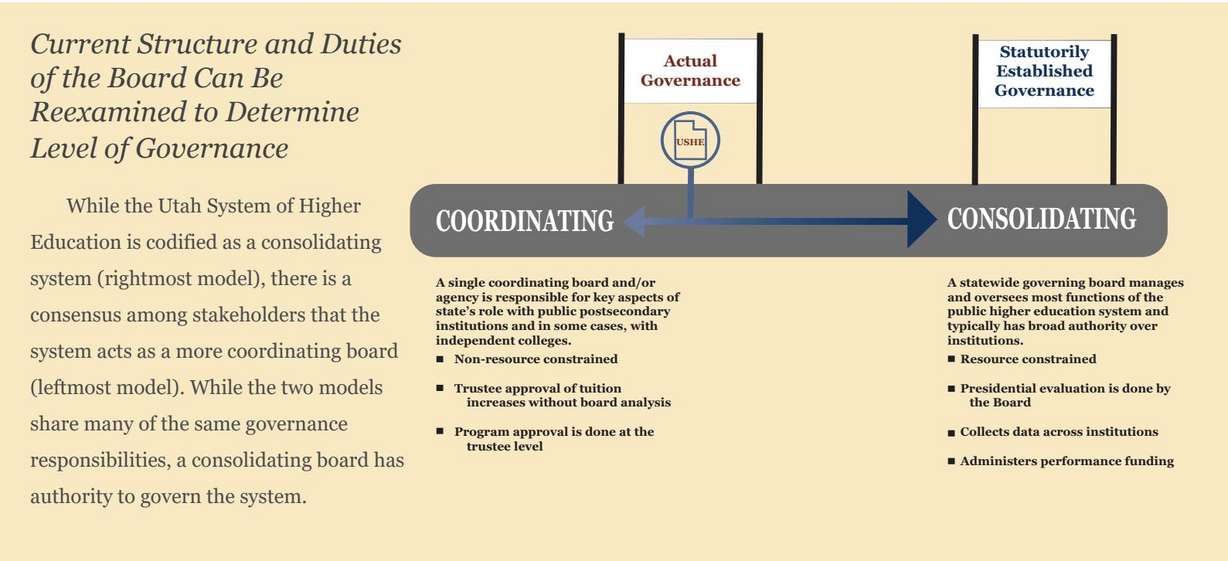
The audit also found that institutions are delegating the approval of tuition increases — along with program approval — to their respective boards of trustees.
"We found a wide chasm between where they need to be and where they are," Martinson said, noting that through the recommendations of the audit, the board can become the consolidating board that Utah code wants it to be.
The last part of the audit found that Utah's board is far larger than boards of similar structure in states of similar size.
Utah's board currently has 18 members, while other states that the audit compared Utah to have between eight and 13 members.
"We felt that something that they could do to be more nimble and more proactive and be able to have more timely responses is to perhaps look to reduce the size of the board," Martinson said.
"I don't know any organization that can have an 18-member board and be effective, so, probably have to look at that," said Utah House Speaker Brad Wilson.
While responding to the audit and its recommendations, Church said that she believes the state has the right board to implement the changes the audit suggested.
"We have the tools to do it, but whether or not we've actually gotten up and done it is the question and we welcome the discussion," Church said.