'%3e%3cpath%20d='M34.1406%205.85938C30.3906%202.10547%2025.3047%200%2020%200C14.6953%200%209.60938%202.10547%205.85938%205.85938C2.10938%209.61328%200%2014.6953%200%2020C0%2025.3047%202.10547%2030.3906%205.85938%2034.1406C9.61328%2037.8906%2014.6953%2040%2020%2040C25.3047%2040%2030.3906%2037.8945%2034.1406%2034.1406C37.8906%2030.3906%2040%2025.3047%2040%2020C40%2014.6953%2037.8945%209.60938%2034.1406%205.85938ZM37.0117%2023.543H31.1602V13.5391H27.6328V19.9414C28.1211%2020.6914%2028.3711%2021.582%2028.3711%2022.5625V22.625C28.3711%2023.668%2028.1172%2024.6055%2027.6328%2025.4297V26.6094H36.082C33.4883%2032.9375%2027.2891%2037.3789%2020.0039%2037.3789C10.3711%2037.3789%202.62109%2029.6289%202.62109%2020C2.62109%2010.3711%2010.3711%202.62109%2020%202.62109C29.6289%202.62109%2037.3789%2010.3711%2037.3789%2020C37.3789%2021.1484%2037.2617%2022.2656%2037.0508%2023.3477C37.0391%2023.4141%2037.0234%2023.4766%2037.0117%2023.543Z'%20fill='white'/%3e%3cpath%20d='M22.3086%2018.5352C20.4336%2018.125%2019.9531%2017.8398%2019.9766%2017.1836V17.1406C19.9766%2016.6992%2020.3477%2016.2148%2021.4023%2016.2148C22.582%2016.2148%2023.8867%2016.6797%2025.0781%2017.4766L26.8516%2015.0195C25.4453%2013.8906%2023.707%2013.3398%2021.5547%2013.3398C18.5195%2013.3398%2016.4375%2015%2016.4063%2017.4766V17.5352C16.3633%2020.2617%2018.5859%2020.9805%2021.293%2021.6016C23.0391%2021.9766%2023.5703%2022.3164%2023.5703%2022.9609L23.5469%2022.9766C23.5469%2023.3906%2023.2578%2023.7031%2022.7852%2023.8359C22.5742%2023.9062%2022.1289%2023.9727%2021.5156%2023.9727C20.7617%2023.9727%2019.7539%2023.8633%2018.6328%2023.4844C18.0898%2023.2891%2017.4727%2023.0039%2016.8047%2022.6133L20.1406%2026.625C20.2813%2026.6602%2021.0977%2026.8516%2021.7734%2026.8516C25.0039%2026.8516%2027.0859%2025.2461%2027.1094%2022.6328V22.5703C27.1602%2020.1133%2025.2148%2019.1719%2022.3086%2018.5352Z'%20fill='white'/%3e%3cpath%20d='M5.24219%2013.5664V26.6133H8.75391V23.7578L10.2969%2021.9531L14.2031%2026.6133H18.3867L12.3555%2019.5195L17.4023%2013.5664H13.4531L8.75391%2019.0586V13.5664H5.24219Z'%20fill='white'/%3e%3c/g%3e%3cdefs%3e%3cclipPath%20id='clip0_97_2430'%3e%3crect%20width='40'%20height='40'%20fill='white'/%3e%3c/clipPath%3e%3c/defs%3e%3c/svg%3e)


- Utah lags in women's political representation, with gaps in influential positions persisting.
- U.S. Rep. Celeste Maloy is Utah's only woman in Congress; no female senators have been elected from Utah.
- Women hold 32.7% of Utah's legislative seats, slightly below the national average of 33.6%.
SALT LAKE CITY — From municipal and state-level to national positions, Utah lags behind other states in women's political representation, according to data from a women's advocacy group at Utah State University.
The study, published by the Utah Women and Leadership Project, explores national and state trends in women's political representation and updates data across leadership areas from the heights of Congress to state and municipal government and even boards of education.
Progress has occurred in these areas in recent years, but gaps remain — particularly in positions with the greatest influence and decision-making power, according to Susan Madsen, Utah Women and Leadership Project founding director and co-author of the report.
"As the 2026 legislative session unfolds, understanding where women are represented in Utah government is more important than ever," Madsen said in a statement.
Here's a look at what the study showed.
Women in national and state politics
U.S. Rep. Celeste Maloy is currently the only woman representing Utah in Congress.
While 44 states now have at least one woman in Congress, Utah has never elected a woman to the Senate and historically has elected only five women to the House.
The study also showed that in 2026, women hold 96 statewide executive offices nationally (31.3%), including 14 governors and 2 territorial governors, with 21 states having female lieutenant governors and 12 states having female attorneys general.
Utah Lt. Gov. Deidre Henderson and State Auditor Tina Cannon — the first female auditor in the state's history — mark Utah's share of women in statewide offices.
A record 2,481 women are serving in state legislatures in 2026 (33.6%), according to the Center for American Women and Politics at Rutgers University.
Utah hovers just below the national average, with women accounting for 32.7% of the state's legislators (34 of 104), including 27.6% of the Senate and one-third of the House, the study says.
"After a spike in 2001 and a dip in 2015, Utah has worked its way back up to near the national average," the USU study said.
Local government
Serving as an intermediary between federal, state, local and tribal governments to meet residents' needs, county government often plays a critical but overlooked role in the political landscape, according to the study.
"Counties are responsible for making important decisions about transportation, maintaining infrastructure, promoting community health, ensuring public safety and providing social services," the study said.
Of Utah's 29 counties, 24 have elected commissioners, while five have elected county councils (Cache, Salt Lake, Summit, Tooele and Wasatch). Each county also elects a clerk, auditor, treasurer, recorder and assessor.
Of the 78 county commissioners in Utah, 16 (20.5%) are women, and 62 (79.5%) are men, the same as last year.
Among the five county councils, four (Cache, Salt Lake, Summit and Wasatch) have women council members. Overall, women hold one-third (11) of the 33 seats, the same as last year, the study reported.
Interestingly, the percentages of Utah's five most populous counties' elected officials demonstrate how much the counties' female representation ranges across the state. Salt Lake County has the highest ratio (52.9%), followed by Weber and Utah (18.2%), Davis (9.1%), and Washington, where no elected county officials are women.
Across the nation, women hold around 25.4% of mayoral offices in cities with over 30,000 residents. Utah's share is up 8% from a decade ago, but still below the national rate at 23.9%.
Notably, women lead three of the five Utah cities with populations over 100,000 people, meaning "Utah's largest cities are disproportionately led by women compared to the statewide average," according to the study.
Salt Lake City Mayor Erin Mendenhall leads Salt Lake City, while Jenny Wilson serves as Salt Lake County's mayor. Together, the two oversee the state's most populous city and county.
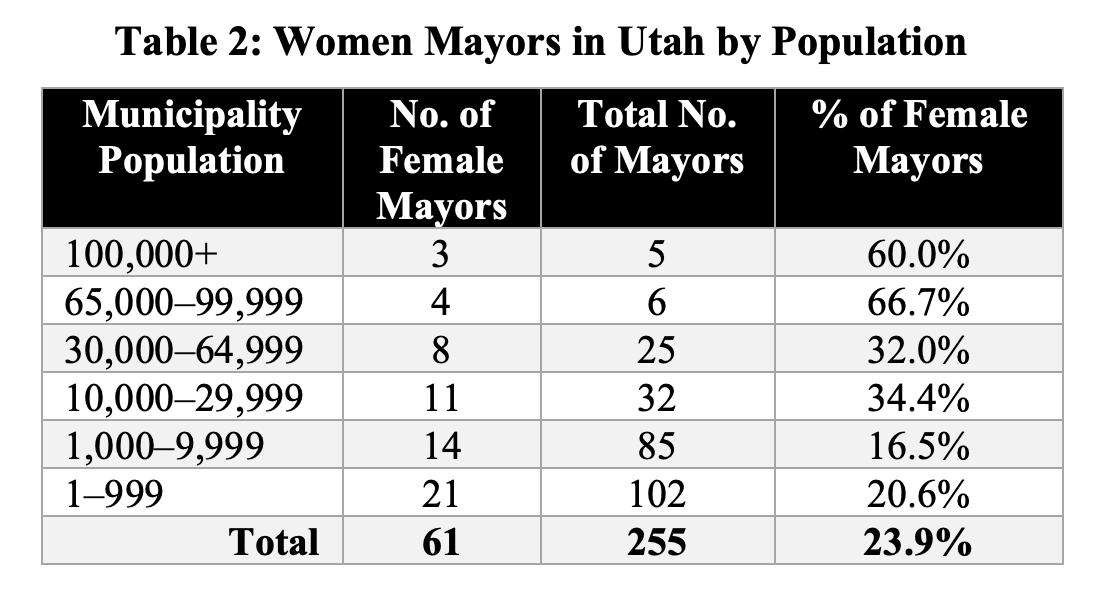
At the city level, women hold roughly 32.4% of municipal offices nationwide in cities with populations over 10,000. In Utah, women hold 31.8% of city and town council seats, a modest increase from 2025 but still lower than the national average.
Similar to mayoral seats, the study shows councils in Utah's five largest cities are now 51.4% women. Despite that, 51 cities in the state still have no women serving on their city councils.
"The 2026 data highlights a clear and persistent pattern: While Utah has made incremental gains in women's political representation, progress remains uneven, with substantial gaps at nearly every level of government," Madsen said in a statement. "Advancing women's representation in Utah is not merely a matter of fairness, but a catalyst for stronger communities, effective governance, and a more representative democracy."