'%3e%3cpath%20d='M34.1406%205.85938C30.3906%202.10547%2025.3047%200%2020%200C14.6953%200%209.60938%202.10547%205.85938%205.85938C2.10938%209.61328%200%2014.6953%200%2020C0%2025.3047%202.10547%2030.3906%205.85938%2034.1406C9.61328%2037.8906%2014.6953%2040%2020%2040C25.3047%2040%2030.3906%2037.8945%2034.1406%2034.1406C37.8906%2030.3906%2040%2025.3047%2040%2020C40%2014.6953%2037.8945%209.60938%2034.1406%205.85938ZM37.0117%2023.543H31.1602V13.5391H27.6328V19.9414C28.1211%2020.6914%2028.3711%2021.582%2028.3711%2022.5625V22.625C28.3711%2023.668%2028.1172%2024.6055%2027.6328%2025.4297V26.6094H36.082C33.4883%2032.9375%2027.2891%2037.3789%2020.0039%2037.3789C10.3711%2037.3789%202.62109%2029.6289%202.62109%2020C2.62109%2010.3711%2010.3711%202.62109%2020%202.62109C29.6289%202.62109%2037.3789%2010.3711%2037.3789%2020C37.3789%2021.1484%2037.2617%2022.2656%2037.0508%2023.3477C37.0391%2023.4141%2037.0234%2023.4766%2037.0117%2023.543Z'%20fill='white'/%3e%3cpath%20d='M22.3086%2018.5352C20.4336%2018.125%2019.9531%2017.8398%2019.9766%2017.1836V17.1406C19.9766%2016.6992%2020.3477%2016.2148%2021.4023%2016.2148C22.582%2016.2148%2023.8867%2016.6797%2025.0781%2017.4766L26.8516%2015.0195C25.4453%2013.8906%2023.707%2013.3398%2021.5547%2013.3398C18.5195%2013.3398%2016.4375%2015%2016.4063%2017.4766V17.5352C16.3633%2020.2617%2018.5859%2020.9805%2021.293%2021.6016C23.0391%2021.9766%2023.5703%2022.3164%2023.5703%2022.9609L23.5469%2022.9766C23.5469%2023.3906%2023.2578%2023.7031%2022.7852%2023.8359C22.5742%2023.9062%2022.1289%2023.9727%2021.5156%2023.9727C20.7617%2023.9727%2019.7539%2023.8633%2018.6328%2023.4844C18.0898%2023.2891%2017.4727%2023.0039%2016.8047%2022.6133L20.1406%2026.625C20.2813%2026.6602%2021.0977%2026.8516%2021.7734%2026.8516C25.0039%2026.8516%2027.0859%2025.2461%2027.1094%2022.6328V22.5703C27.1602%2020.1133%2025.2148%2019.1719%2022.3086%2018.5352Z'%20fill='white'/%3e%3cpath%20d='M5.24219%2013.5664V26.6133H8.75391V23.7578L10.2969%2021.9531L14.2031%2026.6133H18.3867L12.3555%2019.5195L17.4023%2013.5664H13.4531L8.75391%2019.0586V13.5664H5.24219Z'%20fill='white'/%3e%3c/g%3e%3cdefs%3e%3cclipPath%20id='clip0_97_2430'%3e%3crect%20width='40'%20height='40'%20fill='white'/%3e%3c/clipPath%3e%3c/defs%3e%3c/svg%3e)


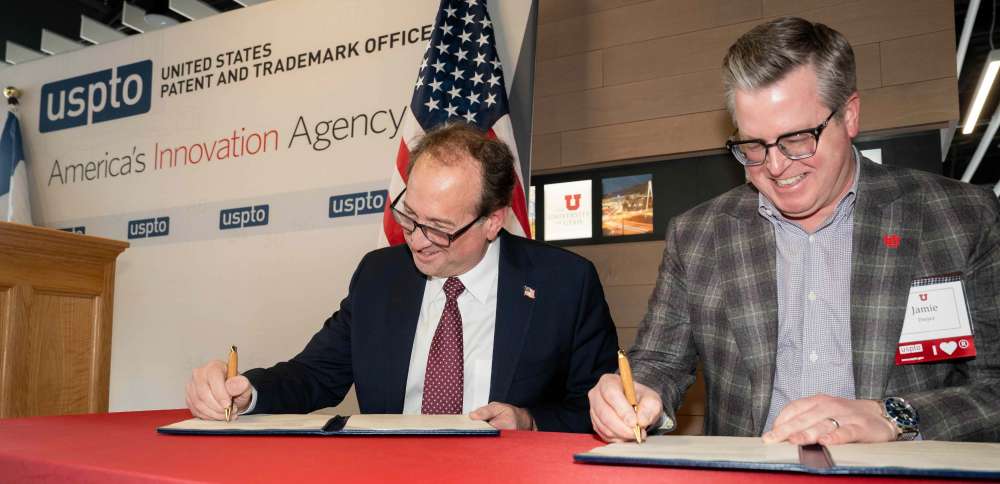
- The University of Utah last week signed an agreement to host a U.S. Patent and Trademark Office.
- This office will provide intellectual property resources across Utah and, more broadly, the Mountain West region.
SALT LAKE CITY — The University of Utah welcomed one of the nation's oldest agencies to its campus last week, signing an agreement to host a federally run U.S. Patent and Trademark Office.
The new community engagement office, which will be housed at the U.'s Research Park Myriad Genetics building, will help drive innovation by providing intellectual property education, resources and expertise for students, entrepreneurs, businesses and communities across the Mountain West, the U. said in a release.
"The Mountain West Community Engagement Office is present and accounted for to the citizens of Utah to help their intellectual property dreams of today become the reality of tomorrow," U.S. Patent and Trademark Office Director John Squires said before signing the agreement with Jamie Dwyer, a nephrologist serving as the U.'s executive associate vice president of research and interim chief innovation officer.
The U.S. Department of Commerce has set up similar offices at the University of New Hampshire and Montana State University, with more planned for the future.
The agreement reflects the university's "long-standing commitment to fostering a culture of innovation," U. President Taylor Randall said in a social media post.
This partnership reflects the @UUtah's long-standing commitment to fostering a culture of innovation. Having @uspto on our campus will ensure our inventors have greater access to the tools and knowledge they need to protect ideas and bring new technologies to market. https://t.co/1ACzwtQFMO
— Taylor Randall, UofU President (@PresidentUofU) February 20, 2026
The new community engagement office will cover an eight-state region that includes Utah, Idaho, Montana, Wyoming, Colorado, North Dakota, South Dakota and Nebraska.
Utah Sen. John Curtis called the agreement "an investment in American ingenuity" that reinforces the state's leadership in "research, technology, and entrepreneurship."
"Utah is ranked among the fastest-growing innovation economies in the country and has always been a place where bold ideas take root and grow. The new community engagement office will help ensure that our innovators have the tools, resources, and federal partnership they need to compete and win in the global economy," Curtis said in a statement.
According to a release from the U.S. Patent and Trademark Office, the U. was selected for the office based on meeting the criteria of having:
- Robust research activity and graduate-level programs of study in areas that lead to innovations, IP, and IP-intensive companies/industries.
- Availability and concentration of existing commercialization and business development resources.
- The ability to support all innovators.
The U. was fueled by $781 million in research activity last year and has an aggressive growth plan for the future.
"Our industry partnerships span biotech, AI, advanced engineering, and energy," Dwyer said. "Each year, our researchers submit hundreds of invention disclosures. Those disclosures become patents. Those patents become licensed technologies, startup companies, and solutions that improve lives."
A recent example is the Utah Bionic Leg, developed by U. researchers as the most advanced bionic leg ever created and named one of Time magazine's "Best Inventions of 2023."
The establishment of the engagement office also adds to the U.'s existing network of IP resources on campus, like the Technology Licensing Office, S.J. Quinney College of Law and the 41-year-old Patent and Trademark Resource Center in the Marriott Library.
As part of the agreement, the patent office will place up to three full-time employees on campus for an initial one-year period, with the option to extend by mutual agreement, according to the university.
Leading the team is Ken Takeda, interim acting director of the U.S. Patent and Trademark Office's Mountain West Community Engagement Office. As the longest-serving regional outreach officer, Takeda helped establish the office's Western office in California's Silicon Valley and oversaw its daily operations for more than a decade.
"The community engagement offices allow us to be more agile," Takeda said. "We can customize the resources and information we provide the public to meet the needs of the communities by focusing on the technologies and issues driving innovation in the region."