'%3e%3cpath%20d='M34.1406%205.85938C30.3906%202.10547%2025.3047%200%2020%200C14.6953%200%209.60938%202.10547%205.85938%205.85938C2.10938%209.61328%200%2014.6953%200%2020C0%2025.3047%202.10547%2030.3906%205.85938%2034.1406C9.61328%2037.8906%2014.6953%2040%2020%2040C25.3047%2040%2030.3906%2037.8945%2034.1406%2034.1406C37.8906%2030.3906%2040%2025.3047%2040%2020C40%2014.6953%2037.8945%209.60938%2034.1406%205.85938ZM37.0117%2023.543H31.1602V13.5391H27.6328V19.9414C28.1211%2020.6914%2028.3711%2021.582%2028.3711%2022.5625V22.625C28.3711%2023.668%2028.1172%2024.6055%2027.6328%2025.4297V26.6094H36.082C33.4883%2032.9375%2027.2891%2037.3789%2020.0039%2037.3789C10.3711%2037.3789%202.62109%2029.6289%202.62109%2020C2.62109%2010.3711%2010.3711%202.62109%2020%202.62109C29.6289%202.62109%2037.3789%2010.3711%2037.3789%2020C37.3789%2021.1484%2037.2617%2022.2656%2037.0508%2023.3477C37.0391%2023.4141%2037.0234%2023.4766%2037.0117%2023.543Z'%20fill='white'/%3e%3cpath%20d='M22.3086%2018.5352C20.4336%2018.125%2019.9531%2017.8398%2019.9766%2017.1836V17.1406C19.9766%2016.6992%2020.3477%2016.2148%2021.4023%2016.2148C22.582%2016.2148%2023.8867%2016.6797%2025.0781%2017.4766L26.8516%2015.0195C25.4453%2013.8906%2023.707%2013.3398%2021.5547%2013.3398C18.5195%2013.3398%2016.4375%2015%2016.4063%2017.4766V17.5352C16.3633%2020.2617%2018.5859%2020.9805%2021.293%2021.6016C23.0391%2021.9766%2023.5703%2022.3164%2023.5703%2022.9609L23.5469%2022.9766C23.5469%2023.3906%2023.2578%2023.7031%2022.7852%2023.8359C22.5742%2023.9062%2022.1289%2023.9727%2021.5156%2023.9727C20.7617%2023.9727%2019.7539%2023.8633%2018.6328%2023.4844C18.0898%2023.2891%2017.4727%2023.0039%2016.8047%2022.6133L20.1406%2026.625C20.2813%2026.6602%2021.0977%2026.8516%2021.7734%2026.8516C25.0039%2026.8516%2027.0859%2025.2461%2027.1094%2022.6328V22.5703C27.1602%2020.1133%2025.2148%2019.1719%2022.3086%2018.5352Z'%20fill='white'/%3e%3cpath%20d='M5.24219%2013.5664V26.6133H8.75391V23.7578L10.2969%2021.9531L14.2031%2026.6133H18.3867L12.3555%2019.5195L17.4023%2013.5664H13.4531L8.75391%2019.0586V13.5664H5.24219Z'%20fill='white'/%3e%3c/g%3e%3cdefs%3e%3cclipPath%20id='clip0_97_2430'%3e%3crect%20width='40'%20height='40'%20fill='white'/%3e%3c/clipPath%3e%3c/defs%3e%3c/svg%3e)




Estimated read time: 8-9 minutes
This archived news story is available only for your personal, non-commercial use. Information in the story may be outdated or superseded by additional information. Reading or replaying the story in its archived form does not constitute a republication of the story.
SALT LAKE CITY — This year's wildfire season is already off to an active start, and given Utah's severe drought and what's shaping up to be an above-average hot summer, fire experts argue there needs to be more public engagement in the effort to prevent dangerous and costly wildfires.
Their message comes not just as the percentage of human-caused fires in Utah has soared in recent years but as home-destroying wildfires have started to emerge as well.
"People need to realize we live in a fire-prone area. We're up against the wall and need to deal with it. Don't be complacent about it," said Robert Sanders, the Salt Lake and Davis County fire warden for the Utah Forestry, Fire and State Lands. "Everyone needs to play their part, not just the government and state but also the private homeowners need to take care of their portion, too."
Sanders was among a panel of federal, state and local land experts who discussed Utah's fire situation and recent trends during an online discussion Wednesday night hosted by the Utah conservation nonprofit Save Our Canyons. The event also included a screening of the PBS documentary "The West is Burning," which highlights the backstory behind how the Pacific Coast turned into a hotbed of large and destructive fires and what's being done to combat them.
While the film focused more on California, Oregon and Washington, experts like Sanders pointed out the trends happening there are also happening in Utah. That is, Utah fires are becoming larger, more intense and costlier.
The cost of a fire
The panel pointed out there are basically two costs from a fire: the price tag for fighting it and what one fire can take away from a community. Those found responsible for starting a fire may find themselves on the hook for paying some or all of those costs.
So what's the cost of suppressing a fire, exactly? That ranges, but it's safe to say it can get quite expensive rather quickly.
In an update Thursday, Bureau of Land Management officials estimate the bill for suppressing the Pack Creek Fire along the Grand-San Juan county line reached to about $8.7 million, as of Thursday. The fire, which started from an abandoned campfire on June 9, has burned close to 9,000 acres.
Bekee Hotze, the Salt Lake District ranger for the U.S. Forest Service, said during Wednesday's event that the Morgan Canyon Fire in Tooele County is closing in on $1 million in fire suppression costs. She added it cost about $400,000 on the first day just to clear flames near the site of a plane crash that sparked it just so investigators could reach that site.
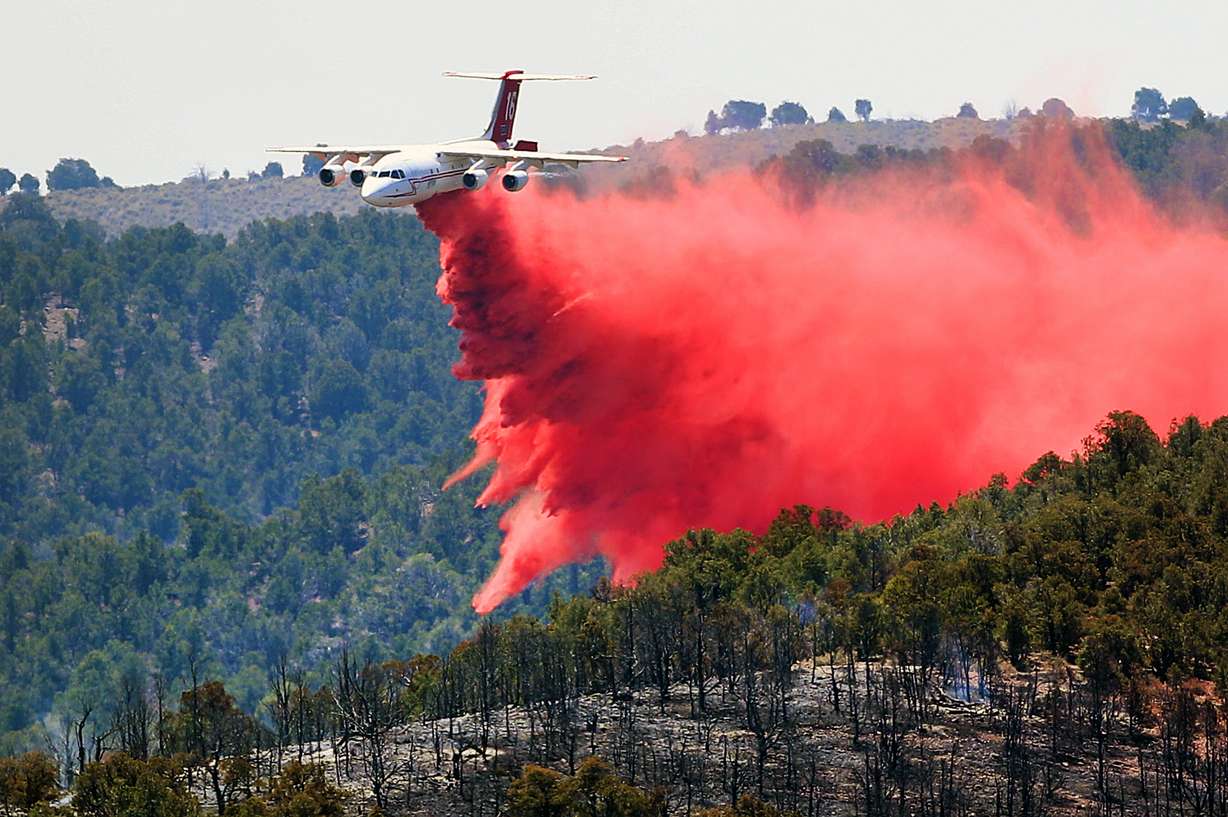
The reason these fires cost so much is the equipment needed to fight massive fires isn't cheap. KRNV in Reno, Nevada, reported last year that it cost about $65,000 for a drop of 11,000 gallons of retardant from a plane plus an additional $22,000 per hour of flight time.
Sanders said it's not uncommon to see a $400,000 bill when a plane is used and that helicopters cost about $2,000 per hour.
Even small, local responses can come with a price tag that can sting. For instance, Provo fire officials said earlier this week that a teenager who sparked a ½-acre fire by illegally launching fireworks could have to pay the $2,420 tab for knocking out the blaze. That's on top of two citations that could result in an additional $2,000 in fines.
But panel members argued there's a cost that goes beyond the price of fighting a fire. For instance, the 2018 Camp Fire in Paradise, California, took dozens of lives and wiped out a portion of the community's economy beyond the homes destroyed. The costs you see from fires don't also reflect other important items such as the loss of downstream resources or the loss of infrastructure, especially if a fire breaks out in a watershed.
Every fire also diverts money from projects that could save wildlands from devastating fires. Brian Trick, an area manager for the Utah Division of Forestry, Fire and State Lands, said one recent Utah watershed project cost $1.3 million, which is a fraction of the cost of the ongoing Pack Creek Fire.
"For the cost of a small fire on the Wasatch Front, we can do years of treatment and hopefully really make an impact to not only the landscape but protect homes. It's astonishing the difference," he said. "We always want to do preventative work rather than be reactive and then spend money and also put folks in danger."
Sanders added fires can also take away from other emergency services. For example, he said firefighters in Salt Lake and Davis counties who may otherwise help on medical calls end up assigned to fires caused by illegal fireworks or fires. That cuts away from the number of people available to respond to medical calls in those areas.
Trying to get the public involved
Given that fires can put humans at risk and are also increasingly caused by them, members of the panel also steered the conversation toward what the public can do to help. They point out that every fire not started saves taxpayers — or the burden of having to pay restitution.
The most noticeable wildfire trend right now is the growth of human-caused wildfires. As of this week, it's estimated that 88% of Utah's 2021 fires are human-caused. That's an increase from a record 78% in 2020. It was 68% in 2019 and 52% in 2018. The state launched a public-awareness campaign called "Fire Sense" earlier this year that aimed to curtail human-caused fires. Human causes can come from vehicles, debris burning, abandoned campfires, target shooting and fireworks.
If you see something, point it out. I would encourage anyone to educate anybody if they see something isn't right in terms of fire-wise and fire-conscious.
–Brian Trick, an area manager for the Utah Division of Forestry, Fire, and State Lands
"We all know what we need to do but we just seem to not be doing it," Trick said. "Whether it is putting out your campfire and fully extinguishing it, looking behind your target; if you're shooting out in the desert or wherever it is, maybe not using exploding targets around vegetation. These really are no-brainers and we tend to still figure it won't happen to us.
"It comes down to everyone is responsible," he added. "If you see something, point it out. I would encourage anyone to educate anybody if they see something isn't right in terms of fire-wise and fire-conscious."
Hotze agreed that it's difficult to get the message they are conveying to stick, adding that signage hasn't fixed the problem. She said the most success has been one-on-one conversations or small group meetings with campers. But getting those opportunities is nearly impossible.
"I have eight permanent employees and, this year in the summertime, I have 55 with seasonal (workers). And trying to have that one-on-one conversation when we have 6 million people up there is almost impossible — well, it is impossible. So I'm open to (any ideas) you have."
Laura Briefer, the public utilities director for Salt Lake City, added it's quite possible that this year's very visible drought could help in reducing activities that can lead to a fire. That's because people are able to see exactly what experts are warning about.
Still, Sanders said he's dealt with many people who simply just don't care. It's why he suggested that it might be easier or more efficient to levy fines or enforce stricter laws that would discourage people from making campfires or lighting off fireworks illegally. If people knew how much they may be forced to pay, such as the costs of fighting a fire, maybe they would start to care.
Not starting new fires isn't the only way people can help out. Sanders encourages homeowners to create defensible spaces and keep their yards uncluttered, not just to lessen the odds of a fire reaching their homes (or a home fire spreading outdoors) but also to make it easier on firefighters working to protect homes. He explained that firefighters don't know if the home they are trying to protect is insured or not, and will do whatever it takes to save homes.
"It's something that gets to my heart that we're putting firefighters' lives at risk to save someone's property," he said. "So I would love to have the public get more involved either individually or as a community — get the community together to come up with a plan, come up with projects around your property to eliminate some of the (dry vegetation)."
Not getting better soon
Sanders started battling fires in California in the 1970s and said what he saw when he started his career isn't the same as what he sees now. In 1977, he fought a fire that burned nearly 200,000 acres. It was the largest in state history at that time. Today, 200,000 acres is just another fire for many Western communities.
He said the 2012 Wood Hollow Fire signaled that tides were changing in Utah. In fact, firefighters have noticed new fire trends over the past 10 to 15 years. There's no sign of it getting better anytime soon.
"Things are changing all the way up into our neighborhoods," he said, pointing to the 2019 Gun Range and 2017 Uintah fires that destroyed six total homes in Davis and Weber counties. "It's a trend. And these homes weren't brand new. They had been there for years. So you can see a change in fire behavior (and) a change in our fuel conditions."
Sanders warns that people shouldn't get a "false sense of security" even with all the preparation and treatments to reduce fires. With Utah experiencing stronger wind events over the past year and with vegetation as dry as it is, conditions are prime for the sort of destructive fires that have plagued other states like California.
"All you need is that right recipe," he said. "So people need to be prepared, come up with a plan and be more proactive."