Estimated read time: 1-2 minutes
This archived news story is available only for your personal, non-commercial use. Information in the story may be outdated or superseded by additional information. Reading or replaying the story in its archived form does not constitute a republication of the story.
ST. GEORGE — Late Sunday night, 2 inches of rain fell in less than 90 minutes, resulting in 3 feet of flooding in some places. When this water accumulates in lower-lying areas faster than it can drain, the result is the potential for sinkholes such as those that appeared in St. George.
On Sunday, the National Weather Service issued a significant weather advisory for parts of Southern Utah, warning of a “strong thunderstorm” expected in the evening. The advisory was later upgraded to a flash flood warning.
That flash flood inundated Washington County and helped to form three sinkholes. Tyler Knudsen, a geologist specializing in hazards mapping with the U.S. Geological Survey, told St. George News that sinkholes happen when the ground below the land surface is no longer able to support the surface above.
The first large sinkhole opened up in the parking lot of the Ramada Inn on St. George Boulevard and was joined by a slightly smaller sinkhole several feet away that was discovered Monday night.
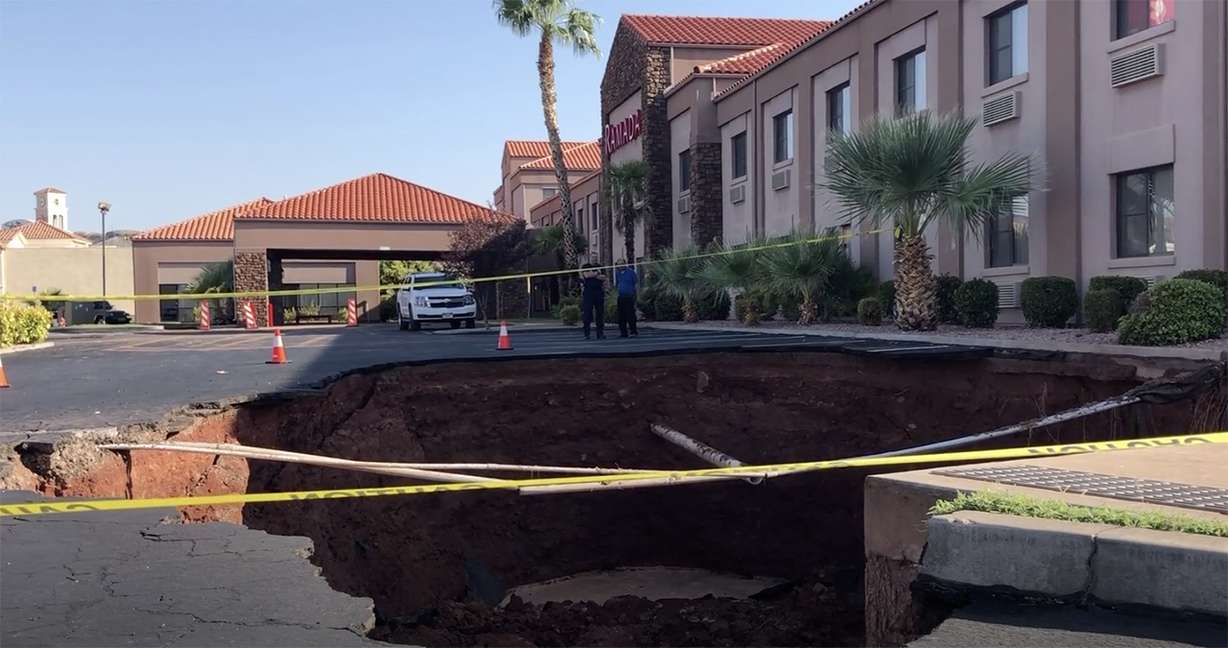
In St. George, much of the rock is made up of carbonate rock or gypsum, the type of rock that is typically associated with catastrophic sinkhole formation, particularly in situations where there is an influx of rain, such as was the case Sunday.
Read the full article at St. George News.