'%3e%3cpath%20d='M34.1406%205.85938C30.3906%202.10547%2025.3047%200%2020%200C14.6953%200%209.60938%202.10547%205.85938%205.85938C2.10938%209.61328%200%2014.6953%200%2020C0%2025.3047%202.10547%2030.3906%205.85938%2034.1406C9.61328%2037.8906%2014.6953%2040%2020%2040C25.3047%2040%2030.3906%2037.8945%2034.1406%2034.1406C37.8906%2030.3906%2040%2025.3047%2040%2020C40%2014.6953%2037.8945%209.60938%2034.1406%205.85938ZM37.0117%2023.543H31.1602V13.5391H27.6328V19.9414C28.1211%2020.6914%2028.3711%2021.582%2028.3711%2022.5625V22.625C28.3711%2023.668%2028.1172%2024.6055%2027.6328%2025.4297V26.6094H36.082C33.4883%2032.9375%2027.2891%2037.3789%2020.0039%2037.3789C10.3711%2037.3789%202.62109%2029.6289%202.62109%2020C2.62109%2010.3711%2010.3711%202.62109%2020%202.62109C29.6289%202.62109%2037.3789%2010.3711%2037.3789%2020C37.3789%2021.1484%2037.2617%2022.2656%2037.0508%2023.3477C37.0391%2023.4141%2037.0234%2023.4766%2037.0117%2023.543Z'%20fill='white'/%3e%3cpath%20d='M22.3086%2018.5352C20.4336%2018.125%2019.9531%2017.8398%2019.9766%2017.1836V17.1406C19.9766%2016.6992%2020.3477%2016.2148%2021.4023%2016.2148C22.582%2016.2148%2023.8867%2016.6797%2025.0781%2017.4766L26.8516%2015.0195C25.4453%2013.8906%2023.707%2013.3398%2021.5547%2013.3398C18.5195%2013.3398%2016.4375%2015%2016.4063%2017.4766V17.5352C16.3633%2020.2617%2018.5859%2020.9805%2021.293%2021.6016C23.0391%2021.9766%2023.5703%2022.3164%2023.5703%2022.9609L23.5469%2022.9766C23.5469%2023.3906%2023.2578%2023.7031%2022.7852%2023.8359C22.5742%2023.9062%2022.1289%2023.9727%2021.5156%2023.9727C20.7617%2023.9727%2019.7539%2023.8633%2018.6328%2023.4844C18.0898%2023.2891%2017.4727%2023.0039%2016.8047%2022.6133L20.1406%2026.625C20.2813%2026.6602%2021.0977%2026.8516%2021.7734%2026.8516C25.0039%2026.8516%2027.0859%2025.2461%2027.1094%2022.6328V22.5703C27.1602%2020.1133%2025.2148%2019.1719%2022.3086%2018.5352Z'%20fill='white'/%3e%3cpath%20d='M5.24219%2013.5664V26.6133H8.75391V23.7578L10.2969%2021.9531L14.2031%2026.6133H18.3867L12.3555%2019.5195L17.4023%2013.5664H13.4531L8.75391%2019.0586V13.5664H5.24219Z'%20fill='white'/%3e%3c/g%3e%3cdefs%3e%3cclipPath%20id='clip0_97_2430'%3e%3crect%20width='40'%20height='40'%20fill='white'/%3e%3c/clipPath%3e%3c/defs%3e%3c/svg%3e)




Estimated read time: 8-9 minutes
This archived news story is available only for your personal, non-commercial use. Information in the story may be outdated or superseded by additional information. Reading or replaying the story in its archived form does not constitute a republication of the story.
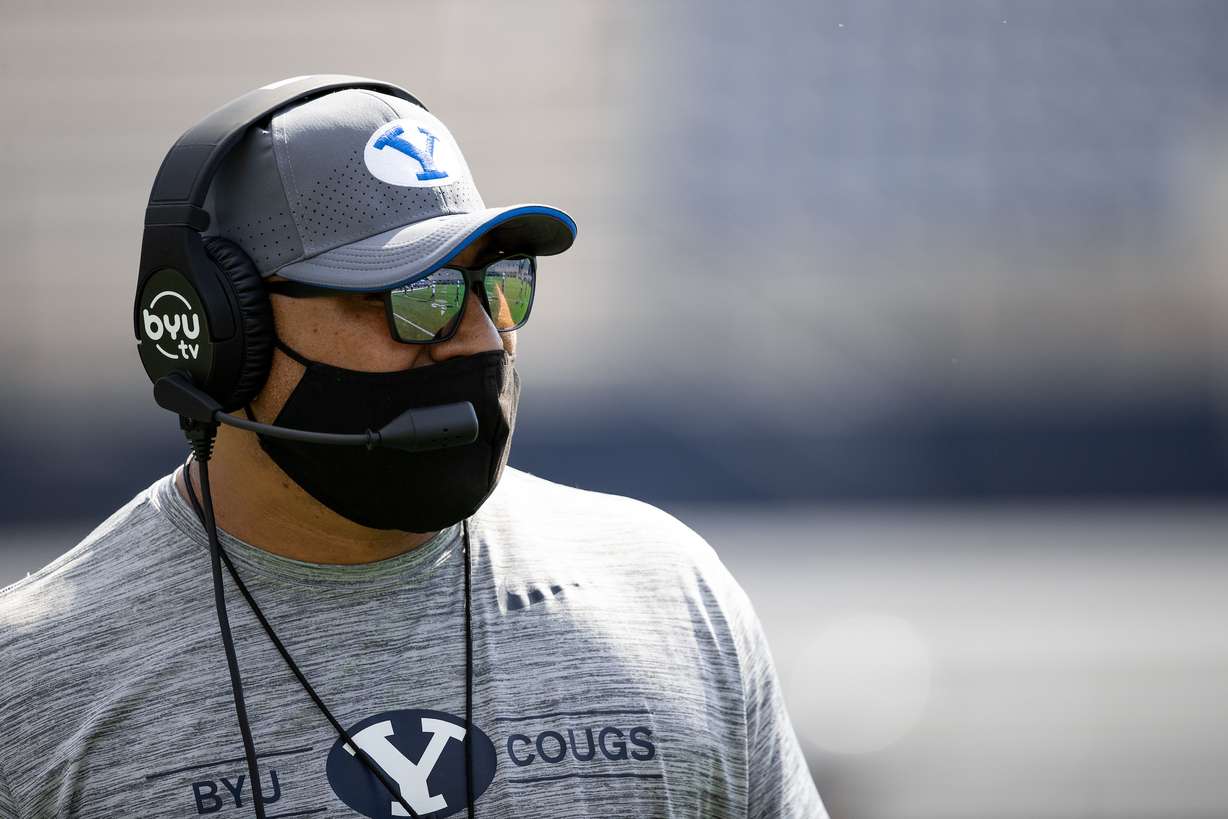
PROVO — BYU head coach Kalani Sitake wore a mask. So did offensive coordinator Jeff Grimes, defensive coordinator Ilaisa Tuiaki and every position coach at the Cougars’ training camp practices in preparation for the 2020 fall season.
What may have looked strange at first has become a part of the new normal due to the COVID-19 pandemic.
The Cougars will do anything to play football this fall, including wearing a face covering before, during and after practice; undergoing mandatory temperature and symptom checks; and maintaining social distancing and self-isolating periods when not in practice. The team even ordered hard-shell plastic face visors to replace the cloth masks many were wearing under their helmets at the start of fall camp. It’s just another layer of security to try to prevent the spread of a virus that is 0.14 microns in diameter.
Many of the players have already signed up for online classes. Others — namely those who aren’t married like quarterback Zach Wilson and wide receiver Dax Milne — have lived together to try to limit their contact tracing circle in response to the pandemic.
Whatever is needed seems like a small price to pay for a season, many of which have been canceled or postponed this fall across the country, including at Utah, Utah State and every other program in the state. BYU’s players have friends and family who play for other schools; they know what’s at risk if they can’t follow the rules.
And they’re reminded of those rules constantly. If a player is less likely to contract COVID-19 during a heavily-monitored and screened practice, scrimmage or game, then what they do outside the walls of the Indoor Practice Facility or Student-Athlete Building may be even more vital.
"We’ve been really harping on them being safe and educating them on everything," Sitake told KSL.com after Thursday’s scrimmage. "That’s been the key; it’s not just one educational moment of teaching them how to stay safe. It’s constantly doing it and having them help each other. We’re holding each other accountable.
"We are all in this together; we all want to play. In order to be in a good position to play, we know we do our part. There may be some external forces that may change it, but right now we know that if we do our part and keep it as safe as possible, we’ll do well."
In many ways, BYU football players and coaches may be safer by preparing for the Sept. 7 opener at Navy.
College football coaches and players know how to navigate risk. Injuries from broken bones to concussions to soft-tissue pains are commonplace. But the novel coronavirus pandemic is, by its very nature, something new — something no one has had to deal with.
There is no playbook for playing in a once-a-century pandemic.
BYU hasn’t had to shut down fall training camp. But the Cougars could only watch as — like many programs around the country — spring football was shut down after barely two weeks. More than two months of quarantine followed, where players weren’t allowed to meet on campus and could only occasionally congregate in small groups for optional workouts.
"During the time of quarantine, it was hard doing nothing," Milne said. "When we were finally getting back at it and back into the swing of things, it felt really good.
"I understand it’s a blessing because not everyone else can do this right now. We’re just taking what we can get."
BYU students will return to campus for a hybrid in-person and online coursework beginning Aug. 31. With it, the number of confirmed positive cases of COVID-19 — which stands at 109 self-reported by the university through Aug. 16, with an estimated 54 considered "recovered" — will likely increase.
As a private university, BYU does not release data related to COVID-19 tests. But a reasonable assumption is that at least one of those 109 cases likely came from a member of the football program. Separating students from the college athletes who have been on campus since June will prove to be a herculean effort once classes resume at the end of the month.
"I trust them," Sitake said. "Even though there will be a high number of people in the area and in Provo, our guys have done a great job so far. They love football, so I think they will try to do whatever they can to keep it as much as a bubble as possible and to play this game."
Still, challenges will arise — and not just the challenges of preparing for a full schedule when only five games are confirmed (and three more reported against Texas State, UTSA and Western Kentucky).
According to data provided by the university, Notre Dame had 33 confirmed positive cases of COVID-19 from nearly 12,000 tests administered before August. The Fighting Irish were among the standard bearers in college football, limiting infection rates not just on the football team, but from the campus community — much of it revolving around athletics, a common thread in college towns during the summer.
But since students returned to campus Aug. 3, with classes beginning Aug. 10, the infection rate soared. The school saw 147 new confirmed positive cases in just 15 days, leading to the administration’s decision to move all classes online.
It was a similar story in the UNC system, where North Carolina students resumed for a hybrid of in-person and online classes on Aug. 10 – and moved to an all-online model just seven days later. The Tar Heels are also sending most students home, or at least away from on-campus housing, after confirming six "clusters" of confirmed cases in residence halls and off-campus housing in just one week.
In the week after the school reopened, UNC reported 135 new cases of COVID-19, with a 13.6% positivity rate — or five times the 2.8% positivity rate of the week before.
"This hard work is being undermined by a very small number of students behaving irresponsibly off campus, which unfairly punishes the vast majority of their classmates who are following the rules," UNC System president Peter Hans said in a statement printed in the student newspaper.
North Carolina State will also shift undergraduate classes online beginning Aug. 24, but students will not be required to vacate student housing.
These and other examples seem to indicate that the problem with playing college football in 2020 isn’t the "football" part — but the "college" portion.
Like safety Troy Warner, BYU defensive back Chris Wilcox returned to Provo after becoming the first member of his family to earn a college degree when he graduated from his exercise and wellness program in April.

Sure, he could’ve transferred elsewhere, or even declared for the NFL draft. But after playing in "barely one game" a year ago while dealing with a serious shoulder injury, the 6-foot-2 native of Fontana, California, opted for one more season with the Cougars.
One can only imagine how motivated he is to follow each and every protocol placed in front of him — whatever they may be.
"I’m really eager to get back on the field," Wilcox said. "With everything going on, it’s very unfortunate. But there are other schools on the west coast that have canceled, and I’m happy that BYU is able to still play. They’re taking really good care of us, as far as taking our temperature and all the procedures we have to follow.
"I’m very happy we’re still able to play."
The same could be said of senior safety Zayne Anderson, who could come back for a seventh season of eligibility if he takes advantage of recommended NCAA legislation is approved that would preserve eligibility for this fall’s athletes, regardless if they play.
But if football is canceled, Wilcox and Anderson will be among several players who have little reason to remain at BYU. If the season is delayed or postponed, and classes are pushed online, many may be encouraged to return home, like some UNC students.
For 55 of those players, that means a short drive to their parents’ house in Utah. But others on the roster would need to disperse across the country: to Colorado, Washington, New Jersey, Nevada, Arizona and California, where current infection rates have led to local government leaders imposing significantly stricter regulations than the ones found in the Beehive State.
If the 100-plus players on the roster, plus coaching staff, managers, athletic trainers and other staff members, are sent home, could they be put in a more dangerous position of potentially contracting a virus that, while hardly fatal in the majority of young cases, has been linked to myocarditis and potential organ failure in several who have otherwise “recovered” from the effects of the coronavirus?
BYU players want to play football. They also want to stay safe.
It turns out, the two may not be as disparate as one might think.
"That’s something that we definitely need to take into consideration," Anderson said. "College football has expressed it; we all want to play. Looking into those long-term benefits or effects are something to definitely keep in mind.
"As frustrating as it is with the virus, it’s something that’s out of our hands. It’s adversity. We just have to take it for what it is."