'%3e%3cpath%20d='M34.1406%205.85938C30.3906%202.10547%2025.3047%200%2020%200C14.6953%200%209.60938%202.10547%205.85938%205.85938C2.10938%209.61328%200%2014.6953%200%2020C0%2025.3047%202.10547%2030.3906%205.85938%2034.1406C9.61328%2037.8906%2014.6953%2040%2020%2040C25.3047%2040%2030.3906%2037.8945%2034.1406%2034.1406C37.8906%2030.3906%2040%2025.3047%2040%2020C40%2014.6953%2037.8945%209.60938%2034.1406%205.85938ZM37.0117%2023.543H31.1602V13.5391H27.6328V19.9414C28.1211%2020.6914%2028.3711%2021.582%2028.3711%2022.5625V22.625C28.3711%2023.668%2028.1172%2024.6055%2027.6328%2025.4297V26.6094H36.082C33.4883%2032.9375%2027.2891%2037.3789%2020.0039%2037.3789C10.3711%2037.3789%202.62109%2029.6289%202.62109%2020C2.62109%2010.3711%2010.3711%202.62109%2020%202.62109C29.6289%202.62109%2037.3789%2010.3711%2037.3789%2020C37.3789%2021.1484%2037.2617%2022.2656%2037.0508%2023.3477C37.0391%2023.4141%2037.0234%2023.4766%2037.0117%2023.543Z'%20fill='white'/%3e%3cpath%20d='M22.3086%2018.5352C20.4336%2018.125%2019.9531%2017.8398%2019.9766%2017.1836V17.1406C19.9766%2016.6992%2020.3477%2016.2148%2021.4023%2016.2148C22.582%2016.2148%2023.8867%2016.6797%2025.0781%2017.4766L26.8516%2015.0195C25.4453%2013.8906%2023.707%2013.3398%2021.5547%2013.3398C18.5195%2013.3398%2016.4375%2015%2016.4063%2017.4766V17.5352C16.3633%2020.2617%2018.5859%2020.9805%2021.293%2021.6016C23.0391%2021.9766%2023.5703%2022.3164%2023.5703%2022.9609L23.5469%2022.9766C23.5469%2023.3906%2023.2578%2023.7031%2022.7852%2023.8359C22.5742%2023.9062%2022.1289%2023.9727%2021.5156%2023.9727C20.7617%2023.9727%2019.7539%2023.8633%2018.6328%2023.4844C18.0898%2023.2891%2017.4727%2023.0039%2016.8047%2022.6133L20.1406%2026.625C20.2813%2026.6602%2021.0977%2026.8516%2021.7734%2026.8516C25.0039%2026.8516%2027.0859%2025.2461%2027.1094%2022.6328V22.5703C27.1602%2020.1133%2025.2148%2019.1719%2022.3086%2018.5352Z'%20fill='white'/%3e%3cpath%20d='M5.24219%2013.5664V26.6133H8.75391V23.7578L10.2969%2021.9531L14.2031%2026.6133H18.3867L12.3555%2019.5195L17.4023%2013.5664H13.4531L8.75391%2019.0586V13.5664H5.24219Z'%20fill='white'/%3e%3c/g%3e%3cdefs%3e%3cclipPath%20id='clip0_97_2430'%3e%3crect%20width='40'%20height='40'%20fill='white'/%3e%3c/clipPath%3e%3c/defs%3e%3c/svg%3e)



Estimated read time: 5-6 minutes
This archived news story is available only for your personal, non-commercial use. Information in the story may be outdated or superseded by additional information. Reading or replaying the story in its archived form does not constitute a republication of the story.
SALT LAKE CITY — The 2019 legislative session began Monday. Over the course of the next 45 days, all sorts of bills and resolutions will be voted on through mid-March.
Among the items to be passed: the state’s 2020 budget, which would take effect July 1, 2019.
The budget is tentatively slated for about $19 billion and covers everything the state pays for. That includes everything from teacher salaries to roads to health, and even to the state’s new prison project.
The Governor's Office of Management and Budget publishes a lengthy book each year that skims through the dozens of places money goes to in the state, which gets divided into all sorts of subgroups.
As the state collects income, sales and property taxes, and user fees — as well as national funding in some cases — it receives revenue to spend on these programs.
“Our philosophy is to take as little funds as we can from people and invest them in ways where we can get the best outcomes for people,” said Kristen Cox, executive director of the Office of Budget and Management. “It really becomes an issue of how do you prioritize the resources? And it’s difficult because there are so many demands out there.”
Cox likened it to budgeting for a household — you spend money where you can and save up funds for projects down the road.
Generally, that means money is divvied to what’s considered most important at the moment. The exact amounts change throughout the course of the next seven weeks, though.
For example, the Legislature may agree to adjust the financial total of money provided in the planned Medicaid expansion, recently passed by voters last November as Proposition 3. Other bills could add or subtract from the final total of the budget — and the exact total the state pays may change throughout the course of the fiscal year.
Education
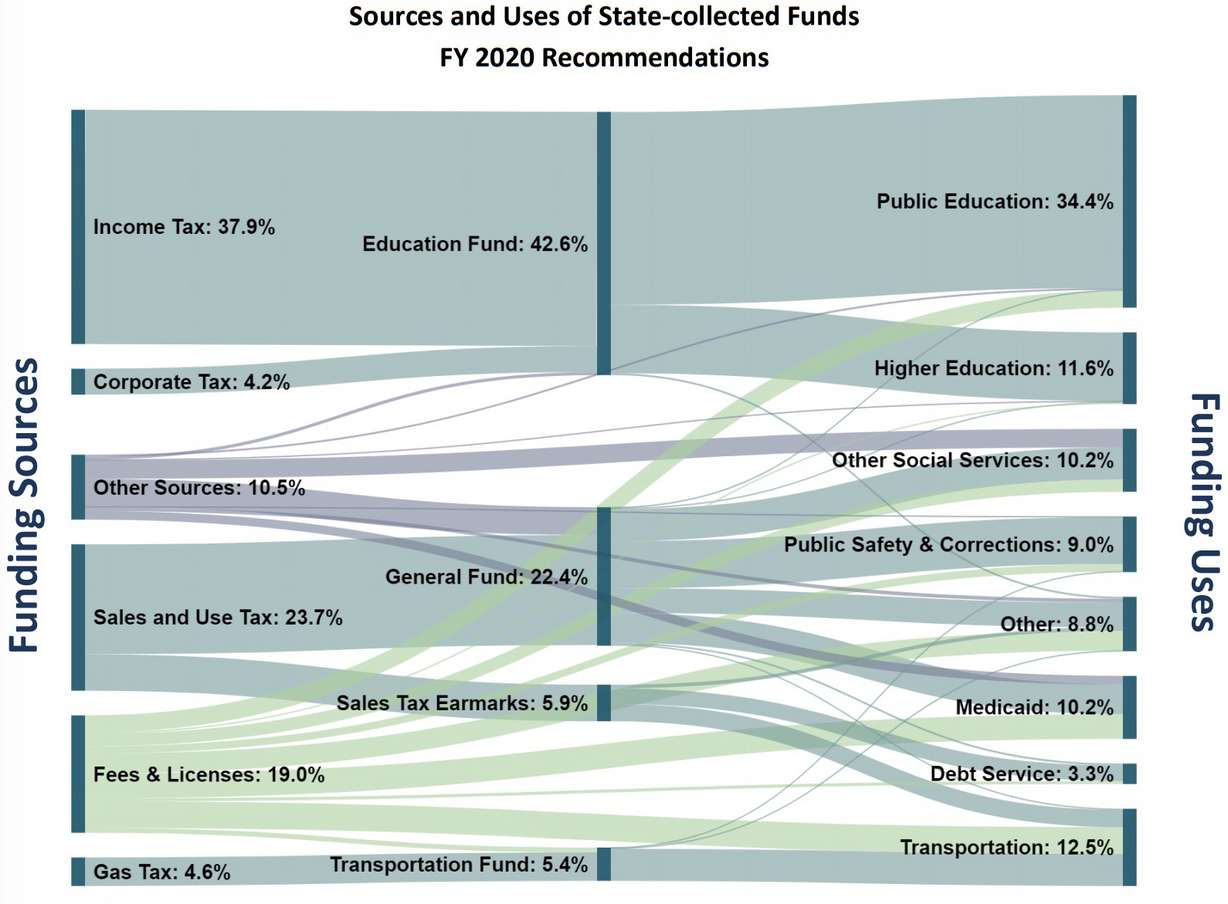
The state’s largest portion of the budget is often directed toward public and higher education, and the proposed 2020 budget is no different. According to the state budget, education needs account for roughly 46 percent of state-collected funds.
“A lot of what we’re doing with tax reform is to shore up strong educational systems for years to come,” Cox explained. “Education is always the governor’s top priority. So when we budget, we put in the big rocks first; and so we say, 'Look, the governor had a commitment of putting in $1 billion of new ongoing revenue in public education over five years. We’re going to hit that target in four years because we put that in first.' When we look at new revenue, we budget to priorities first.”
Transportation
This includes maintenance of Utah’s various roads and new road construction projects and 12.5 percent of state-collected funds go toward this. A good chunk of it comes from a gas tax, transportation funds and fees.
Medicaid
This part of the budget now has an asterisk next to it.
Voters in November passed an expansion to Medicaid that added roughly $1 billion to the budget that wasn’t initially planned for 2020, Cox said. This number is added in the governor’s proposed budget, but is subject to change because lawmakers have discussed the possibility of adjusting the Medicaid proposition.
That has opened up an interesting debate. The governor's office argues the state can’t afford the spike in Medicaid coverage (Medicaid was already expanded by a bill in 2018, but opened up to more people through the passed initiative).
“We don’t make promises that we cannot keep,” Utah Treasurer David Damschen told KSL.com last week, defending the measure to amend the proposition. “That legislation voted on by Utah voters doesn’t fully cover the costs we’ve promised to provide.”
The initiative would spark a tax increase that officials estimated could generate about $1 billion, it but couldn’t keep up with the people growing into the program in the future, Cox said.
“Our concern with it is: the way the proposition was crafted is just not financially viable,” she said.
However, proponents of the bill argue not only can the state afford it, but lawmakers are bypassing the will of the people. More than half of all those who voted on the proposition in 2018 favored it, and it passed with the highest amount of support of the four initiatives on Utah’s November ballot.
Related:
Utahns rally against changes to Proposition 3
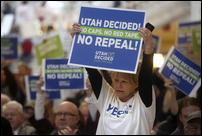
Hundreds gathered at the Utah State Capitol on Monday to rally against changes to Proposition 3, which was passed by voters in November and would expand Medicaid.A group of people protested at the Capitol Monday because of the possibility of the proposition being altered over the next 45 days.
"It's actually an incredible deal — I mean, we get $9 from federal (funding) for every dollar that the state has to chip in,” Utah resident Bryce Anderson said at the rally, arguing in favor of keeping the initiative untouched. “I don't understand why the legislature, as a body, just can't do the math."
Should the initiative remain the same through the legislative session, it would be enacted April 1. As is, Medicaid accounts for a little more than 10 percent of state-collected funds.
Other social services
All other health and social services aside from Medicaid equate to another 10 percent of the state-collected funds, according to the governor’s budget book.
Public Safety and Corrections
This pays for day-to-day police and prison services. The category also includes the prison relocation process already underway. A new state prison is under construction in Salt Lake City’s northwest quadrant, which will replace the one currently located in Draper. The budget proposal calls for $125 million in new one-time funds and $23 million in new ongoing funds for the project.