Estimated read time: 3-4 minutes
This archived news story is available only for your personal, non-commercial use. Information in the story may be outdated or superseded by additional information. Reading or replaying the story in its archived form does not constitute a republication of the story.
ST. GEORGE — A petition to remove the parasite responsible for swimmer’s itch from Sand Hollow State Park has been circulating through social media, prompting St. George News to determine if an eradication program is possible and if so, what that operation would look like.
The Change.org petition to remove swimmer’s itch from Sand Hollow State Park was started by Nicolas Wagner on June 5, based on claims that the water in Sand Hollow Reservoir is "overwhelmed with a parasite known as Cercarial Dermatitis, aka Swimmer’s Itch." The petition states that the water should be "treated for Swimmer’s Itch immediately."
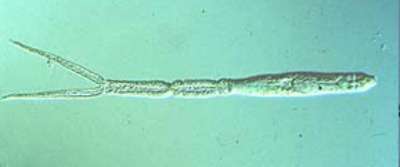
The Centers for Disease Control describes swimmer’s itch, or "cercaria," as a skin rash caused by an allergic reaction to microscopic parasites carried by waterfowl, semi-aquatic mammals and snails.
The petition lists Utah State Parks and Recreation as the agency that should be responsible for the cleanup, but the department’s public information officer, Devan Chavez, told St. George News it is not possible to rid the water of swimmer’s itch "immediately," adding that it doesn’t appear to be possible at all.
"We haven’t been made aware of any program that will remove swimmer’s itch from Sand Hollow or any other body of water in Utah," Chavez said. "We have researched the issue but have yet to find anything that would be effective."
Even if a solution were available, he said, there are multiple agencies that would need to "come to the table" to conduct impact studies on wildlife, agriculture and the food chain.
"But again," he said, "we have not found a program that has any level of effectiveness."
Why can’t we beat the itch?
The fundamental issues involved with implementing an eradication program have to do with the life cycle of the parasite, the effect a chemical additive may have on the environment and logistics.
First, the life cycle of the parasite that causes swimmer’s itch is a three-stage cycle, according to the Centers for Disease Control.
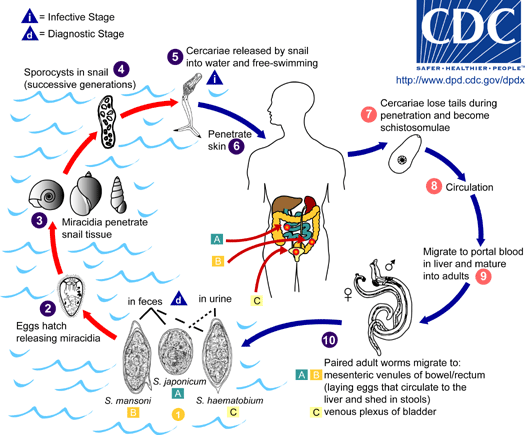
The larvae go through various stages of development, similar to a butterfly, starting with the adult flatworm that lives in the blood of infected birds. The female flatworm lays eggs that are released through the birds’ feces.
Once in the water, the eggs hatch and swim to the surface to optimally find a snail. If successful, the larvae enter the snail and continue to develop, producing thousands of new parasites that are then released into the water where they begin the search for a bird again, completing the cycle.
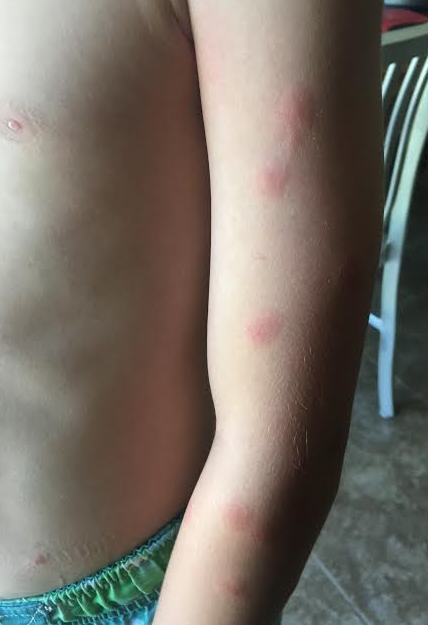
However, if the larvae find a human first, they burrow into the skin of the swimmer and die off, since humans aren’t appropriate hosts. This is what causes the “itch,” a rash that appears as red, bite-like welts within several hours of leaving the water.
To address the problem, different eradication attempts have been tested in various states, including treating the snail population with an insecticide such as copper sulfate, which can be added to the water in early June and has had some effect in reducing the number of snails.
To read the full story, visit St. George News.

KSL's Southern Utah News Section
Looking for more news from the southern part of the state? Visit our southern Utah section for more stories, events and features.