'%3e%3cpath%20d='M34.1406%205.85938C30.3906%202.10547%2025.3047%200%2020%200C14.6953%200%209.60938%202.10547%205.85938%205.85938C2.10938%209.61328%200%2014.6953%200%2020C0%2025.3047%202.10547%2030.3906%205.85938%2034.1406C9.61328%2037.8906%2014.6953%2040%2020%2040C25.3047%2040%2030.3906%2037.8945%2034.1406%2034.1406C37.8906%2030.3906%2040%2025.3047%2040%2020C40%2014.6953%2037.8945%209.60938%2034.1406%205.85938ZM37.0117%2023.543H31.1602V13.5391H27.6328V19.9414C28.1211%2020.6914%2028.3711%2021.582%2028.3711%2022.5625V22.625C28.3711%2023.668%2028.1172%2024.6055%2027.6328%2025.4297V26.6094H36.082C33.4883%2032.9375%2027.2891%2037.3789%2020.0039%2037.3789C10.3711%2037.3789%202.62109%2029.6289%202.62109%2020C2.62109%2010.3711%2010.3711%202.62109%2020%202.62109C29.6289%202.62109%2037.3789%2010.3711%2037.3789%2020C37.3789%2021.1484%2037.2617%2022.2656%2037.0508%2023.3477C37.0391%2023.4141%2037.0234%2023.4766%2037.0117%2023.543Z'%20fill='white'/%3e%3cpath%20d='M22.3086%2018.5352C20.4336%2018.125%2019.9531%2017.8398%2019.9766%2017.1836V17.1406C19.9766%2016.6992%2020.3477%2016.2148%2021.4023%2016.2148C22.582%2016.2148%2023.8867%2016.6797%2025.0781%2017.4766L26.8516%2015.0195C25.4453%2013.8906%2023.707%2013.3398%2021.5547%2013.3398C18.5195%2013.3398%2016.4375%2015%2016.4063%2017.4766V17.5352C16.3633%2020.2617%2018.5859%2020.9805%2021.293%2021.6016C23.0391%2021.9766%2023.5703%2022.3164%2023.5703%2022.9609L23.5469%2022.9766C23.5469%2023.3906%2023.2578%2023.7031%2022.7852%2023.8359C22.5742%2023.9062%2022.1289%2023.9727%2021.5156%2023.9727C20.7617%2023.9727%2019.7539%2023.8633%2018.6328%2023.4844C18.0898%2023.2891%2017.4727%2023.0039%2016.8047%2022.6133L20.1406%2026.625C20.2813%2026.6602%2021.0977%2026.8516%2021.7734%2026.8516C25.0039%2026.8516%2027.0859%2025.2461%2027.1094%2022.6328V22.5703C27.1602%2020.1133%2025.2148%2019.1719%2022.3086%2018.5352Z'%20fill='white'/%3e%3cpath%20d='M5.24219%2013.5664V26.6133H8.75391V23.7578L10.2969%2021.9531L14.2031%2026.6133H18.3867L12.3555%2019.5195L17.4023%2013.5664H13.4531L8.75391%2019.0586V13.5664H5.24219Z'%20fill='white'/%3e%3c/g%3e%3cdefs%3e%3cclipPath%20id='clip0_97_2430'%3e%3crect%20width='40'%20height='40'%20fill='white'/%3e%3c/clipPath%3e%3c/defs%3e%3c/svg%3e)


Estimated read time: 4-5 minutes
This archived news story is available only for your personal, non-commercial use. Information in the story may be outdated or superseded by additional information. Reading or replaying the story in its archived form does not constitute a republication of the story.
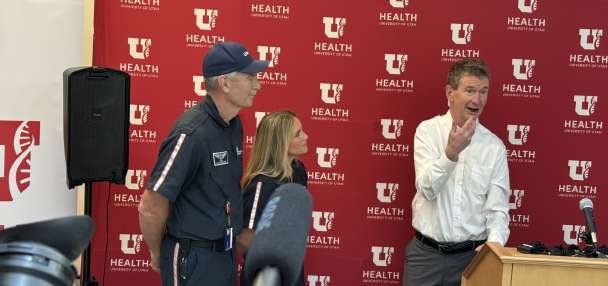
SALT LAKE CITY — After three days of conflict over a timeline for shutting down a section of Rio Grande Street to create a "safe space" for people seeking homeless services, House Speaker Greg Hughes and Mayor Jackie Biskupski stood side by side Thursday to announce a decision.
The two officials said Rio Grande Street — from 200 South to the mid-block property lines of Catholic Community Services and the Road Home — will be temporarily closed to vehicle traffic beginning Friday.
Though the partial closure didn't quell all of Hughes' concerns — wanting a full closure to the general public "yesterday" — the speaker called Thursday's move "critical."
"As we see this holiday weekend coming forward, I do think it’s going to thwart the drug dealers and the drug traffickers to see that that road is no longer the 'McDonald’s drive-thru' for drug dealers," Hughes said.
City officials launched an online survey at www.slcmayor.com and scheduled a public forum for Wednesday so Biskupski can get residents' input on a more long-term closure — until the troubled downtown shelter shutters in June 2019 — on a more expedited timeline.
"It's been a journey, but one worth taking, and I'm very grateful for the work we've been able to do together to make sure that this community's voice is heard in the process," Biskupski said.
The public forum is tentatively scheduled to happen at the old Anthropologie building at The Gateway, 116 S. Rio Grande St., at 6 p.m. Wednesday.
Biskupski said after she receives public input, she may choose to sign a lease agreement between the city and the state as early as next Thursday so the space can begin to be transformed into a more secure area that will be closed not only to traffic but also the general public.
Included in that lease agreement, Biskupski noted, would be a measure to give final say to the City Council, so the longer-term closure can still be considered and voted on during two council meetings in September.
Hughes said he envisions that "safe space" as not a place for camping, but a secure area that will require a homeless services ID card and will be managed by state and city police that will scan for drugs or weapons before people enter.
It's still not clear, however, exactly what services will be available in the space, though Hughes and Biskupski have said service providers will be expanding programs within the area.
The speaker said he believes the space will help officers better enforce camping ordinances by using state and city resources to manage the area so it can "truly be a safe place" for people to come to and not fear theft or violence.
Previously, Hughes said officers have struggled to enforce camping ordinances because people have told officers they don't feel safe in or near the Road Home's downtown shelter. Under the state's Constitution, officers cannot force people to leave a public place unless they can give them a safe alternative.
"We owe it to those who are most vulnerable ... to have an area that is truly safe so that when you have someone who may have resisted going in that area out of fear, we've taken that fear away," Hughes said.
Hughes earlier this week aired on live radio his grievances with Biskupski's reluctance to use her administrative power to immediately close the section of the street between the Road Home and Catholic Community Services' Weigand Center rather than in September after the City Council had a chance to weigh in.
Hughes insisted the street needed to close this week because drug dealers were already beginning to return to the area despite Operation Rio Grande's efforts over the past three weeks.
But Biskupski as recently as Wednesday remained firm on her position to weigh the closure in a public process with the Salt Lake City Council and wait until a special session of the Utah Legislature on Sept. 20 before blocking the street for the next two years.
Biskupski said that had been the plan since Operation Rio Grande began, and Hughes only recently began “demanding” that the street close this week.
But on Wednesday, at least three other City Council members sided with Hughes, criticizing Biskupski for not taking action now.
When asked if Friday's traffic closure quelled all of his concerns, Hughes laughed and said he's "still impatient" and Biskupski "still has to put up with me."
"I'm still wanting everything yesterday, so she's being very patient, but I'm very excited," Hughes said. "I am only here today because we are moving forward; we're making progress."