
Estimated read time: 4-5 minutes
This archived news story is available only for your personal, non-commercial use. Information in the story may be outdated or superseded by additional information. Reading or replaying the story in its archived form does not constitute a republication of the story.
SALT LAKE CITY — As long as Kipenzi gets fed, the long-necked, 12-year-old giraffe will stand patiently in a narrow chute where zookeepers can examine and interact with her.
And, the keepers thought, as long as she's there, they might as well try to get a look at her growing baby bump.
"Kipenzi is one of our best giraffes, we do a lot of work with her. She tolerates an awful lot, and in her mind, if she's being fed she probably doesn't care what I'm doing when I'm ultrasounding her," said Dr. Nancy Carpenter, senior veterinarian and associate director of animal health at Utah's Hogle Zoo. She said Kipenzi isn't restrained during the noninvasive procedure and the ultrasound is only intended to monitor the baby inside, not because of any concern for its well-being.
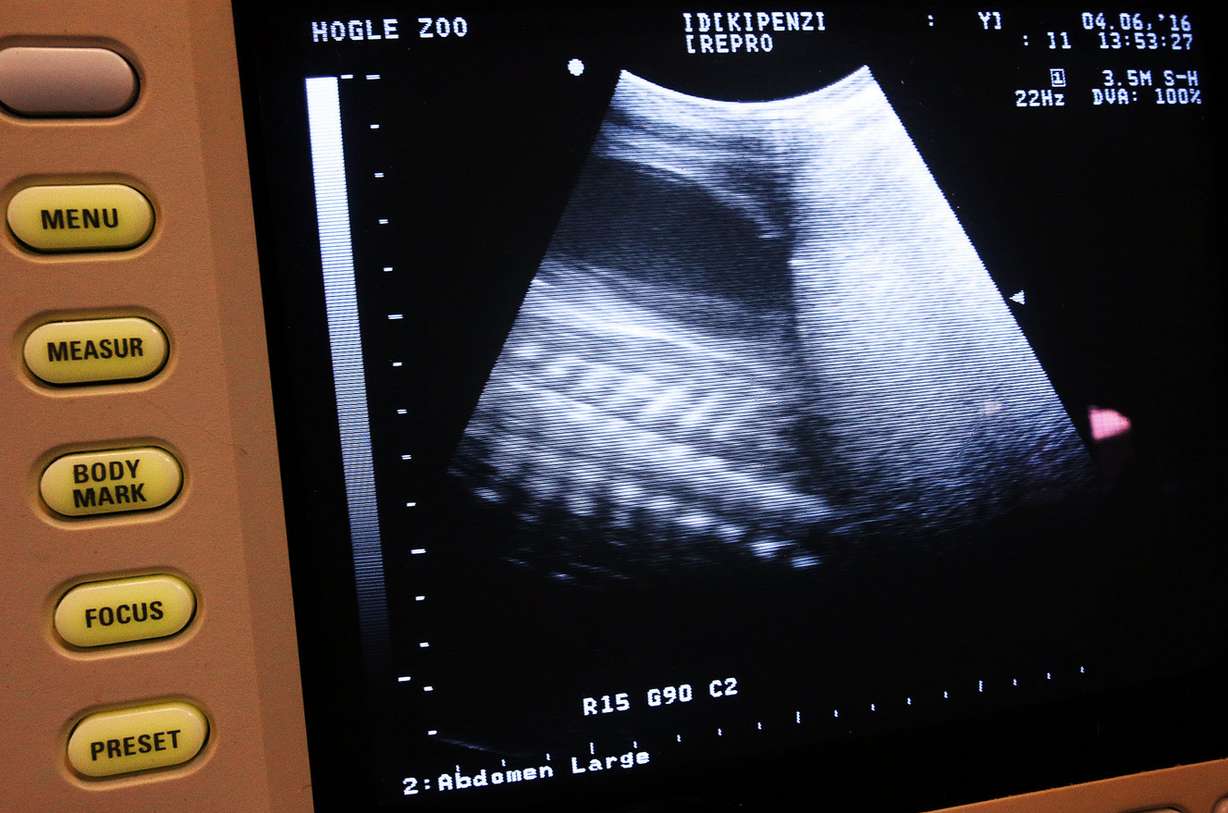
The "full-figured" giraffe, Carpenter said, is pregnant for the third time and has undergone at least three ultrasounds in the first eight months of her nearly 15-month gestational period. The baby is expected to drop some time in December and could weigh close to 150 pounds and stand around 6 feet tall.
"It will be old hat to her now, she's kind of a slow starter as a mom. But, she's figured it out and we don't anticipate any problems," Carpenter said.
Kipenzi's firstborn, a male giraffe named Jamar, died at 8 months old in 2010 due to a "failure to thrive." He wasn't eating enough, likely because Kipenzi wouldn't let him nurse. But a second baby, female Anuli, was delivered in October 2013 and was later sent to Maryland Zoo in Baltimore. Her name means "daughter who brings happiness."
Giraffes don't have much of a maternal instinct, it's something they learn by experience. But other females in the herd also keep watch, forming a nursery group to give the mother a break.
The gender of the fetus is unknown, as only a more invasive and unnecessary type of ultrasound would be required to detect such detail, Carpenter said. It won't matter, as either gender might end up being separated from the mother sometime after birth.
Hogle's herd has only one male, as male giraffes sometimes quarrel with each other, and a female would have to be sent elsewhere to prevent inbreeding.
Willow, a 3-month-old female giraffe, was born to Pogo, 13, in January. The young giraffe is doing well, and it is unknown whether she will be permitted to stay at the Utah refuge.
Related Story:
Utah's Hogle Zoo welcomes baby giraffe named Willow
There's a new giraffe that calls Utah's Hogle Zoo home. Meet Willow, born on Jan. 13 at the zoo. She already stands at 6 feet tall and weighs around 125 pounds, the zookeepers estimate."Giraffes are like the supermodels of the Savanna. They're big. They're beautiful. They're called tall blondes," said Holly Peterson, a giraffe keeper at Hogle Zoo. "They're gentle and majestic, and it's fun to hear the public's reaction to them. They like to see them. They're just really pretty animals."
Native to Africa, various subspecies of giraffes are experiencing population declines and may soon end up on threatened or endangered species lists.
"They're quietly disappearing," Peterson said, adding that the zoo is hoping to increase awareness of giraffes and spread the word that "giraffes are awesome animals but they are disappearing in the wild."
In addition to Kipenzi, Pogo and Willow, Utah's Hogle Zoo is home to 12-year-old Riley, sire to both Willow and the unborn giraffe. The zoo also houses Daphne, an almost 31-year-old female — the second-oldest giraffe in the United States.
"It's always exciting for us to have giraffe babies," Carpenter said. "The public loves them, we love them and giraffes do so well in small herds."
She said the zoo does not breed animals just to showcase the babies, but all breeding done there is regulated by species survival plans, making sure genetics are kept in line.
Zookeepers were certain after the absence of her 19-day cycle, and an inattentiveness of the male giraffe, Riley, that Kipenzi became pregnant in September. The mother will give birth inside the giraffe barn during the winter and won't be visible to the public. Staff members don't plan to interfere with the process unless there are problems, as Carpenter said it's imperative that babies bond with their mothers, so they are given ample time and monitored remotely with cameras.
Training will begin shortly thereafter, as Peterson said giraffes aren't domesticated animals and don't like to be touched.
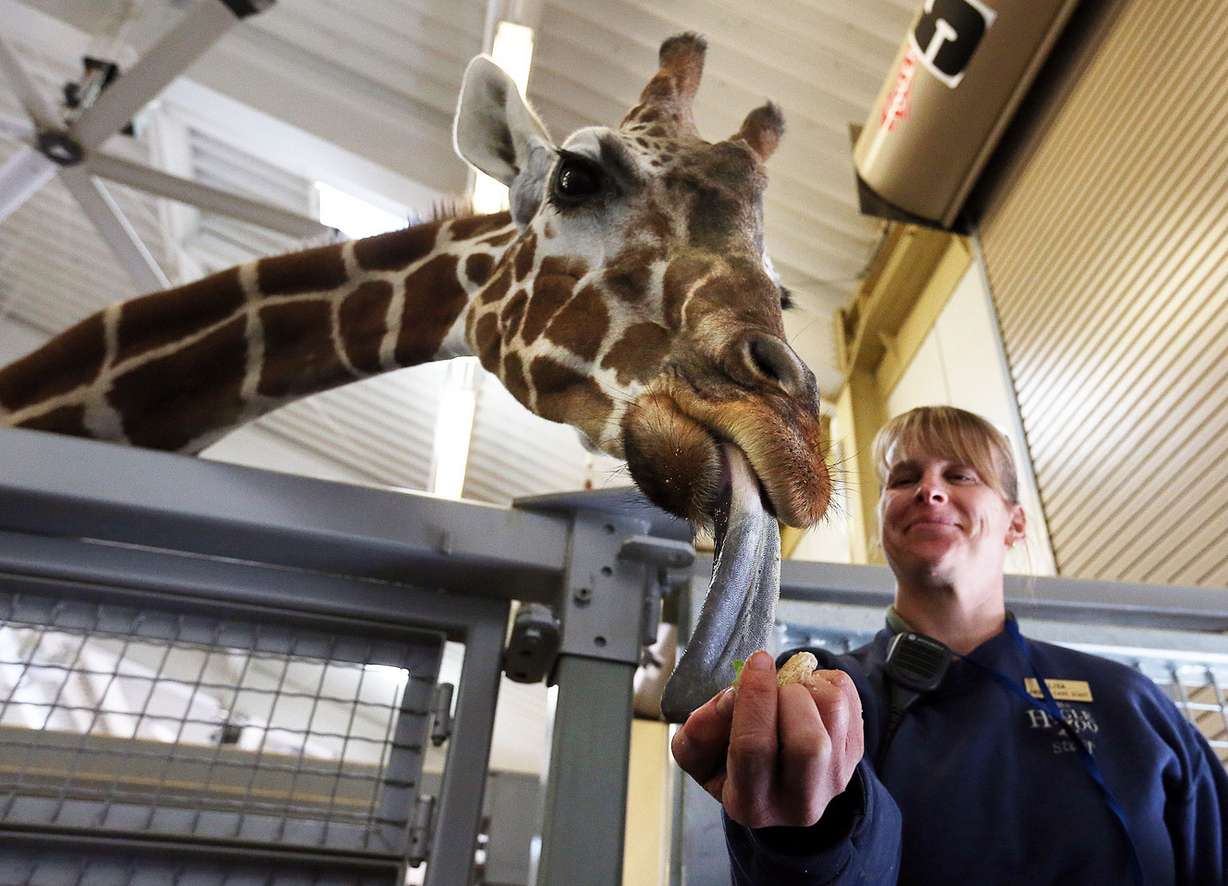
Positive reinforcement is used to "desensitize" the animals, she said, and prepare them for any potential interventions. The situation was favorable enough with Kipenzi that an ultrasound could be done. The procedure isn't common among animals, and especially giraffes due to their size.
"Kipenzi is one of our best because she's very people-friendly and very food-motivated, which really helps," Peterson said. "They know our voices and pay more attention to us if we have food."
Peterson said Kipenzi's diet of alfalfa and pellets fortified for herbivores will remain the same throughout her pregnancy, and the giraffe certainly knows what's going on. Contractions and other signs of labor will be visible when it happens later this year.
"We haven't had two young calves together," Peterson said, adding that she's looking forward to seeing how the youth interact on the African Savanna exhibit at the zoo. "It's exciting for all of us."