

Estimated read time: 4-5 minutes
This archived news story is available only for your personal, non-commercial use. Information in the story may be outdated or superseded by additional information. Reading or replaying the story in its archived form does not constitute a republication of the story.
SALT LAKE CITY — An apprentice program at Salt Lake Community College is working to fill the skills gap that threatens the growth of Utah's construction industry.
Mention "apprentice" to most high school students and they will probably think of the NBC show hosted by billionaire Donald Trump. However, real apprentices in Utah have good jobs and steady incomes in trades like plumbing and electrical technology.
Second-year plumbing apprentice Marc Bullock has been working on a job at a new fire station under construction in West Jordan. Bullock's training helped him navigate the plumbing maze with little difficulty. He has been on the job with C.L. Wayman and in the classroom at Salt Lake Community College since 2013.
Ralph Tasker is the trades programming manager at SLCC, where almost 350 students are currently enrolled in the plumbing and electrical technology apprenticeship programs.
"All of our apprentices are working, so they work during the day and they come to school two nights a week," he said.
Teachers in the program are all licensed in their trades and working full-time as plumbers or electricians. Many came through the SLCC program in four years and then tested to earn their journeyman's license.
Bullock likes working and learning side-by-side with licensed plumbers.
"The journeymen in the field who have all been through the schooling and training, they expect you to know certain things. If they're not teaching it to me, I'm learning it here at school," he explained.
Bullock and his classmates are almost halfway through SLCC's four-year plumbing apprenticeship program. They all are earning while they are learning a trade that's in high demand.
"They're coming out in a trade after four years, a lot of them making between $50,000 and $60,000 to $65,000 a year," Tasker said.
The electrical and plumbing students also avoid the student debt most four-year college graduates face, because their employers are paying for the bulk of their education. Mace Terburg is in the fourth and final year of his electrical apprenticeship with SLCC.
"They (employers) want us to be the best electricians that money can buy," he said.
Terburg has been with Copper Mountain Electric for the past four years and is currently wiring two new operating rooms at St. Marks Hospital. He wishes he had gone into the program when he finished high school.
"Just go for it, the sooner the better," he advised.
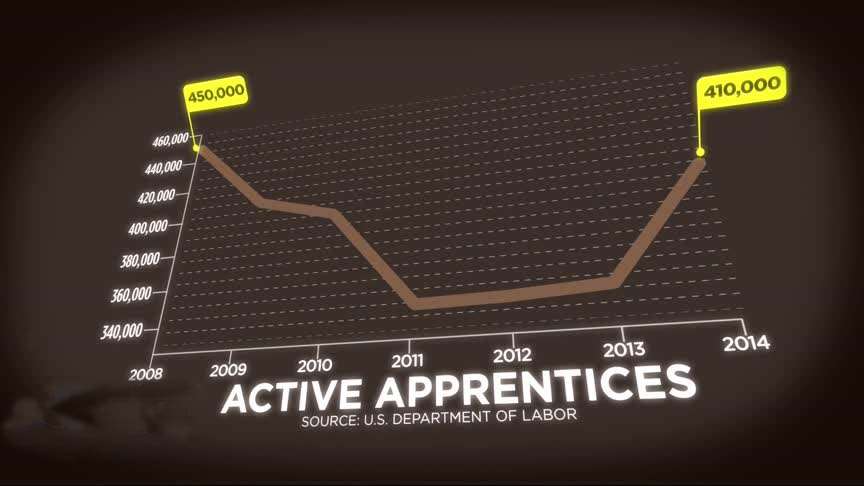
Why isn't this type of education more popular? The recession had an impact. In 2008, the U.S. Department of Labor reported 450,000 active apprentices. The number dropped by about 100,000 in 2011 and then rebounded last year to 410,000.
Tasker said the program faces another challenge: "Trying to convince high school counselors that this is a viable option."
Learning a trade is something where you can make good money right off the bat and increasingly get to a good wage.
–David Butterfield, licensed journeyman
It's an option that more and more SLCC students appear to be taking advantage of. Eighty-five apprentices started the electrical program this year — three times the 26 who will graduate and test for their journeyman's licenses this spring. The plumbing program has more than doubled in size from 14 in the graduating class this year to 37 wrapping up their first year in the program.
Tanner Hart is in the second year of the plumbing apprenticeship program.
"When I was getting out of high school, I kind of thought what am I going to do? And so I talked to my neighbor who was a plumber and he got me into the industry," he said.
Plumbing is just one of many construction industries hungry for new workers, according to Tasker.
"We're getting a lot of feedback from employers that they can't find people to put to work," he said.
David Butterfield has been a licensed journeyman plumber for two decades. He also teaches plumbing at SLCC.
"Learning a trade is something where you can make good money right off the bat and increasingly get to a good wage," he said.
Tasker sees the need and the potential for more growth in SLCC's apprenticeship program. Last week he met with dozens of high school counselors along the Wasatch Front to ask for their support. He wants them to recommend apprenticeships to those students who may not be interested in a four-year college degree program.
"There's a lot of students that do better in a hands-on trade," Tasker said.






