Estimated read time: 2-3 minutes
This archived news story is available only for your personal, non-commercial use. Information in the story may be outdated or superseded by additional information. Reading or replaying the story in its archived form does not constitute a republication of the story.
Jed Boal reportingMany of us have spotted deer and other wildlife from our cars recently. They feed at the side of the road, and many get killed there.
On average, cars collide with deer 2,000 times each year. But the Utah Department of Transportation is working on some animal crossings that are starting to make a difference.
Deer, elk and moose often head for the side of the road to feed on salt-covered grass. Deep snow or not, their spring and fall migration paths often put them right in front of our speeding cars and trucks.
UDOT wildlife biologist Paul West said, "Where we have the largest concentrations of animals is where you're going to find the accidents happening, unfortunately."
A viewer told us he drove from the mouth of Weber Canyon to Park City and back for Easter and counted more than 80 dead mule deer, five elk, one moose, three coyotes, three raccoons and two fox.
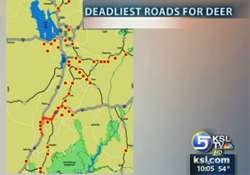
Deer-vehicle collisions alone can wipe out as much as 17 percent of the deer population in Northern Utah each year. UDOT studies the most dangerous wildlife corridors, which include I-70, U.S. 6 and I-80.
"They're big areas, and high traffic volume contributes, too," West said. "We need to find solutions, and that's what we're trying to do."
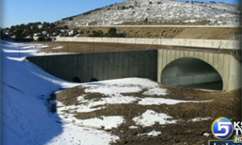
The state built underpasses on migratory routes, so wildlife can cross safely. UDOT plans to design more of these, with fences, for the busiest corridors.
"What we do is put this fence along the right of way and funnel the animals into those crossing structures. That's the only option they have," West explained.
The structures apparently work. This work is expensive. It helps wildlife, but is a priority for UDOT because it reduces our risk on the road.
"A deer will probably bounce off and cause a lot of damage. But your elk and moose are going to cause serious injuries," West said.
The Division of Wildlife Resources advises motorists to slow down, put down the cell phone, and stay alert. Scan the side of the road as you drive. At night, keep your headlights on high beam as much as possible. Watch for deer crossing signs to alert you to areas that have high numbers of deer, moose and elk.