
Estimated read time: 2-3 minutes
This archived news story is available only for your personal, non-commercial use. Information in the story may be outdated or superseded by additional information. Reading or replaying the story in its archived form does not constitute a republication of the story.
SALT LAKE CITY — The Sun played peek-a-boo with thousands of sky watchers late Tuesday, hiding behind the clouds. But many finally observed one of the rarest astronomical events you can see with your own eyes.
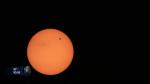
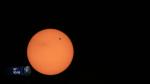
The transit of Venus, the passage of the planet Venus across the face of the sun, attracted nearly 1,000 people Utah's Natural History Museum in Salt Lake City, where a viewing party was held.
"Way more (viewers came) than we expected. There's a lot of interest," said Paul Michael Maxfield, the museum's gallery programs coordinator. "(We're) just really excited that people are so eager to come and visit with us."
For a while, it looked like the museum party was going to be a party without its star attraction, the sun, and its expected guest, Venus. While astronomers and star buffs spent hours inside the museum educating the crowd, the sun refused to appear, staying hidden behind a deck of clouds.
"I'm a long ways from being discouraged, at this point," Patrick Wiggins, NASA's ambassador to Utah, said early Tuesday evening.
Shortly after that, Wiggins he said that bugged out for clear skies in Tooele County, where got a great picture of the sun with Venus right in front of it.
As the evening wore on toward sunset at the museum, patience was rewarded. As the sun burst into view, hundreds of people were waiting on the museum terrace with eclipse glasses and scopes. One woman began singing The Beatles Hit "Here Comes the Sun."
"Now we can see Venus. We've had to be patient, but now it's visible," said Rodger Fry, with the Salt Lake Astronomical Society. "When you're into astronomy, it always thrills you. It's worth waiting."
NASA captured spectacular video of the transit from other locations, and so did KSL News photographer Alan Neves in Utah County. He shot beautiful scenes of our seemingly tiny neighboring planet cruising across the face of the sun. Venus is actually almost as big as Earth, but Tuesday night it was dwarfed by the distant sun.
Many of those who witnessed the planet's transit realize it's their last chance. The next transit of Venus will be 105 years from now.
No one would argue that this is a visual spectacle on a par with a solar eclipse, and yet it stirred people because of its scientific and historical interest. People were happy to be part of such a rare event.