
Estimated read time: 3-4 minutes
This archived news story is available only for your personal, non-commercial use. Information in the story may be outdated or superseded by additional information. Reading or replaying the story in its archived form does not constitute a republication of the story.
SALT LAKE CITY — Utah has become the first state since 1971 to make precious metals, gold and silver, legal currency. But that doesn't mean you can run down to the local grocery store, pick up some bread and milk, pay with a $1,500 gold coin and expect to get change back.
The “Utah Legal Tender Act” took effect Tuesday, changing how gold and silver are classified under the state tax code. Previously, gold and silver were classified as “assets” and therefore subject to state and capital gains taxes when exchanged for cash. Under the new law, silver and gold are now considered “currency,” and those tax issues are gone, at least in Utah. Federal taxes would still apply.
The Utah law is a toned down version of a Georgia bill introduced last December that would have required all transactions with the state, including paying taxes, be paid with gold or silver coins.
Legal tender or not, there’s a lot of interest to buy gold and silver.
“We're seeing a lot more activity, a lot more buyers than what we've had in the past,” says Josh Rust, manager of Rust Rare Coins in Salt Lake. “And the big reason is that people are scared about where the dollar is and where it's heading, and gold and silver give protection against that.”
Rust says every customer is different. Some make smaller purchases over a long period of time; others come in and make a big buy.
Customers have many reasons for wanting gold and silver. “We hear everything from the sky is falling and this is the time the dollar is going to implode within a week and we better get ready for it,” Rust said.
Most customers, however, just want a little in their portfolio just in case.
Sharla Jessop, vice president of Smedley Financial Services, says her firm has also seen an increase in clients asking about precious metals. “I think because what's happened in the market in the last four or five years, especially since we've had the deep downturn and recession, it's caused people to think outside of the box and they are considering precious metals as part of their portfolio,” she said.
Jessop says for those wanting to invest in gold or silver, a good rule of thumb is 5 percent of a total portfolio.
- During the Great Depression, President Franklin Roosevelt took steps that essentially prohibited gold and silver as legal currency to prevent hoarding.
- In 1971, President Richard Nixon formally abandoned the gold standard.
-In 1986, the U.S. Mint began producing the gold and silver American Eagle coins, primarily aimed at investment portfolios and allowing people to trade them at market value but with capital gains taxes on profits.
In terms of risk, precious metals are extremely volatile.
“If you go back and look at charts, there are days when it'll be up $35 in a day, and down the same amount the next. If it's something that you're going to be buying and watching, it'll keep you up at night, because of the volatility," Rust said. "We recommend it more as an insurance policy rather than a standard investment like a stock that may pay a dividend or something like that. We believe that it's an important part of someone's portfolio to give them some protections against the falling dollar.”
Jessop adds that many people don’t understand how to go about investing in precious metals. She highly recommends consulting with a professional planner.
“People are coming in because they just hear about it. They hear you've got to have gold. My friend has gold. They don’t really understand it. A lot of time we get questions because of what's going on and what they're hearing out there (in the media). Sometimes it's beneficial to them and sometimes it's not.”
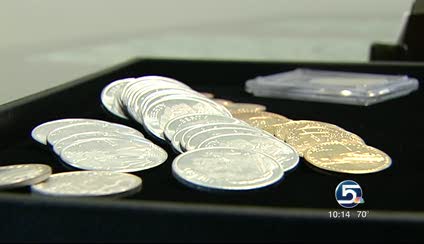
In terms of actual coins, gold and silver come in several weights. Rust says customers are buying 1-ounce coins, as well as fractional sizes, which include a tenth of an ounce, a quarter ounce and half-ounce sizes. “It depends on the person,” he says.
As far as buying the bread and milk? You’ll have to exchange your gold or silver for cash to do that.
Email:kmccord@ksl.com