Estimated read time: 5-6 minutes
This archived news story is available only for your personal, non-commercial use. Information in the story may be outdated or superseded by additional information. Reading or replaying the story in its archived form does not constitute a republication of the story.
CAPE CANAVERAL, Fla. -- It was the quality of the time, not the quantity, when Alan B. Shepard Jr. (rear admiral, U.S. Navy retired) forever changed space history for America by spending a whopping 15 minutes in space. In 1961, that was considered miraculous.
"50 years ago today, Alan Shepard rocketed into space on America's first manned space mission. That flight set our nation on a path of exploration and discovery that continues to this day," NASA Administrator Charles Bolden said.
A great step forward for American space exploration had been accomplished.
"May 5, 1961, was a good day,” Bolden said. “When Alan Shepard launched toward the stars that day, no American had ever done so, and the world waited on pins and needles praying for a good outcome. The flight was a great success, and on the strength of Shepard's accomplishment, NASA built the leadership role in human spaceflight that we have held ever since.”
The dedication Shepard exhibited continues in NASA programs today.
Alan Shepard was the first American in space, but the second man in space. Soviet cosmonaut Yuri Gagarin beat him into space by less than a month.
"With the same spirit of innovation and grit of those early days of space flight, we now move out on an exciting path forward where we will develop the capabilities to take humans to even more destinations in the solar system,” Bolden said. “We are just getting started. Our future, as an agency and as a country, holds many more firsts. We know the next 50 years will be just as exciting as the last.”
Shepard was born Nov. 18, 1923, in East Derry, N.H. The space pioneer died on July 21, 1998. His wife, Louise, died on Aug. 25, 1998. They are survived by daughters Julie, Laura and Alice and six grandchildren.
Shepard began his naval career after graduation from Annapolis and served aboard the destroyer Cogswell in the Pacific during World War II. He subsequently entered flight training at Corpus Christi, Texas, and Pensacola, Fla., and received his wings in 1947. His next assignment was with Fighter Squadron 42 at Norfolk, Va., and Jacksonville, Fla. He served several tours aboard aircraft carriers in the Mediterranean while with this squadron.
In 1950, he attended the United States Navy Test Pilot School at Patuxent River, Md. After graduation, he participated in flight test work, which included high-altitude tests to obtain data on light at different altitudes and on a variety of air masses over the American continent. He took part in experiments of the Navy's in-flight refueling system, carrier suitability trails of the F2H3 Banshee and Navy trials of the first angled carrier deck. He was subsequently assigned to Fighter Squadron 193 at Moffett Field, Calif., a night fighter unit flying Banshee jets. As operations officer of this squadron, he made two tours to the Western Pacific aboard the carrier Oriskany.
Related:
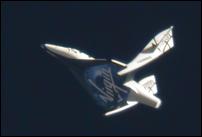
Space tourism craft reaches glide-test milestone
- High over the Mojave Desert, the stubby-winged SpaceShipTwo bent itself into a near-right angle shape and plunged nearly straight downward for more than a minute before unfolding and gliding to a runway landing before an excited crowd.He returned to Patuxent for a second tour of duty and engaged in flight testing the F3H Demon, F8U Crusader, F4D Skyray and F11F Tigercat. He was also project test pilot on the F5D Skylancer, and his last five months at Patuxent were spent as an instructor in the Test Pilot School. He later attended the Naval War College at Newport, R.I., and upon graduating in 1957 was assigned to the staff of the commander in chief of the Atlantic Fleet as aircraft readiness officer.
He logged more than 8,000 hours flying time, 3,700 hours of that in jet aircraft.
In April 1959, Shepard was named by NASA as one of the Mercury astronauts. In 1961, the historic launch took place.
In 1963, he was designated chief of the astronaut office with responsibility for monitoring the coordination, scheduling and control of all activities involving NASA astronauts. This included monitoring the development and implementation of effective training programs to assure the flight readiness of available pilot/non-pilot personnel for assignment to crew positions on manned space flights; furnishing pilot evaluations applicable to the design, construction and operations of spacecraft systems and related equipment; and providing qualitative scientific and engineering observations to facilitate overall mission planning, formulation of feasible operational procedures and selection and conduct of specific experiments for each flight.
There were also personnel health challenges to weather as an inner ear disorder required Shepard to undergo corrective surgery. The surgery was deemed successful, and he was restored to full flight status in May 1969.
Shepard seemed destined to fly and remained dedicated to NASA and its programs.
He flew in a second space flight as spacecraft commander on the Apollo 14 moon mission from Jan. 31 to Feb. 9, 1971. He was accompanied on that third lunar landing mission by Stuart A. Roosa, command module pilot; and Edgar D. Mitchell, lunar module pilot. They maneuvered their lunar module, "Antares," to a landing in the hilly upland Fra Mauro region of the moon.
Achievements of the Apollo 14 mission included the first use of the Mobile Equipment Transporter (MET); the largest payload placed in lunar orbit; the longest distance traversed on the lunar surface; the largest payload returned from the lunar surface; the longest lunar surface stay time (33 hours); the first use of shortened lunar orbit rendezvous techniques; and the first use of color TV broadcasts from the moon.
Shepard once again served as chief of the astronaut office in June 1971 and served in this capacity until he retired from NASA and the Navy on Aug. 1, 1974.
Shepard belonged to numerous organizations, including a fellow of the American Astronautical Society and the Society of Experimental Test Pilots; a member of the Rotary Club, the Kiwanis, the Mayflower Society, the Order of the Cincinnati and the American Fighter Aces; an honorary member of the board of directors for the Houston School for Deaf Children; a director of the National Space Institute and a director of the Los Angeles Ear Research Institute.
Becky Robinette Wright is a freelance writer and photographer who lives in Virginia.