Estimated read time: 4-5 minutes
This archived news story is available only for your personal, non-commercial use. Information in the story may be outdated or superseded by additional information. Reading or replaying the story in its archived form does not constitute a republication of the story.
WARREN, Weber County — Clint Wade is a fourth-generation dairyman who is milking cows much differently than his great-grandpa. Despite his impressive state-of-the-art milking parlor on a carousel and computer-monitored ankle bracelets on every cow, one thing hasn’t changed — when it rains, it pours.
Since the nearby Weber River receded slightly over the weekend, operations on Wadeland Dairy in Warren are not as critical as they were last week. The pump the dairy installed on an earthen dike dug by Weber County workers is turned off but not removed.
“A little more rain or a lot of sunshine could bring the waters right back,” said Clint Wade. His father, Blaine Wade, confirmed, “If it turns warm, things could become critical real fast.”
A little more rain or a lot of sunshine could bring the waters right back.
–Clint Wade
Only a railroad track and a few soggy acres separate the river from hundreds of calving pens full of newborn Holsteins and Jerseys. The Wades have 1,600 milk cows, more than 1,500 heifers and 26 employees to help keep operations running smoothly. They grow some feed crops but buy more than 50 percent of needed corn silage and 80 percent of their alfalfa from other producers.
The Wades produce 100,000 pounds of milk per day, supplying local cheese companies like Gossner’s and Beehive Cheese; the latter uses the Wades' milk exclusively in its line of artisan cheese.
Driving over a dirt road that was recently submerged, Clint Wade points to 300 swampy acres of productive farming land on which planting has been delayed by at least a month this season. More than 40 acres are clearly under water, and the Wades doubt the area will be useful at all this year.
While their Holstein and Jersey herds won’t have to be moved even if floodwaters return, their commodity sheds and haystacks were in peril and could be again.
From the Archives:
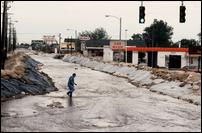
“We’ve got several different kinds of grain stored and all the minerals,” Blaine Wade said. “It’s pretty expensive feed, so protecting that was our first priority and we’ve got it in control now."
The Wades certainly remember the floods of 1983 and have expanded operations since then. They bought more ground, including the south dairy, where Clint Wade’s family home had to be sandbagged to survive.
With clouds dumping again today, Blaine Wade said water isn’t his only concern this season. “I grew up on a dairy. I’ve never known anything else,” he said. “So I always worry about the weather. I worry about prices, and this year could be worse than ever on both accounts. We’re not there yet, but Mother Nature has not been kind, and who knows what’s coming next. It could be a tough year all the way around.”
The Wades have attempted to diversify, receiving accolades for the bio-gas digester installed by Utah State University inventors a couple of years ago that processes manure into methane gas. While hopes were high it could be a renewable source of fuel as well as another commodity for dairies, Blaine Wade said the experiment has proven to be just that: experimental.
Related:

Flood Watch 2011
Keep track of water levels with KSL's exclusive Flood Watch 2011 River Flow Tracker.“Things worked well the first year, but after, well, it’s been temperamental,” he said. “There’s still a lot of improving to do, but they’re trying to get grants to keep it going.”
Last year, the Wades built a 50-rotary milking parlor, where cows take an eight-minute ride on a revolving carousel to be milked. As they disembark from their ride, a computer reads individual ankle bracelets and records data. Clint Wade monitors the numbers from his office computer and instantly knows how many steps the cow has taken that day, how much milk she produced and if she’s ready to breed. If either the pedometer or production number is off, automated gates sort the cow to an alternate pen for further evaluation.
“There’s a thousand things we can monitor on the cows,” Clint Wade said. “But it’s been really helpful to know if we’ve got one that’s lame or has mastitis without having to track her down in the field.”
Despite the availability of modern processes and savvy technology, Blaine Wade said, “You can’t invest in new technology without any money, so we’ll just keep things going the way we know best and hope milk prices meet our costs this year.”
As rain continues to pour and water in the fields rises and falls, Blaine Wade jokingly agreed that it was “all hands on deck” at the dairy this spring.
Stacie Lloyd Duce is a columnist and magazine editor featured regularly in several Montana newspapers and magazines. Her column appears every Thursday on www.MormonTimes.com.