- A new display at Salt Lake County Government Center uses marbles to help visualize water.
- The display highlights water sources, solutions and trends for the Great Salt Lake.
- Envision Utah is collaborating on a new long-term lake management plan.
Editor's note: This article is published through the Great Salt Lake Collaborative, a solutions journalism initiative that partners news, education and media organizations to help inform people about the plight of the Great Salt Lake.
SALT LAKE CITY — Utah's future relies very heavily on the health of the Great Salt Lake, but Jason Brown agrees that handling it can be very tricky and confusing.
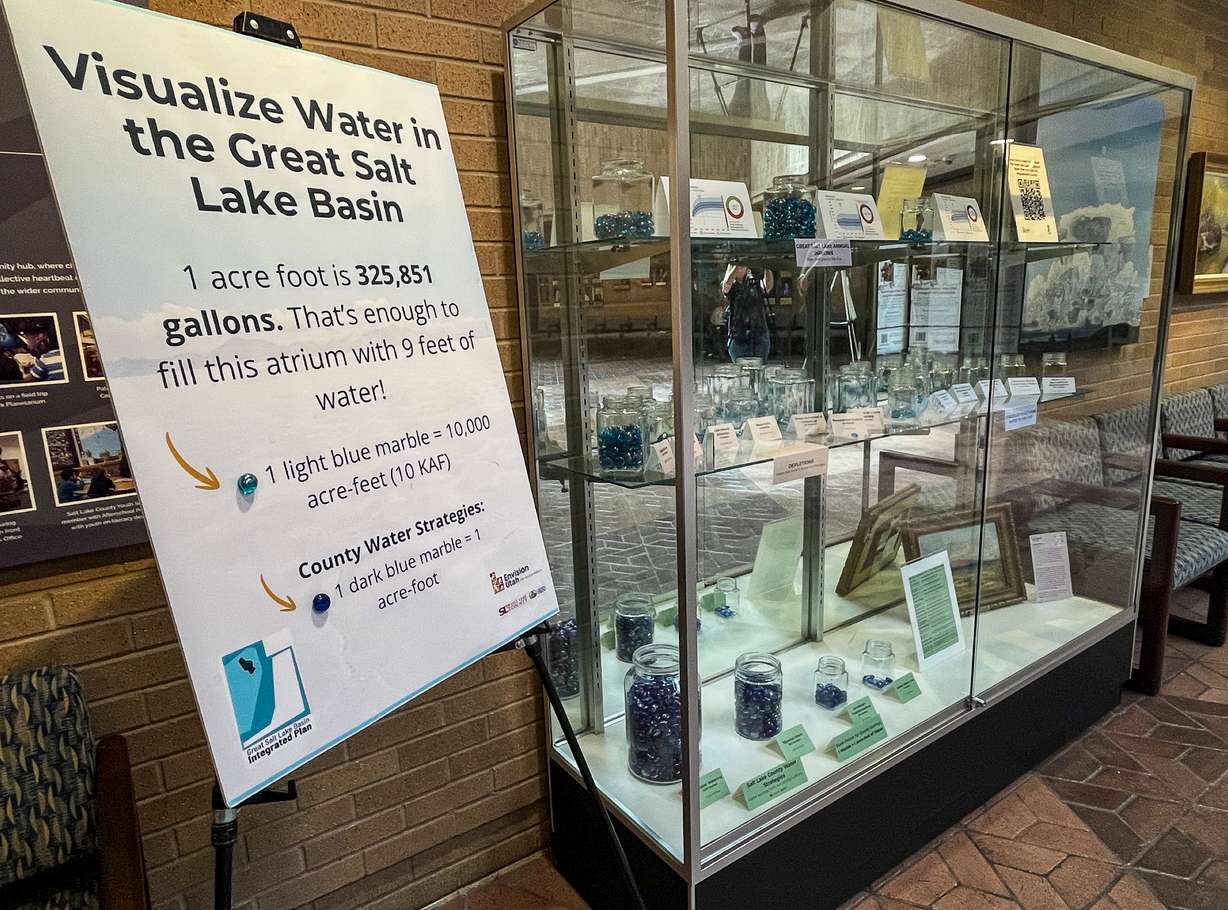
"It's probably one of the biggest challenges. We also believe that the more people that understand what really goes into some of these issues, the better abled we're going to be to figure out how to make changes to get what we want out of the feature," said Brown, CEO of Envision Utah, as he points to a glass case tucked inside the Salt Lake County Government Center on Tuesday.
The case is stocked with multiple glass jars filled with blue marbles, all of which represent 10,000 acre-feet of water. One shelf highlights the amount of water pulled away from the lake from various sources, while another displays the amount of water each solution could bring back to it.
"Visualize Water in the Great Salt Lake Basin," the display's name, also includes graphs that display the latest water projection trends outlined by the Great Salt Lake Strike Team.
It's meant to help simplify the lake's complexity, helping visualize its barriers and the value of each potential water solution, thus making it easier for residents to understand its situation, he explains. Envision Utah, a state growth planning nonprofit, helped design the display as an educational tool, as it works with state agencies on a new plan to manage the lake.
Brown presented county leaders with a brief presentation on water consumption trends after the organization added the display to the center's North Building Atrium, located at 2001 S. State. He and others told county leaders that the lake factors heavily in economic and environmental issues, including air quality and snowpack concerns.
The lake is currently between 6 and 7 feet below its minimum healthy level.
"Making sure that we can have a healthy Great Salt Lake to support a thriving quality of life here is probably one of the biggest existential questions we have," he told KSL afterward. "If the lake dries up, that would be catastrophic for the state. It would make this place very unhealthy and almost uninhabitable. ... It would be a huge problem."
Envision Utah is currently working alongside the Office of the Great Salt Lake Commissioner and other natural resource agencies on a first-of-its-kind lake management plan called the Great Salt Lake Basin Integrated Plan. It will help outline strategies to balance a healthy lake with a higher quality of life when it's completed in 2027.
It's currently in its initial stages, which include gathering data as well as feedback from people to understand lake and water priorities, and what types of trade-offs people would be willing to support, Brown said. This information will be used to develop different scenarios for how Utah could manage the lake while it grows.
The organization coordinated with Salt Lake County to place "Visualize Water in the Great Salt Lake Basin" in its headquarters, so that residents can be better informed about the situation during this process. It's expected to remain in the building over the next few months.
"We're educating, and we're putting the information in people's hands who need to know how they can conserve," said Emily Paskett, the county's sustainability director.
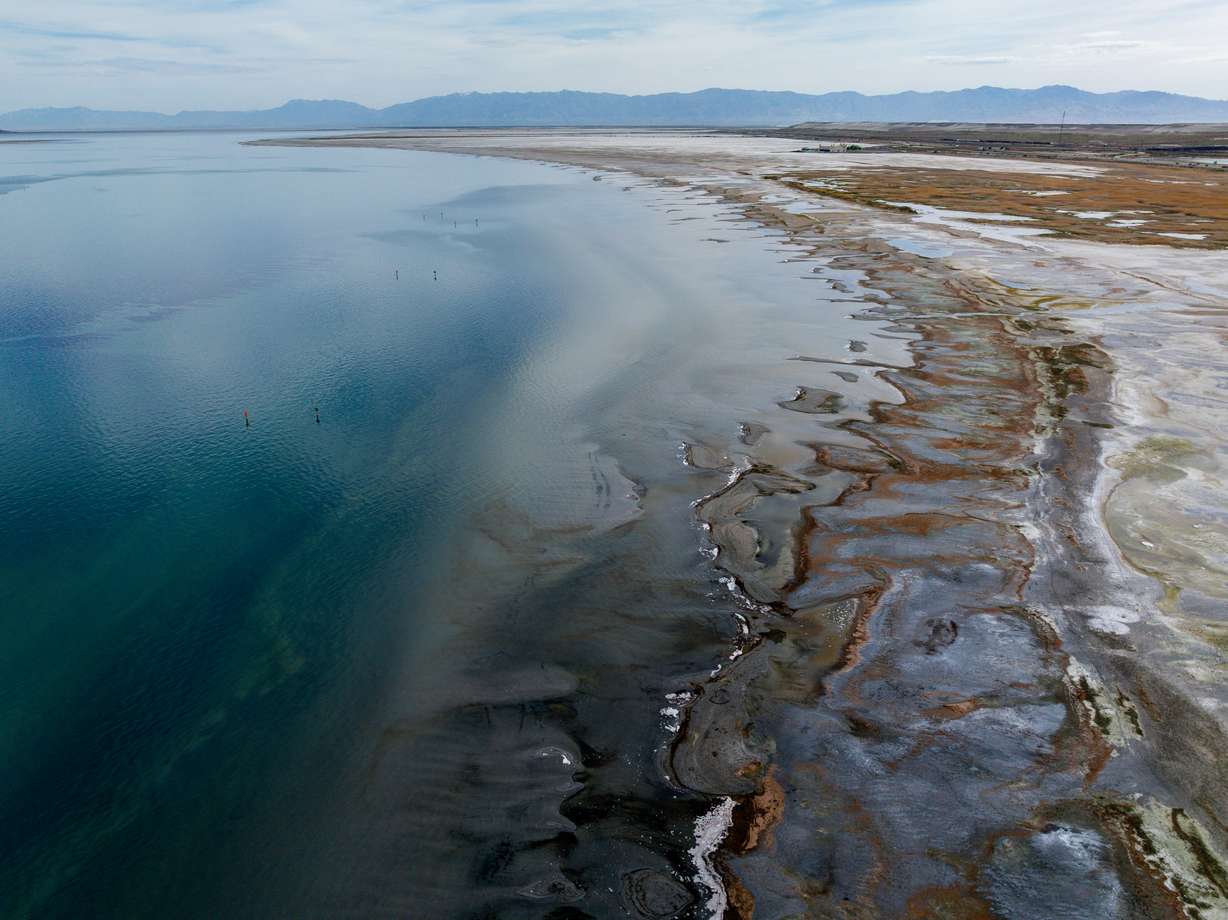
This year adds a wrinkle in planning for the lake, which was brought up in the meeting. Utah's statewide snowpack peaked at a record low, refueling drought concerns.
Salt Lake County doesn't provide water, and it can't impose restrictions, but it does help coordinate water issues among its cities. It plans to publish a water supply outlook and conservation recommendation report next month. That should help the lake in the short-term, Paskett said.
Evaporative loss isn't included in the marbles. About 2.6 million acre-feet of water is lost within the lake, wetlands and exposed sediment every year, which is close to the 2.1 million acre-feet lost to upstream depletions, according to a BYU study published in 2023. That's something that county leaders say residents should also consider when using water.
"It's really a lot that we have to fill, so everything matters, and everything that we can do to help is great," said Salt Lake County Councilwoman Dea Theodore.
The state is urging residents to hold off on outdoor watering until at least May 15, on top of other ways to conserve water this year.
It comes just three years after it experienced a record high snowpack, giving experts a much wider range of winter scenarios to consider in the future. That's helping adjust models for situations the lake could face any given year.
"I think the changes we've seen over the last few years ... can be a little bit of a wakeup call to help us understand that we can't really predict what our water future is going to look like," Brown said. "But we can use the last few years as a good lesson to say, 'We've got to figure out how to manage our water in ways that make us resilient to (both extremes)."