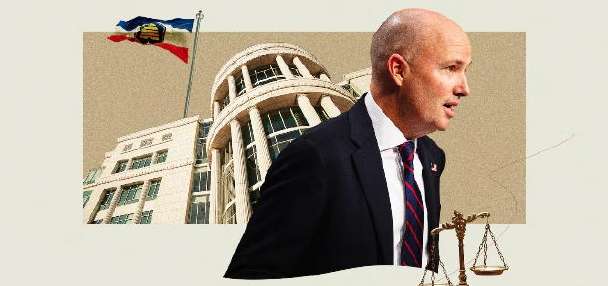
- Rep. Celeste Maloy defended her congressional record as Phil Lyman challenged the GOP establishment during a debate Monday.
- Both candidates for Utah's 3rd Congressional District raised questions about the proposed data center in Box Elder County.
- Maloy is supportive of an immigrant detention facility in Utah, while Lyman calls for quick deportations.
SALT LAKE CITY — Rep. Celeste Maloy defended her congressional record while challenger Phil Lyman called out the Republican establishment during a primary debate on Monday.
The nearly hourlong contest between the two candidates for Utah's 3rd Congressional District was cordial, and while both outlined conservative policy priorities, they sometimes disagreed on the specifics of how they would approach issues in Washington.
Lyman told reporters after the debate that his campaign is looking to highlight the issues he has with Maloy's record since she joined Congress in 2023.
"It really is to try to differentiate," he said. "And it's not to be negative about my opponent, it's to say, 'Do you realize that the stakes are very, very high on these things, and the person that we elect is going to affect these things moving forward?' And this is her track record so far, which I think is a poor track record."
Maloy said she has also been critical of Congress in the past and even since being elected, but said "everybody's critical of things that they haven't had to try yet."
"I haven't exactly served a long time, but I've been there long enough to know that it takes a steady hand, a patient attitude, a people person who's willing to go in and build coalitions and work with people and find out what matters to them," she told KSL. "I've started doing that. I actually think I'm pretty good at it, and I'd like to keep doing that. It's easy to criticize Congress from the outside. When you're on the inside, you have to find ways to get things done, and that's what I've been doing."
Here's how both candidates sought to differentiate themselves on several key issues, including data centers and a proposed immigrant detention facility in Salt Lake City.
Data center development
Moderator Thomas Wright kicked off Monday's debate at the PBS Utah studios in Salt Lake City by asking both candidates for their thoughts on the large data center proposed in Box Elder County. The Stratos Project, backed by celebrity investor Kevin O'Leary, has quickly turned into a political flashpoint.
Both candidates expressed reservations about the data center but left the door open for supporting future projects if Utah voters are more involved in the process.
"On paper, Utah is a perfect place to build data centers," Maloy said. "Unfortunately, data centers aren't built on paper, and states are made up of people, and the people in Utah have questions, and they want those questions answered."
She said future projects should be built "where people want them" and should "match our resources." That could include prioritizing projects that are cooled by air instead of water, given the scarcity of water in Utah.
"I support building data centers in Utah when the people of Utah support them, and right now I don't know that we have that in Box Elder County," she said, later adding that she hopes the state can "get to a place where the people of Utah welcome data centers."
Lyman criticized the process and said Box Elder County residents have been "treated poorly" and were not adequately consulted on the project in advance. And in response to public backlash, he said they were met with "a reprimand, a put-down, a condescension toward those people."
"I don't agree that Utah is the best place for data centers," he said. "They are water intensive, and they are a drain on resources, and those things can all be measured if we have transparency on the front end of it."
"I'm a fan of Kevin O'Leary," he added. "I'm a fan of data. I'm a fan of computers. I'm a fan of technology. I believe in that, but as far as the one in Box Elder County, until they're transparent about it, I'm opposed to it."
Immigration
Lyman and Maloy also offered divergent visions for how to deal with immigration, and for a federal proposal to build an immigrant detention facility in Salt Lake City.
Lyman said some in Congress "hate America" and said a policy of "suicidal empathy" on immigration has led to abuse of temporary visa programs.
He said he opposes the detention facility and that undocumented immigrants should be quickly deported instead.
"Utah has kind of a prison mentality already, and I'm afraid that if we build a big facility like that, the emphasis would be more to keep it full than to get it emptied," he said.
Maloy credited President Donald Trump with establishing border security upon his return to office and said Congress now needs to work toward fixing the nation's legal immigration system.
"We have to make sure we're deporting the people who need to be deported and fixing the legal immigration system so that people who want to come here, live the American dream and become Americans have a way to do that that makes sense," she said.
She expressed support for more detention beds in Utah, and said she would like to see "the administration work with Utah and treat us like we are a state that supports them and find a place and do it in a way that makes sense for the state."
What's next?
Maloy is seeking her second full term in Congress and narrowly defeated Lyman during the GOP nominating convention in April. She currently represents Utah's 2nd Congressional District but is running for reelection in the 3rd District thanks to a newly redrawn map that will be in place for the fall election.
Lyman has served on the San Juan County Commission and as a state lawmaker from Blanding. He is running for higher office for the second time in several years after unsuccessfully challenging Gov. Spencer Cox in 2024.
The winner will go on to face Democrat Kent Udell, Cassie Easley of the Constitution Party and Libertarian Michael Stoddard in the general election.
The primary election is June 23, and ballots will be sent out beginning this week.