'%3e%3cpath%20d='M34.1406%205.85938C30.3906%202.10547%2025.3047%200%2020%200C14.6953%200%209.60938%202.10547%205.85938%205.85938C2.10938%209.61328%200%2014.6953%200%2020C0%2025.3047%202.10547%2030.3906%205.85938%2034.1406C9.61328%2037.8906%2014.6953%2040%2020%2040C25.3047%2040%2030.3906%2037.8945%2034.1406%2034.1406C37.8906%2030.3906%2040%2025.3047%2040%2020C40%2014.6953%2037.8945%209.60938%2034.1406%205.85938ZM37.0117%2023.543H31.1602V13.5391H27.6328V19.9414C28.1211%2020.6914%2028.3711%2021.582%2028.3711%2022.5625V22.625C28.3711%2023.668%2028.1172%2024.6055%2027.6328%2025.4297V26.6094H36.082C33.4883%2032.9375%2027.2891%2037.3789%2020.0039%2037.3789C10.3711%2037.3789%202.62109%2029.6289%202.62109%2020C2.62109%2010.3711%2010.3711%202.62109%2020%202.62109C29.6289%202.62109%2037.3789%2010.3711%2037.3789%2020C37.3789%2021.1484%2037.2617%2022.2656%2037.0508%2023.3477C37.0391%2023.4141%2037.0234%2023.4766%2037.0117%2023.543Z'%20fill='white'/%3e%3cpath%20d='M22.3086%2018.5352C20.4336%2018.125%2019.9531%2017.8398%2019.9766%2017.1836V17.1406C19.9766%2016.6992%2020.3477%2016.2148%2021.4023%2016.2148C22.582%2016.2148%2023.8867%2016.6797%2025.0781%2017.4766L26.8516%2015.0195C25.4453%2013.8906%2023.707%2013.3398%2021.5547%2013.3398C18.5195%2013.3398%2016.4375%2015%2016.4063%2017.4766V17.5352C16.3633%2020.2617%2018.5859%2020.9805%2021.293%2021.6016C23.0391%2021.9766%2023.5703%2022.3164%2023.5703%2022.9609L23.5469%2022.9766C23.5469%2023.3906%2023.2578%2023.7031%2022.7852%2023.8359C22.5742%2023.9062%2022.1289%2023.9727%2021.5156%2023.9727C20.7617%2023.9727%2019.7539%2023.8633%2018.6328%2023.4844C18.0898%2023.2891%2017.4727%2023.0039%2016.8047%2022.6133L20.1406%2026.625C20.2813%2026.6602%2021.0977%2026.8516%2021.7734%2026.8516C25.0039%2026.8516%2027.0859%2025.2461%2027.1094%2022.6328V22.5703C27.1602%2020.1133%2025.2148%2019.1719%2022.3086%2018.5352Z'%20fill='white'/%3e%3cpath%20d='M5.24219%2013.5664V26.6133H8.75391V23.7578L10.2969%2021.9531L14.2031%2026.6133H18.3867L12.3555%2019.5195L17.4023%2013.5664H13.4531L8.75391%2019.0586V13.5664H5.24219Z'%20fill='white'/%3e%3c/g%3e%3cdefs%3e%3cclipPath%20id='clip0_97_2430'%3e%3crect%20width='40'%20height='40'%20fill='white'/%3e%3c/clipPath%3e%3c/defs%3e%3c/svg%3e)




- Latino soccer fans in Utah, notably aficionados of Mexico, are paying close attention to the World Cup.
- Mexico and several other nations of Latin America, where the sport is king, have teams in the tournament.
- Nielsen, the audience measurement firm, says Latinos are "the heart of U.S. soccer fandom and the engine behind the sport's cultural foothold."
SALT LAKE CITY — If you grow up in a Mexican family, rooting for the Mexican national soccer team apparently comes natural.
"I think when you're Mexican, it's the law," joked Gill Armenta, who's from Salt Lake City though he has family members from Mexico.
Now that the World Cup is unfolding, though, focus on the team is even more intense by him and Latinos around the state and beyond. Mexico and several other Latin American nations are fielding teams in the tournament and Latino fans are paying close attention as the games unfold. The 801 Events Center in Salt Lake City, operated by Armenta and his family, hosted a watch party for Wednesday's World Cup game between Mexico and Czechia, and Juan Hernandez was one of the many people on hand to watch.
"I'm just rooting for (Mexico) because it's my home country," he said, seated with a group of friends. Hernandez, wearing a dark green Mexican team jersey, is originally from the Mexican state of San Luis Potosi though he now lives in Salt Lake City.
Alberto Jimenez, originally from Argentina but now living in Springville, was also there. Though quietly watching the Mexican team en route to a 3-0 win over Czechia, his heart is with Argentina's team and the squad's star player, Lionel Messi, who led the country to the 2022 World Cup title.
"We're going to be champs again," said Jimenez.
To be sure, the soccer fanbase as a whole has been growing in the United States, though football, basketball and baseball still dominate as the most popular sports. But Latino soccer fans in the United States, people like Jimenez, are especially attuned to the World Cup, according to Nielsen, the audience measurement firm that has researched the issue.
"Hispanic audiences have been at the heart of U.S. soccer fandom and the engine behind the sport's cultural foothold," Nielsen said in a recent report on the World Cup, The Fans Behind the Game. Nielsen estimates that 67% of first- and second-generation Hispanic fans in the United States plan to engage with the tournament via social media and that the Latino population is 102% more likely to have watched a World Cup qualifying match in the last 12 months.
The passion was evident at the 801 Events Center, where the crowd erupted after each of Mexico's three goals.
A man who identified himself as Hugo G., of Guatemalan descent, says his heart is with the Guatemalan national team. They didn't make the tournament, though, so he was there to support Mexico, which borders the Central American nation. "It's kind of like the next closest thing I can root for," he said.
He says the sport serves as a unifier, especially among people rooting for the same team, and lamented soccer's secondary status to sports like football and basketball. "I wish it could be bigger here. It's awesome. It unites a lot of people," he said.
While Mexico won Wednesday's game and moves on to the next stage of the World Cup, Armenta said there's something about playing on the global stage, win or lose. "Even if we lose we're very proud of our culture, glad to be there, glad to be representing," he said.
'Proud of our heritage, our roots'
At the same time as the watch party at the 801 Events Center, another watch party was taking place nearby at the Mexican Civic Center, also in Salt Lake City. The Mexicano Latino Institute of Utah helped organized the event in conjunction with the Mexican Consulate of Salt Lake City. Watch parties were also held at the civic center for Mexico's earlier games against South Korea and South Africa.
Juan Carlos Becerra, who helps lead the institute, said the intent of the watch parties has been to promote a sense of community among the area's scattered soccer fans. Many attending on Wednesday were wearing the dark green jersey of Mexico, though some also said they'd be rooting for the U.S. team, which, like Mexico, also makes it to the next round.
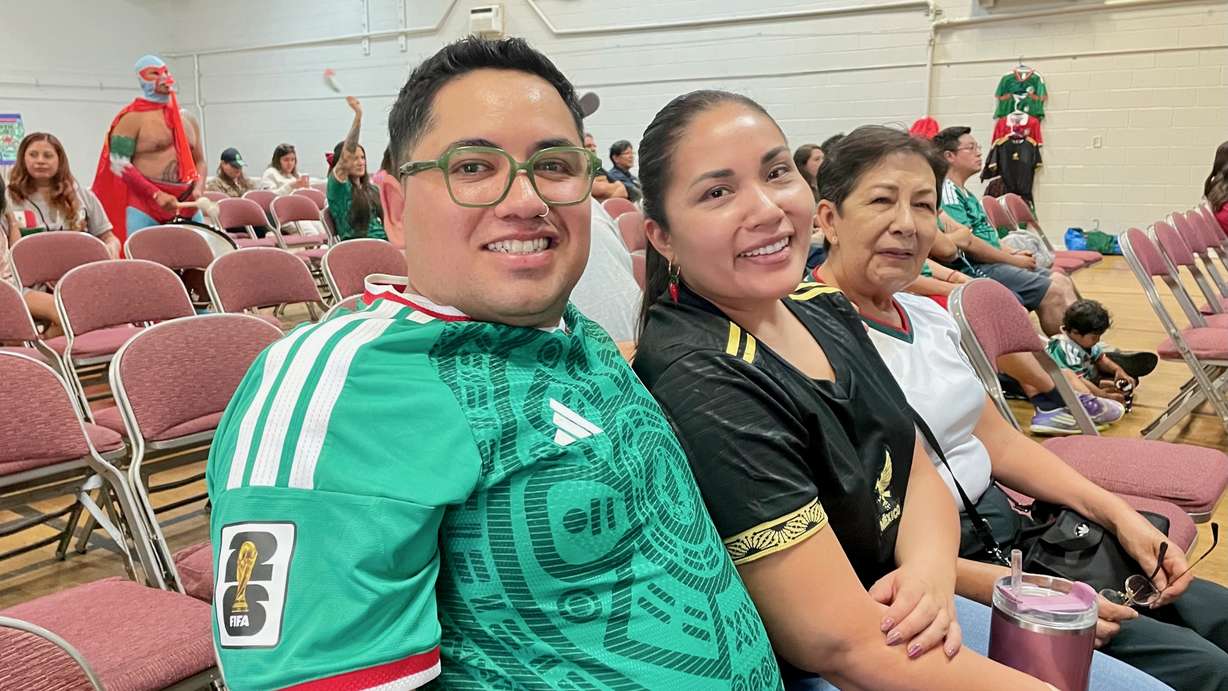
"It's obviously the most followed sport in the world, but in Latin America it's lived as a passion," Becerra said. He said he "grew up playing it, coached it, watch it, eat it, drink it. I don't know, all of the above."
Fercho Sanchez was wearing wrestling tights, a cape and a mask in true Mexican "lucha libre" fashion, banging on a drum to rouse the fans. Nevertheless, he thinks passion for things like soccer comes naturally, without a whole lot of prodding.
Read more:

Voces de Utah
Looking for more news from Utah's Latino community? Visit our Voces de Utah section for more stories, events and features."I want to tell you a secret — the Hispanic community, they like to celebrate anything. We just look for any excuse to celebrate. No matter who's playing, we're going to be there to celebrate," he said. While cheering on Mexico, he said he'd actually root for the United States if the two teams were to meet.
Fazur Alberto Estrada was watching last Wednesday's game with his wife Elizabeth Estrada, both in green Mexican jerseys. "We are proud of our heritage, our roots. Soccer unites Mexico," Elizabeth Estrada said.
Carlos Becerra, whose wife works for the Mexican Consulate, said getting together with friends, family or strangers, even, to watch when the Mexican national team plays is a tradition. "If Mexico plays in Japan or Africa or the Moon or Mars, we'll always watch them together," he said.