'%3e%3cpath%20d='M34.1406%205.85938C30.3906%202.10547%2025.3047%200%2020%200C14.6953%200%209.60938%202.10547%205.85938%205.85938C2.10938%209.61328%200%2014.6953%200%2020C0%2025.3047%202.10547%2030.3906%205.85938%2034.1406C9.61328%2037.8906%2014.6953%2040%2020%2040C25.3047%2040%2030.3906%2037.8945%2034.1406%2034.1406C37.8906%2030.3906%2040%2025.3047%2040%2020C40%2014.6953%2037.8945%209.60938%2034.1406%205.85938ZM37.0117%2023.543H31.1602V13.5391H27.6328V19.9414C28.1211%2020.6914%2028.3711%2021.582%2028.3711%2022.5625V22.625C28.3711%2023.668%2028.1172%2024.6055%2027.6328%2025.4297V26.6094H36.082C33.4883%2032.9375%2027.2891%2037.3789%2020.0039%2037.3789C10.3711%2037.3789%202.62109%2029.6289%202.62109%2020C2.62109%2010.3711%2010.3711%202.62109%2020%202.62109C29.6289%202.62109%2037.3789%2010.3711%2037.3789%2020C37.3789%2021.1484%2037.2617%2022.2656%2037.0508%2023.3477C37.0391%2023.4141%2037.0234%2023.4766%2037.0117%2023.543Z'%20fill='white'/%3e%3cpath%20d='M22.3086%2018.5352C20.4336%2018.125%2019.9531%2017.8398%2019.9766%2017.1836V17.1406C19.9766%2016.6992%2020.3477%2016.2148%2021.4023%2016.2148C22.582%2016.2148%2023.8867%2016.6797%2025.0781%2017.4766L26.8516%2015.0195C25.4453%2013.8906%2023.707%2013.3398%2021.5547%2013.3398C18.5195%2013.3398%2016.4375%2015%2016.4063%2017.4766V17.5352C16.3633%2020.2617%2018.5859%2020.9805%2021.293%2021.6016C23.0391%2021.9766%2023.5703%2022.3164%2023.5703%2022.9609L23.5469%2022.9766C23.5469%2023.3906%2023.2578%2023.7031%2022.7852%2023.8359C22.5742%2023.9062%2022.1289%2023.9727%2021.5156%2023.9727C20.7617%2023.9727%2019.7539%2023.8633%2018.6328%2023.4844C18.0898%2023.2891%2017.4727%2023.0039%2016.8047%2022.6133L20.1406%2026.625C20.2813%2026.6602%2021.0977%2026.8516%2021.7734%2026.8516C25.0039%2026.8516%2027.0859%2025.2461%2027.1094%2022.6328V22.5703C27.1602%2020.1133%2025.2148%2019.1719%2022.3086%2018.5352Z'%20fill='white'/%3e%3cpath%20d='M5.24219%2013.5664V26.6133H8.75391V23.7578L10.2969%2021.9531L14.2031%2026.6133H18.3867L12.3555%2019.5195L17.4023%2013.5664H13.4531L8.75391%2019.0586V13.5664H5.24219Z'%20fill='white'/%3e%3c/g%3e%3cdefs%3e%3cclipPath%20id='clip0_97_2430'%3e%3crect%20width='40'%20height='40'%20fill='white'/%3e%3c/clipPath%3e%3c/defs%3e%3c/svg%3e)




- Salt Lake City opened the 400 South Viaduct Trail, featuring a 2,000-foot art piece.
- The trail connects east and west sides, enhancing pedestrian and bicycle access past I-15.
- "Strut," designed by Haddad Drugan, reflects Poplar Grove's history and improves trail safety.
SALT LAKE CITY — Utah's capital city has a new urban trail, and it comes with what might be the state's longest piece of art celebrating a unique story from the community it connects.
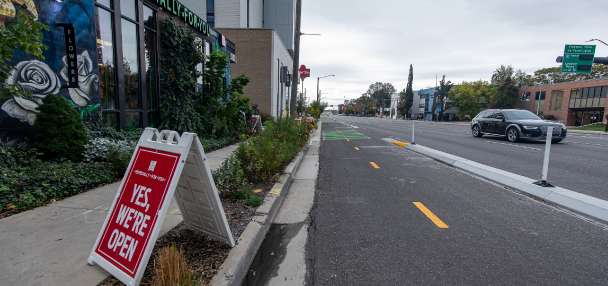
Salt Lake City completed its new 400 South Viaduct Trail this spring, a path that runs alongside 400 South from 900 West in Poplar Grove to 200 West in downtown. It offers safer pedestrian and bicycle passage along I-15 in the area and expands the city's planned urban trail network.
It also reaches a recently completed extension of the 300 West Bikeway, a bike path that connects to the 9-Line Trail and also runs toward the southwest end of the Ballpark neighborhood.
Both projects, which cost approximately $10.2 million, were previously identified as prime locations for trails and bike lanes in a 2015 master plan, which aimed to create a connected network within the city, said Will Becker, transportation planner for Salt Lake City.
City planners knew that an increasingly residential city would require options for travel and that the designs would be important in getting people to shopping and business areas, too.
The planning paid off, as the network is located in an area of the city that has experienced some of the most growth over the past decade. It crosses Salt Lake City's Granary and Post districts, which have effectively extended downtown south and west, and the Central Ninth and Ballpark neighborhoods have also started to see new redevelopment along 300 West.
The Rio Grande area, located toward the meeting point of the two trails, is also poised for growth, while Pioneer Park — adjacent to the connection point — is receiving a facelift this year.
"I think it's just fortuitous that we were able to get a head start on that, knowing that a lot is happening in those parts of the city," Becker said.

Salt Lake City has recently embarked on efforts to solve long-standing transportation challenges between its east and west sides, where the 400 South Viaduct Trail helps. The city installed new bus stops, signage, and other elements to make it easier for people to travel along the trail or by transit past I-15.
Shifting two narrow walkways into one larger one and adding lighting should improve safety, said Daniel Tuutau, chairman of the Poplar Grove Community Council.
While both projects are slated for possible modifications through SB242, Salt Lake City had a soft launch of each in April. It's holding a grand opening on Wednesday.
City officials and project leaders will meet with residents and riders at Neighborhood House, 1050 W. 500 South, for a bike ride across the bridge, to 300 West, and around the 9-Line Trail back to Poplar Grove. It coincides with a community council meeting at the Neighborhood House at 7 p.m., also on Wednesday.
"We're very excited anytime the city makes those connections better," Tuutau said. "We get a lot of lip service of wanting to give help, so it's nice to see a couple of times it actually happens."
An 'iconic landmark'
Its crown jewel, however, is Strut, a colorful panel of signs along the south end of the 400 South Viaduct bridge, which spans nearly 2,000 feet. Its design is a nod to Poplar Grove in both a literal and metaphoric sense, while also serving as a functional piece of the trail.
While Salt Lake City transportation planners were designing the new trail, they also began discussing the creation of some sort of "iconic landmark" to accompany it, said Mary Sizemore, a city transportation engineer.
Since the project received funding from the city's capital improvement program, it qualified for public arts funds, at which point the Salt Lake City Arts Council got involved. Over 70 artists applied, but the field was narrowed when everyone agreed on artist-designed infrastructure, in which the art piece was integrated into the transportation project itself.
"This project was unique because we were looking for an artist who could also be working as somewhat of an engineer and a designer," said Renato Olmedo-González, public art program manager for the arts council.
That led them to Laura Haddad and Tom Drugan, of Haddad Drugan, an artist team based in Seattle that specializes in "public art that is often integrated into large-scale infrastructure projects."
Haddad and Drugan met with Poplar Grove residents and learned more about the neighborhood's history. Residents highlighted the Jordan River and nature, as well as their unique peafowl history dating back several decades.
Leon and Leonne Brown brought peafowls to the neighborhood in the 1940s and 1950s, Tuutau explained. They ended up becoming intertwined in the ecosystem and have remained with Poplar Grove ever since.

Visit Poplar Grove today, and you'll find playful signs in yards and on trees, advising people to slow down because of the peacocks. Perhaps you'll find one squawking as it meanders through the neighborhood. They're even the official mascot of the neighborhood council.
It inspired Strut, a series of retro-reflective sign film and solid polycarbonate panels in different colors that resemble the colors of Utah's nature throughout the seasons, as well as the colors of a peacock's feathers.
"It also has this sense of movement, moving from east to west, you get one color block at a time," Sizemore said, noting that a barrage of colors toward its western edge by Poplar Grove represents peafowl.

The film and panels also help improve nighttime lighting, making the trail safer for users. That's the additional functional element.
At nearly 2,000 feet, it's twice as long as the River Tunnel at Salt Lake City International Airport and a few hundred feet longer than the Spiral Jetty at the Great Salt Lake, Olmedo-González said. He points out that Nine Mile Canyon is "the world's longest art gallery," but Strut is believed to be the longest single piece of artwork in Utah.
"It was different for us in terms of how we select artists, but I think, in the end, it resulted in a really beautiful and rewarding experience for everybody," he said, adding that he hopes people feel safer when they cross the bridge and joy in its uniqueness.
Tuutau, who was glad to see the peacock featured in the design, hopes it might raise awareness of Poplar Grove and showcase what it has to offer.
"Any kind of acknowledgment we can get is going to be helpful for us, to have our own identity," he said. "Hopefully, this is one step of getting more recognition so people know that we're here ... and having more advocacy on a wider scale."