'%3e%3cpath%20d='M34.1406%205.85938C30.3906%202.10547%2025.3047%200%2020%200C14.6953%200%209.60938%202.10547%205.85938%205.85938C2.10938%209.61328%200%2014.6953%200%2020C0%2025.3047%202.10547%2030.3906%205.85938%2034.1406C9.61328%2037.8906%2014.6953%2040%2020%2040C25.3047%2040%2030.3906%2037.8945%2034.1406%2034.1406C37.8906%2030.3906%2040%2025.3047%2040%2020C40%2014.6953%2037.8945%209.60938%2034.1406%205.85938ZM37.0117%2023.543H31.1602V13.5391H27.6328V19.9414C28.1211%2020.6914%2028.3711%2021.582%2028.3711%2022.5625V22.625C28.3711%2023.668%2028.1172%2024.6055%2027.6328%2025.4297V26.6094H36.082C33.4883%2032.9375%2027.2891%2037.3789%2020.0039%2037.3789C10.3711%2037.3789%202.62109%2029.6289%202.62109%2020C2.62109%2010.3711%2010.3711%202.62109%2020%202.62109C29.6289%202.62109%2037.3789%2010.3711%2037.3789%2020C37.3789%2021.1484%2037.2617%2022.2656%2037.0508%2023.3477C37.0391%2023.4141%2037.0234%2023.4766%2037.0117%2023.543Z'%20fill='white'/%3e%3cpath%20d='M22.3086%2018.5352C20.4336%2018.125%2019.9531%2017.8398%2019.9766%2017.1836V17.1406C19.9766%2016.6992%2020.3477%2016.2148%2021.4023%2016.2148C22.582%2016.2148%2023.8867%2016.6797%2025.0781%2017.4766L26.8516%2015.0195C25.4453%2013.8906%2023.707%2013.3398%2021.5547%2013.3398C18.5195%2013.3398%2016.4375%2015%2016.4063%2017.4766V17.5352C16.3633%2020.2617%2018.5859%2020.9805%2021.293%2021.6016C23.0391%2021.9766%2023.5703%2022.3164%2023.5703%2022.9609L23.5469%2022.9766C23.5469%2023.3906%2023.2578%2023.7031%2022.7852%2023.8359C22.5742%2023.9062%2022.1289%2023.9727%2021.5156%2023.9727C20.7617%2023.9727%2019.7539%2023.8633%2018.6328%2023.4844C18.0898%2023.2891%2017.4727%2023.0039%2016.8047%2022.6133L20.1406%2026.625C20.2813%2026.6602%2021.0977%2026.8516%2021.7734%2026.8516C25.0039%2026.8516%2027.0859%2025.2461%2027.1094%2022.6328V22.5703C27.1602%2020.1133%2025.2148%2019.1719%2022.3086%2018.5352Z'%20fill='white'/%3e%3cpath%20d='M5.24219%2013.5664V26.6133H8.75391V23.7578L10.2969%2021.9531L14.2031%2026.6133H18.3867L12.3555%2019.5195L17.4023%2013.5664H13.4531L8.75391%2019.0586V13.5664H5.24219Z'%20fill='white'/%3e%3c/g%3e%3cdefs%3e%3cclipPath%20id='clip0_97_2430'%3e%3crect%20width='40'%20height='40'%20fill='white'/%3e%3c/clipPath%3e%3c/defs%3e%3c/svg%3e)





- The American Civil Liberties Union of Utah advises residents on ICE entry limits amid a federal lawsuit.
- Residents are reminded they don't need to open the door for ICE agents.
- Only judicial warrants, not administrative warrants, allow home entry without consent, says the ACLU.
SALT LAKE CITY — A new federal lawsuit challenging an internal Immigration and Customs Enforcement policy is raising critical questions about what ICE agents can legally do at someone's home — and what Utahns' rights are in those moments.
The American Civil LibertiesUnion of Utah stated that more people have been reaching out for help, although the organization does not publicly release its complaint totals.
"The ACLU of Utah at this time doesn't release aggregated legal intake data on specific issues to protect the privacy of communities seeking legal help," the organization told KSL.
Still, the demand for assistance is climbing.
"We've seen an increase in formal intakes related to immigrant rights, as well as a rise in requests from community partners, attorneys and members," said Aaron Welcher, director of communications for the ACLU of Utah.
The concern follows reporting on an internal federal memo that immigration advocates said would allow ICE officers to enter homes without presenting a judge-signed warrant, a policy now being challenged in court.
"ICE does not get to opt out of the Fourth Amendment," said Molly Karasick, immigrant rights legal fellow with the ACLU of Utah. "The Constitution, the United States Constitution and the Utah Constitution apply to every single person in the United States, regardless of your citizenship."
Do you have to open the door? The ACLU says no
The ACLU's advice begins with a single, crucial point: You do not have to open the door.
"You can expressly say, 'I do not consent to you entering my home,'" Karasick said.
You may ask ICE to show a warrant, without opening the door, by requesting they slide it underneath or display it through a window.
According to the ACLU, most warrants ICE carries are administrative warrants, which do not authorize entry into a home without consent.
"It requires ICE to present a valid judicial warrant before entering somebody's home or a private space — not an administrative warrant, which is signed by an ICE officer," Karasick said.
"You do not have to answer any questions from an ICE agent who is outside your door," she added. "And if you're unsure of what to do, I think it's best to not answer the door."
Top 10 things the ACLU says you need to know
The following guidance reflects what the ACLU of Utah advises based on current law and ongoing legal challenges.
- You do not have to open the door: You can communicate through the door and clearly state, "I do not consent to you entering my home."
- Ask to see the warrant — without opening the door: You may ask officers to slide it under the door or display it through a window.
- Administrative warrants do not authorize home entry, according to the ACLU: These warrants are signed by ICE, not by a judge.
- Only judicial warrants authorize entry, according to the ACLU: A valid judicial warrant must be issued by a court, bear a judge's signature and list the exact address to be searched.
- You have the right to remain silent: This applies, regardless of citizenship.
- You may ask ICE for identification.
- Never physically resist ICE entry: Physical resistance can escalate danger.
- Document everything: Karasick said under the Utah law and the Constitution, "everyone has the right to record law enforcement interactions, as long as you're not interfering." If recording isn't possible, write down the time, date, officer names and vehicle identifiers.
- If detained, you have the right to an attorney — but one will not be appointed automatically.
- Red cards can be handed to ICE and outline your rights in writing.
Easy ways to tell an administrative warrant from a judicial warrant
Not all warrants are the same.
One of the most important — and most confusing — distinctions is the difference between an administrative warrant and a judicial warrant. According to immigration attorneys, only one of them allows ICE to enter a private home without consent.
Administrative warrant (ICE-issued)
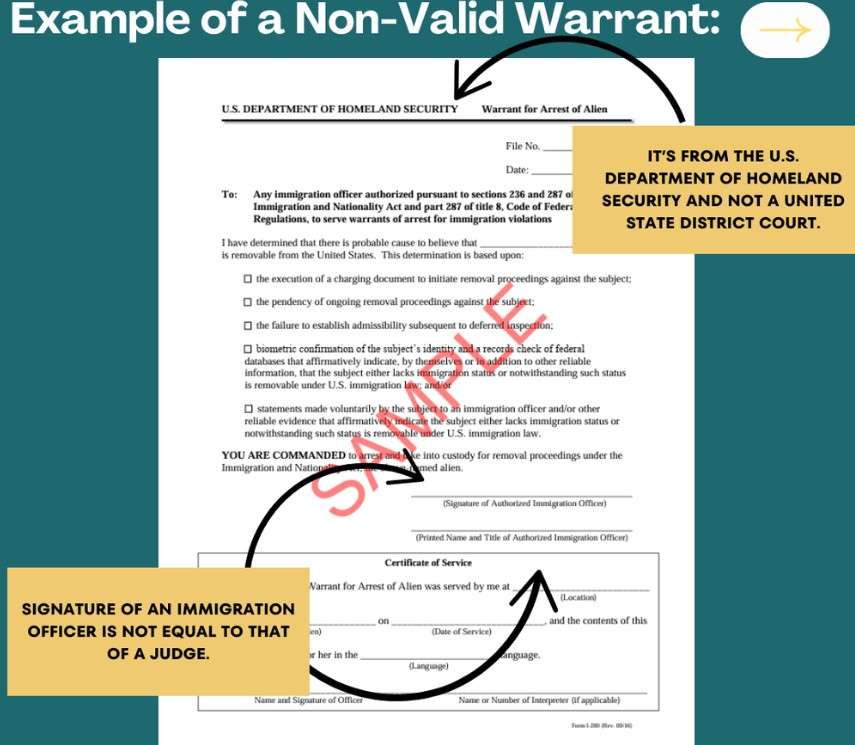
This is the type of warrant ICE carries most often — and it does not permit home entry.
An administrative warrant is an immigration document issued and signed by ICE itself. It is used for civil immigration enforcement, not criminal search.
How to recognize it:
- The top states "U.S. Department of Homeland Security," not a court name.
- The signature line reads "Signature of Authorized Immigration Officer."
- It may be labeled "Form I-200 or Form I-205."
- It typically lists a person's name, not a home address.
What it allows:
- ICE may arrest someone in a public location.
- ICE cannot enter a home with only this warrant.
What the ACLU says this means:
This type of warrant does not authorize ICE to enter a home without consent.
Judicial warrant (court-issued)
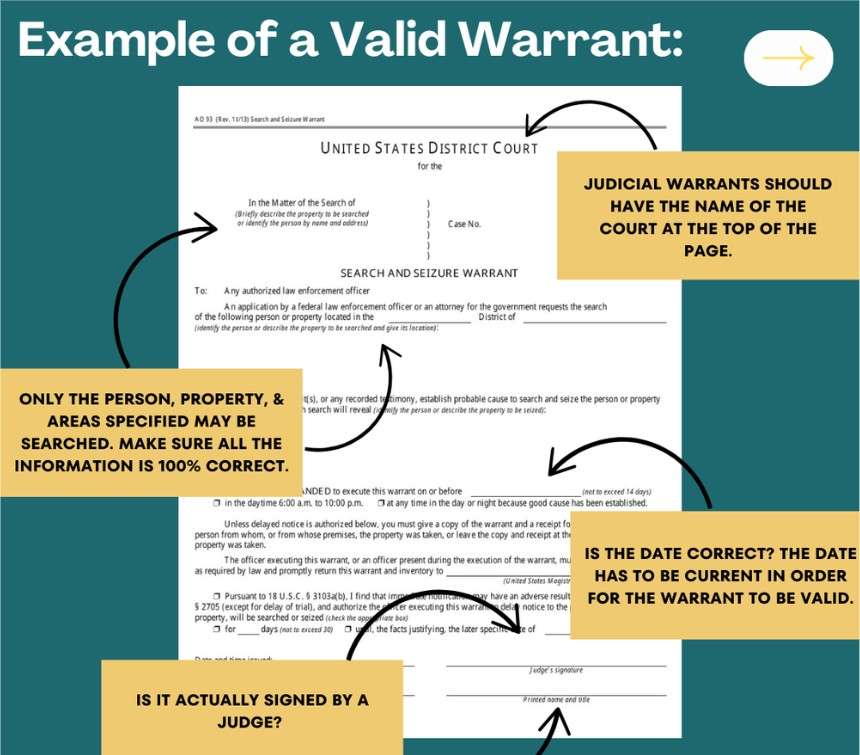
This is the only type of warrant that permits ICE to enter a home without consent, according to the ACLU and immigration attorneys.
A judicial warrant is a court order issued by a judge based on probable cause.
How to recognize it:
- The top lists an official court name.
- It includes a judge's signature.
- It lists the exact address to be searched.
- It carries a court seal and case number.
What it allows:
- ICE may legally enter the home even if the occupant does not consent.
- Officers may search only the areas listed in the warrant.
What the ACLU says this means:
Only a judicial warrant authorizes ICE to enter a home without consent.
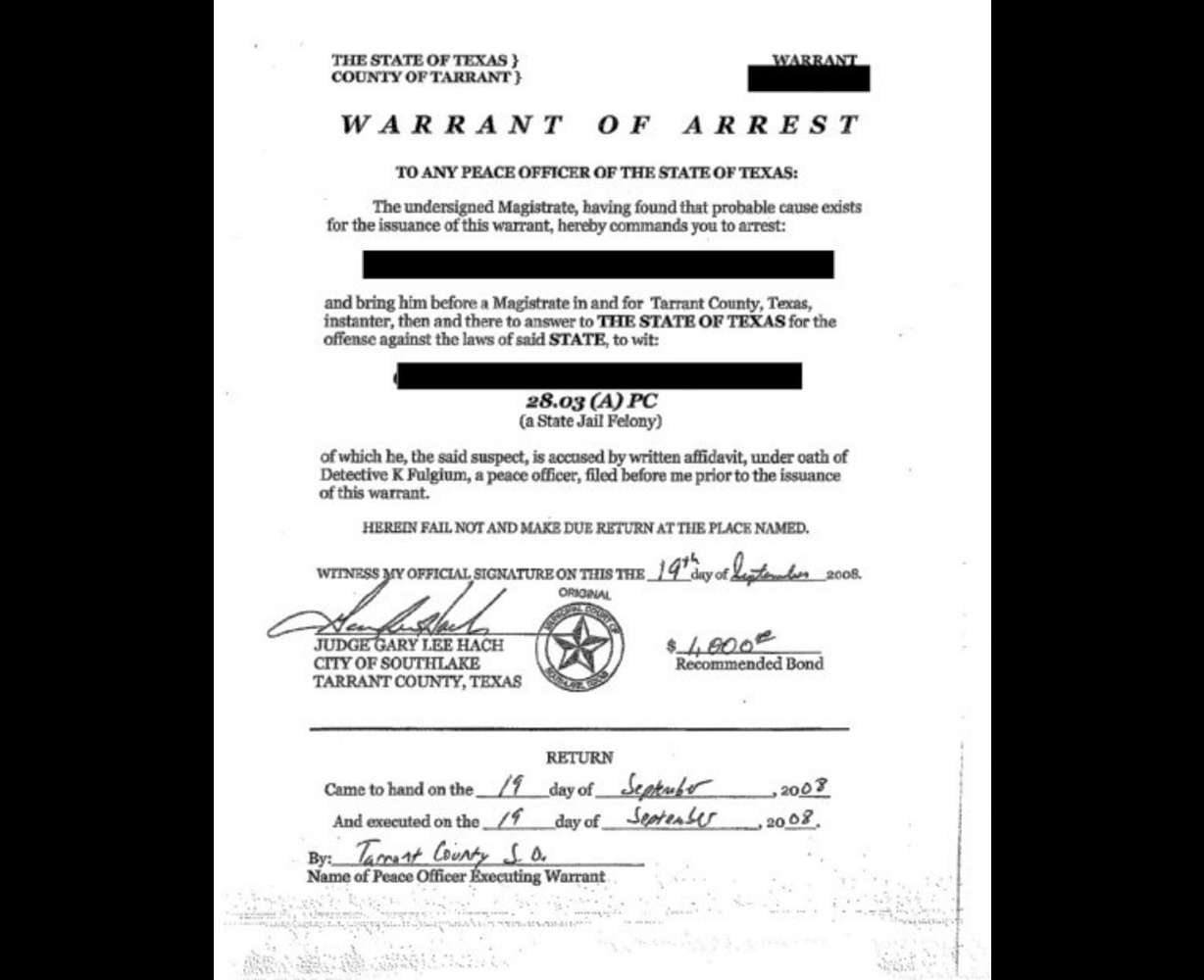
What to do if ICE enters without the proper warrant
The ACLU stresses that no one should physically resist, even if the entry appears unlawful.
"Some of the specific constitutional rights that are extremely important are the Fifth Amendment right to remain silent and the Fourth Amendment, which protects against unreasonable searches and seizures by the government," Karasick said.
Karasick said the ACLU has also raised broader concerns based on cases and complaints it has reviewed.
"People are not having appropriate access to contact their attorneys when they're detained by ICE," Karasick said. "We've also seen, on multiple occasions, ICE detaining U.S. citizens, which is a clear constitutional violation."
She said those concerns are not limited to home-entry situations.
"It's scary just to see ICE and CBP violating people's rights on the streets who are simply exercising their First Amendment right to protest," Karasick said. "It's chilling."
ICE and the Department of Homeland Security have previously disputed claims of systemic constitutional violations and state that detainees are afforded due process under federal law.
Have you experienced something you think just isn't right? The KSL Investigators want to help. Submit your tip at investigates@ksl.com or 385-707-6153 so we can get working for you.