'%3e%3cpath%20d='M34.1406%205.85938C30.3906%202.10547%2025.3047%200%2020%200C14.6953%200%209.60938%202.10547%205.85938%205.85938C2.10938%209.61328%200%2014.6953%200%2020C0%2025.3047%202.10547%2030.3906%205.85938%2034.1406C9.61328%2037.8906%2014.6953%2040%2020%2040C25.3047%2040%2030.3906%2037.8945%2034.1406%2034.1406C37.8906%2030.3906%2040%2025.3047%2040%2020C40%2014.6953%2037.8945%209.60938%2034.1406%205.85938ZM37.0117%2023.543H31.1602V13.5391H27.6328V19.9414C28.1211%2020.6914%2028.3711%2021.582%2028.3711%2022.5625V22.625C28.3711%2023.668%2028.1172%2024.6055%2027.6328%2025.4297V26.6094H36.082C33.4883%2032.9375%2027.2891%2037.3789%2020.0039%2037.3789C10.3711%2037.3789%202.62109%2029.6289%202.62109%2020C2.62109%2010.3711%2010.3711%202.62109%2020%202.62109C29.6289%202.62109%2037.3789%2010.3711%2037.3789%2020C37.3789%2021.1484%2037.2617%2022.2656%2037.0508%2023.3477C37.0391%2023.4141%2037.0234%2023.4766%2037.0117%2023.543Z'%20fill='white'/%3e%3cpath%20d='M22.3086%2018.5352C20.4336%2018.125%2019.9531%2017.8398%2019.9766%2017.1836V17.1406C19.9766%2016.6992%2020.3477%2016.2148%2021.4023%2016.2148C22.582%2016.2148%2023.8867%2016.6797%2025.0781%2017.4766L26.8516%2015.0195C25.4453%2013.8906%2023.707%2013.3398%2021.5547%2013.3398C18.5195%2013.3398%2016.4375%2015%2016.4063%2017.4766V17.5352C16.3633%2020.2617%2018.5859%2020.9805%2021.293%2021.6016C23.0391%2021.9766%2023.5703%2022.3164%2023.5703%2022.9609L23.5469%2022.9766C23.5469%2023.3906%2023.2578%2023.7031%2022.7852%2023.8359C22.5742%2023.9062%2022.1289%2023.9727%2021.5156%2023.9727C20.7617%2023.9727%2019.7539%2023.8633%2018.6328%2023.4844C18.0898%2023.2891%2017.4727%2023.0039%2016.8047%2022.6133L20.1406%2026.625C20.2813%2026.6602%2021.0977%2026.8516%2021.7734%2026.8516C25.0039%2026.8516%2027.0859%2025.2461%2027.1094%2022.6328V22.5703C27.1602%2020.1133%2025.2148%2019.1719%2022.3086%2018.5352Z'%20fill='white'/%3e%3cpath%20d='M5.24219%2013.5664V26.6133H8.75391V23.7578L10.2969%2021.9531L14.2031%2026.6133H18.3867L12.3555%2019.5195L17.4023%2013.5664H13.4531L8.75391%2019.0586V13.5664H5.24219Z'%20fill='white'/%3e%3c/g%3e%3cdefs%3e%3cclipPath%20id='clip0_97_2430'%3e%3crect%20width='40'%20height='40'%20fill='white'/%3e%3c/clipPath%3e%3c/defs%3e%3c/svg%3e)



Estimated read time: 3-4 minutes
- Utah Rep. Katy Hall, who sponsored HB261, said the measure isn't meant to prohibit speech but to promote wide-ranging debate.
- Controversy flared after Weber State supplied a potential guest speaker with a list of "prohibited words and concepts," citing HB261.
- Hall and Sen. John Johnson, also involved in crafting HB261, addressed the issue at a forum at the Ogden university.
OGDEN — Utah Rep. Katy Hall says HB261, a new state law banning public diversity, equity and inclusion initiatives, was never meant to prohibit speech on university campuses.
"We want speakers on all ends of the spectrum so we can have that bouncing of ideas," she said Thursday at a legislative forum at Weber State University in Ogden. "We don't want to limit speech. That's never what (HB261) was about."
The issue has flared on the Weber State campus stemming from a list of "prohibited words and concepts" the university supplied to a potential guest speaker, citing HB261, legislation sponsored in 2024 by Hall. The would-be guest speaker, author Darcie Little Badger, opted not to appear at WSU last month because of the list.
Utah Sen. John Johnson, who also took part in the forum, echoed Hall, a South Ogden Republican. He was key in helping craft HB261, which targeted diversity, equity and inclusion programs at Utah's public universities.
"I think it's crucial that we do talk about sensitive topics, but we do them in a sensible manner," said Johnson, a North Ogden Republican. "There is nothing in that bill that says you can't use these words."
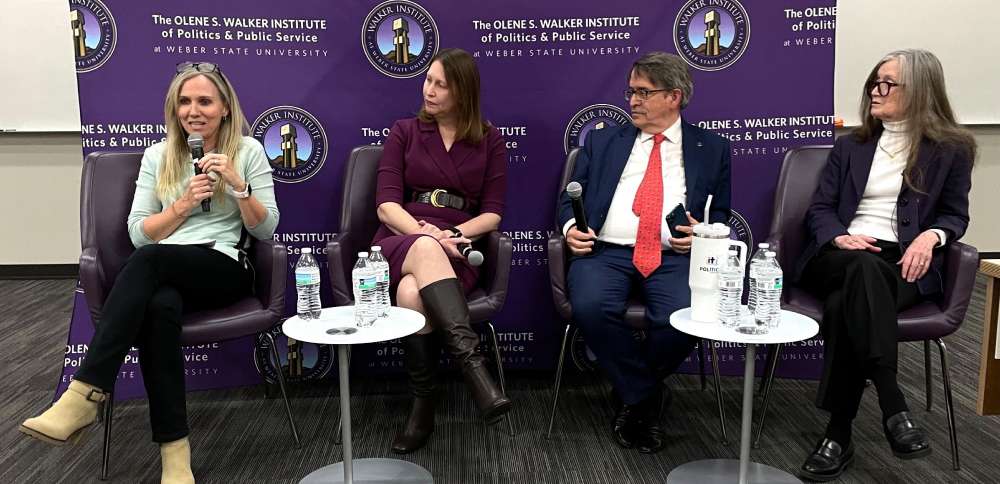
The two lawmakers and Rep. Karianne Lisonbee, R-Syracuse, penned an opinion piece on the issue that appeared in the Deseret News Dec. 15. Hall and Johnson addressed the issue for the first time in a public setting at Thursday's gathering, which also included Utah Rep. Karen Peterson, R-Clinton, and Utah Sen. Ann Millner, R-Ogden.
Leah Murray, director of Weber State's Walker Institute of Politics and public service and a political science professor at the university, helped moderate Thursday's gathering. She led off the forum with a question about HB261 and the speech guidelines supplied to Little Badger.
University officials, she said, "felt the way that we were implementing (HB261) was the best way to make sure we did not run afoul of the Legislature's wishes." After the controversy emerged, Interim WSU President Leslie Durham said the university was reviewing its response to HB261 with an eye to potentially revising it.
Hall, however, said she was "shocked" the university had crafted a list of prohibited words, and Johnson was likewise surprised.
"Quite frankly I was kind of sad that that happened at Weber because honestly, I think Weber State's done a fantastic job of implementing that law, probably better than any other university," Johnson said.
HB261 required Weber State and Utah's other public universities to get rid of diversity, equity and inclusion initiatives. Critics say that such programming, typically geared to traditionally marginalized communities to help them adjust to university life, is discriminatory to other groups. The law also prohibits universities from requiring would-be students or faculty to take part in training or sign documents aimed at making them abide by diversity, equity and inclusion principles.
"The idea is to teach students to question things. That's kind of been our philosophy all along," Johnson said. "What we don't want to do is force people to think a certain way."
Johnson said he and Hall are considering a "cleanup bill" in the 2026 legislative session "to make sure we articulate what was meant." He and Hall are also considering additional legislation meant to bring in speakers to university campuses to foster debate on "sensitive topics," though he didn't provide many additional details.
Millner said the "silver lining" of the controversy at Weber State over language guest speakers may use is that it helps clarify the issue. New legislation can sometimes be misinterpreted, requiring lawmakers to revisit it, she said, "and I think that's what's happened here."