'%3e%3cpath%20d='M34.1406%205.85938C30.3906%202.10547%2025.3047%200%2020%200C14.6953%200%209.60938%202.10547%205.85938%205.85938C2.10938%209.61328%200%2014.6953%200%2020C0%2025.3047%202.10547%2030.3906%205.85938%2034.1406C9.61328%2037.8906%2014.6953%2040%2020%2040C25.3047%2040%2030.3906%2037.8945%2034.1406%2034.1406C37.8906%2030.3906%2040%2025.3047%2040%2020C40%2014.6953%2037.8945%209.60938%2034.1406%205.85938ZM37.0117%2023.543H31.1602V13.5391H27.6328V19.9414C28.1211%2020.6914%2028.3711%2021.582%2028.3711%2022.5625V22.625C28.3711%2023.668%2028.1172%2024.6055%2027.6328%2025.4297V26.6094H36.082C33.4883%2032.9375%2027.2891%2037.3789%2020.0039%2037.3789C10.3711%2037.3789%202.62109%2029.6289%202.62109%2020C2.62109%2010.3711%2010.3711%202.62109%2020%202.62109C29.6289%202.62109%2037.3789%2010.3711%2037.3789%2020C37.3789%2021.1484%2037.2617%2022.2656%2037.0508%2023.3477C37.0391%2023.4141%2037.0234%2023.4766%2037.0117%2023.543Z'%20fill='white'/%3e%3cpath%20d='M22.3086%2018.5352C20.4336%2018.125%2019.9531%2017.8398%2019.9766%2017.1836V17.1406C19.9766%2016.6992%2020.3477%2016.2148%2021.4023%2016.2148C22.582%2016.2148%2023.8867%2016.6797%2025.0781%2017.4766L26.8516%2015.0195C25.4453%2013.8906%2023.707%2013.3398%2021.5547%2013.3398C18.5195%2013.3398%2016.4375%2015%2016.4063%2017.4766V17.5352C16.3633%2020.2617%2018.5859%2020.9805%2021.293%2021.6016C23.0391%2021.9766%2023.5703%2022.3164%2023.5703%2022.9609L23.5469%2022.9766C23.5469%2023.3906%2023.2578%2023.7031%2022.7852%2023.8359C22.5742%2023.9062%2022.1289%2023.9727%2021.5156%2023.9727C20.7617%2023.9727%2019.7539%2023.8633%2018.6328%2023.4844C18.0898%2023.2891%2017.4727%2023.0039%2016.8047%2022.6133L20.1406%2026.625C20.2813%2026.6602%2021.0977%2026.8516%2021.7734%2026.8516C25.0039%2026.8516%2027.0859%2025.2461%2027.1094%2022.6328V22.5703C27.1602%2020.1133%2025.2148%2019.1719%2022.3086%2018.5352Z'%20fill='white'/%3e%3cpath%20d='M5.24219%2013.5664V26.6133H8.75391V23.7578L10.2969%2021.9531L14.2031%2026.6133H18.3867L12.3555%2019.5195L17.4023%2013.5664H13.4531L8.75391%2019.0586V13.5664H5.24219Z'%20fill='white'/%3e%3c/g%3e%3cdefs%3e%3cclipPath%20id='clip0_97_2430'%3e%3crect%20width='40'%20height='40'%20fill='white'/%3e%3c/clipPath%3e%3c/defs%3e%3c/svg%3e)


- Utah System of Higher Education head Geoff Landward says Weber State was "misguided" in crafting a list of prohibited words and concepts for guest speakers.
- The university crafted the list in response to HB261, but Landward said the controversial law doesn't contemplate a ban on the language.
- HB261 aims to ensure "viewpoint diversity," not restrict specific words or concepts.
SALT LAKE CITY — The head of the Utah System of Higher Education is denouncing restrictions that Weber State University tried to place on what a guest speaker could say in the name of complying with HB261.
"That was frankly just misguided and is contrary to what we're trying to do with invited speakers," said Geoff Landward, commissioner of the entity, which helps set and implement policy related to operation of the state's public universities and colleges. "We're not banning or censoring certain words or something because that kind of defeats the whole purpose of having viewpoint diversity."
News publicly emerged last week that Darcie Little Badger, an author and editor scheduled to speak at Weber State University, opted out of appearing after university officials provided her with a list of "prohibited words and concepts." The list included "equity, diversity and inclusion," "anti-racism," "bias, "critical race theory," "implicit bias," "oppression," "intersectionality," "prohibited discriminatory practices," "racial privilege" and "promoting stereotypes based on personal identity characteristics."
"I will not humor this censorship. It does a disservice to the stories I'm discussing & the audience, who deserve unfettered access to information & conversation," Little Badger wrote in a social media post after pulling out of the Weber State speaking engagement. She was to have spoken on Nov. 20 at Weber State's Annual Native Symposium.
According to the list supplied to Little Badger, also supplied to KSL.com by Weber State in response to a public records request, the words and ideas come from HB261, or at least the university's interpretation of the law. HB261 is the 2024 Utah law that prohibits diversity, equity and inclusion initiatives at the state's public universities. Diversity, equity and inclusion critics maintain that such programming, typically geared to traditionally marginalized communities to help them adjust to university life, is discriminatory to other groups.
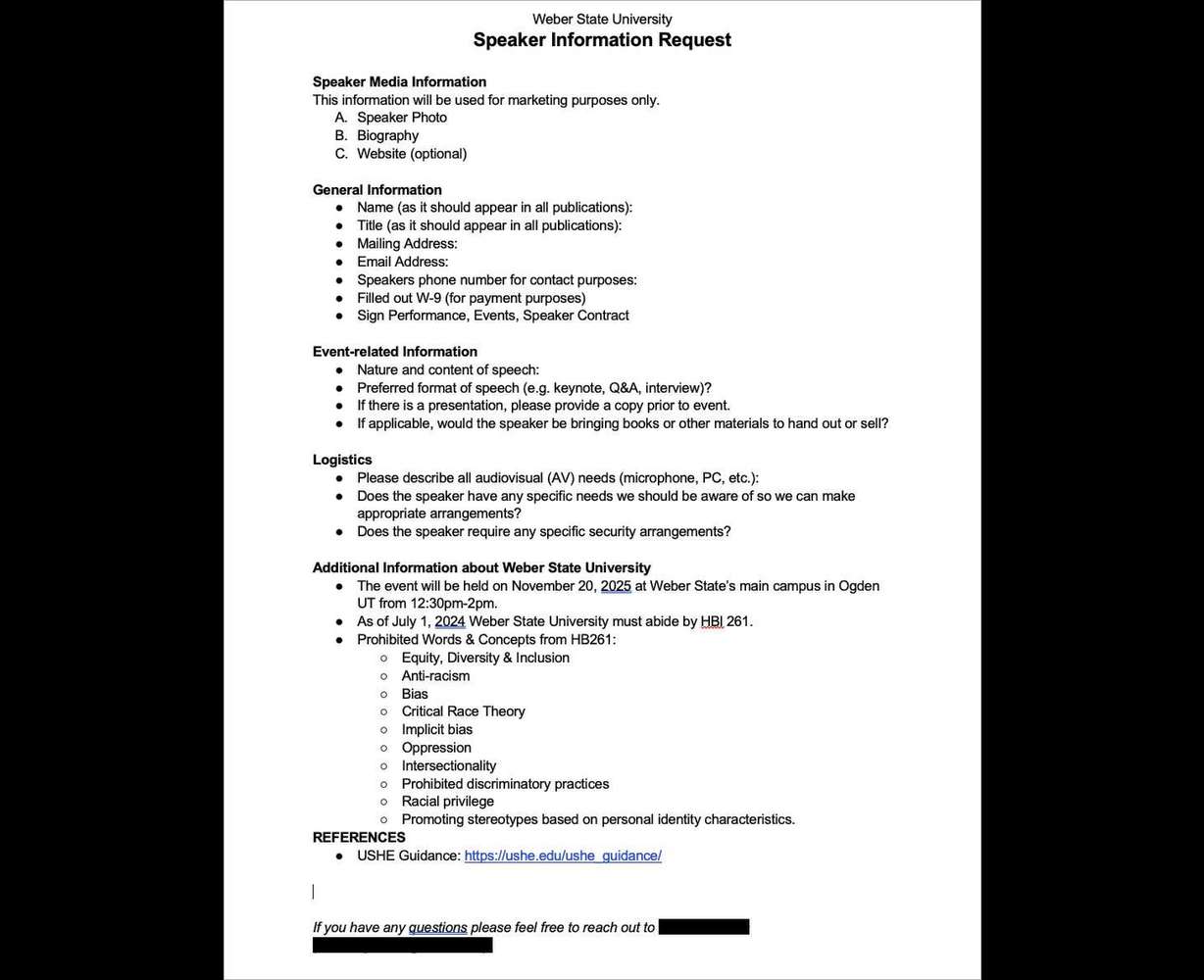
But Landward said HB261 doesn't contain a list of prohibited words or concepts applicable to visiting speakers at universities. The Utah System of Higher Education has helped Weber State and Utah's other public universities adjust their policies and guidelines to comply with the law. "I think this was just an overly cautious approach to a law that went, in my mind, too far. It went beyond what the law requires," he said.
In a message to the university community last Friday, Leslie Durham, the interim Weber State president, addressed the controversy, saying the university is reviewing its response to HB261 and will revise it "where appropriate." The review, she said, is meant to make sure Weber State complies with HB261 and "to ensure we remain fiercely committed to free speech."
Underlying passage of HB261 were concerns among some Republican lawmakers that liberal viewpoints predominate on university campuses in Utah, and HB261 contains provisions meant to promote "viewpoint diversity" among invited speakers. Rather than prohibiting use of certain words or discussion of certain topics, though, Landward said the provision is meant to assure an array of viewpoints among visiting speakers.
"If it appears like an institution is only seeking to invite one viewpoint, that's a problem," Landward said. "But as long as they're making an effort to bring viewpoints on the campus that present different ideas, that's what we want to see."
The point of the provision, he went on, is to promote expression of a range of viewpoints on issues. "Let students think critically, understand the issue better and be able to formulate opinions on this. The school needs to be looking for opportunities to make sure students, the communities, have exposure to the different viewpoints on controversial issues," he said.
Path Forward Utah, a conservative group aimed at promoting civic involvement among racial and ethnic minorities, had tough words for the turn of events at Weber State.
The aim of HB261, which Path Forward Utah backed, wasn't to silence people but to stop what it views as "ideological enforcement" via university programming, including diversity, equity and inclusion programs, the group said in a social media post.
"If Weber State is now blocking speakers from even using certain terms in academic or public events, that is an overcorrection that undermines HB261 and violates the spirit of open inquiry. Conservatives did not fight to remove DEI orthodoxy just to replace it with another form of restricted speech," the group said.

Photos
Related stories
Most recent Politics stories
Related topics
 Tim Vandenack