- UDOT proposes a $258.4 million plan for Big Cottonwood Canyon improvements.
- The plan includes increased transit frequency, tolling and a 1,750-space parking structure.
- UDOT seeks public feedback until January 2026, with a final decision expected in spring.
COTTONWOOD HEIGHTS — The days of "amazing travel" during Big Cottonwood Canyon's peak times are probably never coming back as Utah continues to grow, and people get more involved in its outdoor spaces, says Devin Weder.
However, the project manager for the Utah Department of Transportation believes a series of transportation improvements that the agency is now recommending for the canyon can drastically improve travel times over the next 25 years.
UDOT released its environmental assessment tied to a study of state Route 190 from Fort Union Boulevard to Brighton on Wednesday, which leans toward a recommendation of a 1,750-space parking structure near the mouth of the canyon, as well as increased transit frequency and tolling up the canyon.
"What we're aiming for is to make it better than it is today or the same, so everyone's able to get up the canyon in a reasonable amount of time ... while still getting the same amount or more people up there," he told KSL.com.
The full build-out is expected to cost $258.4 million, but that includes elements of plans for Little Cottonwood Canyon transportation.
What's next for Big Cottonwood Canyon?
Utah Transit Authority currently offers a Big Cottonwood Canyon bus route that runs between Fort Union Station in Midvale and Brighton, which runs on a 30-minute frequency. The plan calls for increasing bus service to a 10 to 15-minute frequency in the winter, which could begin by the end of this decade, Weder said.
The ultimate goal is to increase that to five to seven minutes by 2050. The plan also calls for a "bus-only transitway" that would allow buses to bypass Wasatch Boulevard on their way up and down the canyon, as well as a bus priority lane at the top of the canyon by Brighton Loop Road, which can cut travel times by five minutes.
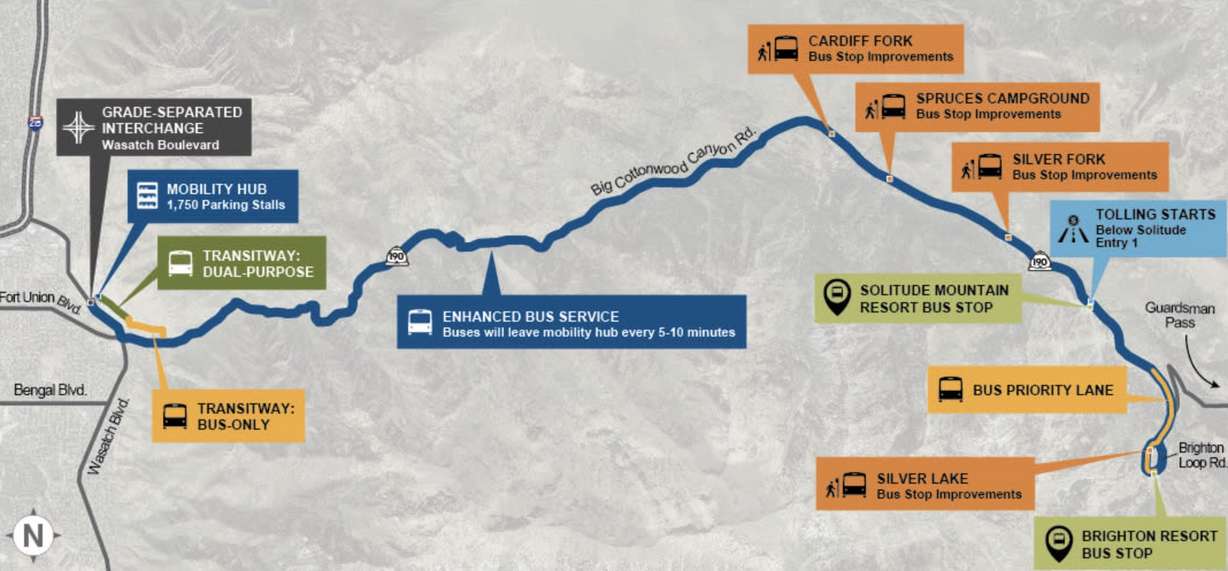
The mobility hub would be located northeast of the intersection linking Fort Union and Wasatch boulevards near the mouth of the canyon. New indoor bus stop facilities are also recommended to be built at Solitude Mountain Resort and Brighton Resort, the two resorts in the canyon. These would include restrooms, lockers and a place to get out of the elements for people traveling up and down the canyon.
Existing stops at other key outdoor places like Cardiff Fork, Spruces Campground, Silver Fork and Silver Lake would be improved by new safety features, platforms and pedestrian crossings, as well.
Tolling is another option that UDOT is considering as it seeks to address canyon transportation, which could encourage people to ride the bus or carpool. The agency is looking at a "variable price" winter-season toll beginning near Solitude.
"It could be nothing or it could be some amount of money," Weder explains. "We will determine what that toll is based on the traffic demand. We want to keep the road moving because it can only handle about 1,000 cars an hour before we get a lot of slowdowns."
It's another option that could be on the table by the end of the decade. Exemptions for Big Cottonwood Canyon residents and employees are being considered if it's implemented.
UDOT launched its study of Big Cottonwood Canyon in 2024, seeking to address travel concerns in the canyon, which is already "at capacity" with 1,000 to 1,200 cars per hour during peak travel periods.
The study projects that bus travel times will improve from nearly 36 minutes now to approximately 25 minutes by 2050, should every element be included. That's also half the time estimated if the improvements aren't implemented. Personal vehicle times might be a bit longer in 2050, but also half what's estimated without changes.
Alex Cabrero, KSL-TVThe next steps
The full build-out's estimated cost does include approximately $114 million that was already outlined in plans for Little Cottonwood Canyon. Utah lawmakers allocated $150 million toward transit enhancements in both Big Cottonwood Canyon and Little Cottonwood Canyon two years ago, as well.
That leaves some funding that will need to be secured before the project is completed. Weder expects that designing could begin as early as next year, but construction may not be complete until 2028 or 2029.
Wednesday's update is not a final decision, though. UDOT says it will collect feedback on the assessment through Jan. 9, 2026, before it reaches a final decision, which is expected in the spring.
The agency will also hold an open house to discuss the plan with residents and recreationists at Canyon View Elementary, 3050 E. Bengal Blvd., on Dec. 17 as a part of that process. It will hold an online meeting the following day, too. Both events are slated to run from 6 p.m. to 8 p.m.
It follows a similar review of Little Cottonwood Canyon, which ended with state transportation officials recommending increased bus service and tolling, road widening and snow sheds, and eventually a gondola as part of a three-phase plan released in 2023. UDOT has yet to implement any of the phases, however, because of delays from a lawsuit over the proposed gondola.
A gondola was not considered for Big Cottonwood Canyon because it wasn't considered in the 2023 legislative funding, and the canyon's topography would also make it difficult, Weder said.