'%3e%3cpath%20d='M34.1406%205.85938C30.3906%202.10547%2025.3047%200%2020%200C14.6953%200%209.60938%202.10547%205.85938%205.85938C2.10938%209.61328%200%2014.6953%200%2020C0%2025.3047%202.10547%2030.3906%205.85938%2034.1406C9.61328%2037.8906%2014.6953%2040%2020%2040C25.3047%2040%2030.3906%2037.8945%2034.1406%2034.1406C37.8906%2030.3906%2040%2025.3047%2040%2020C40%2014.6953%2037.8945%209.60938%2034.1406%205.85938ZM37.0117%2023.543H31.1602V13.5391H27.6328V19.9414C28.1211%2020.6914%2028.3711%2021.582%2028.3711%2022.5625V22.625C28.3711%2023.668%2028.1172%2024.6055%2027.6328%2025.4297V26.6094H36.082C33.4883%2032.9375%2027.2891%2037.3789%2020.0039%2037.3789C10.3711%2037.3789%202.62109%2029.6289%202.62109%2020C2.62109%2010.3711%2010.3711%202.62109%2020%202.62109C29.6289%202.62109%2037.3789%2010.3711%2037.3789%2020C37.3789%2021.1484%2037.2617%2022.2656%2037.0508%2023.3477C37.0391%2023.4141%2037.0234%2023.4766%2037.0117%2023.543Z'%20fill='white'/%3e%3cpath%20d='M22.3086%2018.5352C20.4336%2018.125%2019.9531%2017.8398%2019.9766%2017.1836V17.1406C19.9766%2016.6992%2020.3477%2016.2148%2021.4023%2016.2148C22.582%2016.2148%2023.8867%2016.6797%2025.0781%2017.4766L26.8516%2015.0195C25.4453%2013.8906%2023.707%2013.3398%2021.5547%2013.3398C18.5195%2013.3398%2016.4375%2015%2016.4063%2017.4766V17.5352C16.3633%2020.2617%2018.5859%2020.9805%2021.293%2021.6016C23.0391%2021.9766%2023.5703%2022.3164%2023.5703%2022.9609L23.5469%2022.9766C23.5469%2023.3906%2023.2578%2023.7031%2022.7852%2023.8359C22.5742%2023.9062%2022.1289%2023.9727%2021.5156%2023.9727C20.7617%2023.9727%2019.7539%2023.8633%2018.6328%2023.4844C18.0898%2023.2891%2017.4727%2023.0039%2016.8047%2022.6133L20.1406%2026.625C20.2813%2026.6602%2021.0977%2026.8516%2021.7734%2026.8516C25.0039%2026.8516%2027.0859%2025.2461%2027.1094%2022.6328V22.5703C27.1602%2020.1133%2025.2148%2019.1719%2022.3086%2018.5352Z'%20fill='white'/%3e%3cpath%20d='M5.24219%2013.5664V26.6133H8.75391V23.7578L10.2969%2021.9531L14.2031%2026.6133H18.3867L12.3555%2019.5195L17.4023%2013.5664H13.4531L8.75391%2019.0586V13.5664H5.24219Z'%20fill='white'/%3e%3c/g%3e%3cdefs%3e%3cclipPath%20id='clip0_97_2430'%3e%3crect%20width='40'%20height='40'%20fill='white'/%3e%3c/clipPath%3e%3c/defs%3e%3c/svg%3e)





- Utah's Department of Workforce Services announced SNAP benefits won't be issued in November.
- Over 80,000 Utah households will lose food assistance amid the federal shutdown.
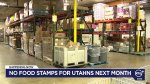
- Community leaders urge Utahns to support food banks as demand is expected to rise.
SALT LAKE CITY — More than 80,000 Utah households will lose access to food assistance next month because of the federal government shutdown, according to the Utah Department of Workforce Services.
The agency, which administers payments for the Supplemental Nutrition Assistance Program, or SNAP, said payments for the federal program will not be issued in November. Also known as food stamps, the program serves about 86,000 Utah households and an estimated 177,000 individuals.
Agriculture Secretary Brooke Rollins told reporters last week that the program would run out of money in two weeks, which could leave 42 million Americans without food assistance.
"So you're talking about millions of vulnerable families, of hungry families that are not going to have access to these programs because of this shutdown," she said.
In a press release on Wednesday, the Department of Workforce Services said it doesn't expect SNAP payments to resume until the federal government reopens.
The department had enough remaining funds to continue benefits for Utahns through October, according to spokeswoman Becky Wickstrom, who said November benefits would not be covered.
"I think that one unknown is that on Nov. 1, if the government shutdown persists, there's a chance that all SNAP services could be interrupted," she told KSL.com. "So that means, even if you have a balance on your card from a prior month, you may not be able to use that card. ... That's what we're hearing. We're still working to get confirmation on that, but we want people to know that that may be a possibility so that they can prepare for that."
It remains unclear whether funding will be available by Nov. 1 if Congress reaches a short-term spending deal before then, or if back benefits will be available if the shutdown is resolved after that date.
The loss of benefits could come at a difficult time for many Utahns, as Tom Hogan, CEO of Community Action Services and Food Bank in Provo, said the need for food has risen steadily over the years, "and it's not going down."
"This is really a great time for Utah to stand up and show the nation who we are as people," he said. "We're good people, and this is going to put about $30 million worth of SNAP benefits out of commission throughout the state. We're not going to be able to meet all of that, but I'll bet you we're going to be able to work together as a community to meet that need."
Bria Cox, of American Fork, recently lost her housing and said she is worried about how to make ends meet.
"Being a single mom, having that benefit is very, very, very helpful, especially in times that are rough," she said. "Now losing the benefits for food just adds to the tremendous stress."
She said she hadn't paid much attention to the government shutdown before realizing it would impact her personally.
"Right now I'm unemployed, so I'm thinking, 'How am I going to feed my kid?'" she said.
Hogan said the Provo food bank generally serves about 200 households per day from food that is mostly donated, and said he anticipates "an uptick in need." Utahns interested in donating or volunteering can visit communityactionprovo.org to help.
"These aren't people that are lazy that are coming to my food pantries," Hogan said. "These are people that are already working two jobs that are getting hit by higher housing costs, inflation rate on everything and higher grocery costs."
Utah's Department of Health and Human Services issued a statement later Wednesday noting that the Women, Infants and Children program, or WIC, will continue for the time being thanks to "contingency funds issued by the U.S. Department of Agriculture."
The department noted that many families on the Women, Infants and Children program also receive SNAP benefits and said the loss of benefits would make it significantly harder for those families to meet nutritional needs.
"While WIC provides targeted supplemental support such as specific healthy foods, nutrition education and breastfeeding support, it does not cover the same broad grocery needs as the SNAP program," the department said in a press release.
Wickstrom said her department is communicating with state lawmakers about the situation, but said "at this time, we're not hearing they're going to use state funding" to backfill food stamps and other federal programs.
Utah House Speaker Mike Schultz, R-Hooper, called the loss of benefits a "stark reminder of how federal dysfunction" hurts Americans and Utahns, and blamed Democrats in Washington for the shutdown. While Republicans control Congress, they don't have enough to clear the 60-vote threshold in the Senate.
"Let's be clear: this problem is not of Utah's making. It is the result of a shutdown in Washington, D.C. that has halted the federal funds Utah families rely on for basic nutrition," Schultz said in a statement. "There's a clear path forward: pass the basic funding to keep government open, then work through the rest. There's no reason to drag everyday Americans into a political game. It just takes a few more Democrats willing to put common sense — and the good of the people — ahead of politics."
Utah Senate President Stuart Adams, R-Layton, said the state balances its budget every year and "is not equipped to fund federal programs for weeks or months in the absence of congressional action."
"It is unacceptable for Congress to allow Utahns and Americans to bear the burden of inaction," he said.
Beneficiaries were directed to call 211 or visit 211Utah.org for information about food pantry locations, meal sites and other available resources. Utahns Against Hunger also has information about emergency food resources.
The Department of Workforce Services said updates will be available on its website or through the customer benefits portal for current beneficiaries.
Contributing: Daniel Woodruff